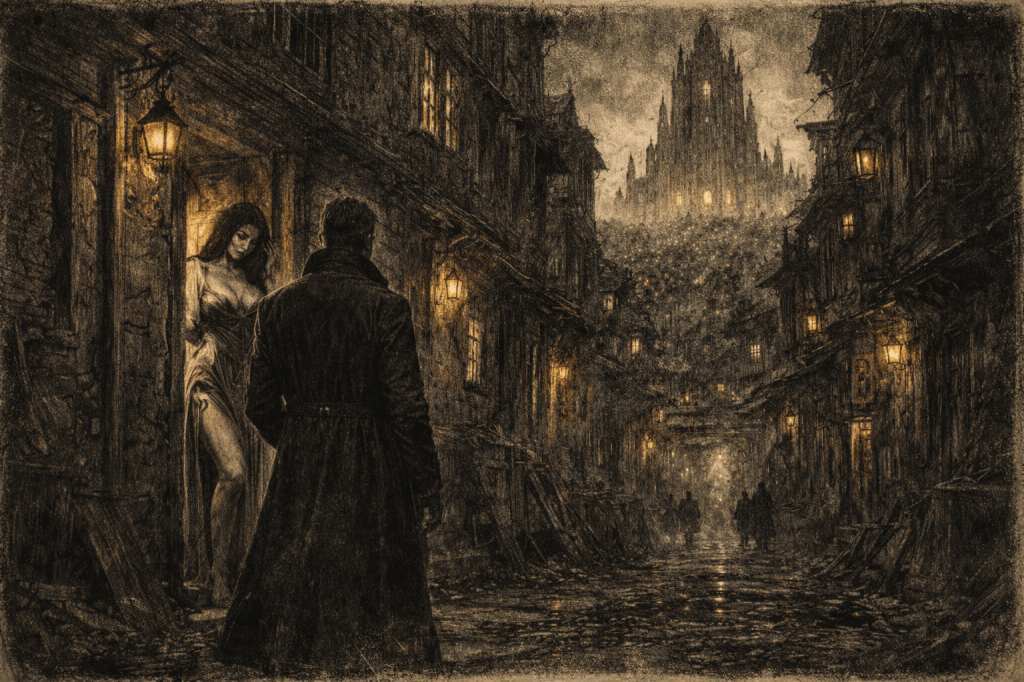
In Streindarke, love was not forbidden, it was improved.
Albrecht Baus learned that distinction early, long before the Hall of Concordance ever placed a seal in his hand. Even then, the city taught him that affection left to itself grew wild, unmanageable and prone to error. Streindarke did not crush love, nothing of the sort. It corrected it.
Every morning, Albrecht crossed the bridge to the inner wards, across dark stones, alongside the other people who had learned where to place their feet. Lamps shone at regulated intervals, products of alchemical design. The light was consistent and predictable. Nothing in Streindarke flickered unless it was meant to.
The Hall of Concordance rose from the street like a monument to function. It displayed no ornament or flourish. It was there to convey the authority of the city and, indeed, people only entered because they had to.
Albrecht took his place at the desk he had occupied for thirteen years. He removed his gloves, aligned his papers, and allowed the quiet magic of the Hall to rest around him. It was not a magic that shouted loud at all. It worked by suggestion, and the reinforcement of the words spoken within its walls. Promises made there felt truer, even when they were not.
The first couple of the day stood before him, hands linked with studied ease.
“State your intent,” Albrecht said.
They spoke in unison, their voices confident because they had rehearsed this moment for months. As they talked, Albrecht felt the the Hall responding to both their symmetry and their compliance. Their posture also demonstrated the same confidence as they spoke, heads thrown back, chins pointing like fingers. Certification had not yet occurred, but their anticipation of success lent them an assurance they believed would carry them.
When Albrecht pressed the seal into the wax, the change was subtle but clear. Relief passed through them like heat melting ice and their smiles widened. They knew they had done things right and were no longer asking permission.
“Go in concordance,” Albrecht said, and the pair left taller than when they had entered.
By midday, he had certified seven bonds and deferred three. He ate bread, cheese and butter tea alone, as always, seated near the tall windows that overlooked the inner square. Below him, people moved with purpose, unaware of how many of their assumptions had been authorised.
It was late afternoon when the woman arrived. Her papers were so incomplete that the junior clerk who escorted her in looked apologetic.
“State your petition,” Albrecht said, already reaching for the Codex.
She named a man who was clearly not with her.
“That will not suffice,” Albrecht replied. “Bonds are certified jointly.”
“He will not come,” she said. “But the bond exists regardless.”
Her tone was neither defiant nor pleading but it unsettled him because its confidence was unauthorised.
“You seek recognition,” Albrecht said.
“I seek accuracy,” she replied. “If this city insists on recording everything, it should at least try not to lie.”
He looked at her more closely, paying more attention to her appearance than was usual for him. She was not young or particularly striking. Her clothes were worn and practical but her eyes were different. They showed determination and intent without fear and Albrecht found himself looking down at the document again
“Duration?” he asked.
“Two years.”
“Mutual benefit?”
She hesitated. “We are worse off materially. Better otherwise.”
That earned a flicker of irritation. “Stability of means?”
“No.”
“Absence of disruptive attachment?”
She smiled faintly. “No.”
Albrecht closed the Codex. “There is nothing here to certify,” he said.
“What happens if it is not entered?” she asked.
“It holds no standing.”
“That is erasure by another name.”
He felt it then, the faint tension he had learned to ignore. “Uncertified bonds are not prohibited,” he said. “They are simply… unsupported.”
She nodded slowly. “Then I understand,” she said. “You will do nothing.”
“I will follow procedure Madam.”
“Of course,” she replied, and turned to leave.
At the door she paused. “May I ask you something, Registrar?”
Albrecht looked up, shaken by the experience of being taken beyond the bounds of formality so easily.
“Do you believe love improves when it is watched?”
The question hung there long after she was gone, disrupting the ordered quiet of the Hall.
That evening, Albrecht walked. The lower wards of Streindarke did not glow so steadily. Lamps burned gases here, their housings dented, and their light pooling chaotically across the street. He had come here many times over the years and always with the same justification. He was there to observe and to understand, or so he told himself. It always ended the same way
He entered a narrow house where no names were asked and he was shown into a dark room, unadorned save for a table, a chair and a bed with plain sheets. The woman who came to him was a professional. Her touch was efficient and her affection rehearsed. She gave him the release he required and took what he offered, satisfied. Afterwards, as he dressed, she watched him with a knowing expression.
“You work in the upper wards,” she said.
“Yes Ms Lane. You already know this”
“You all do,” she replied.
On the walk home, a memory returned to Albrecht like an old friend. Her name had been Elena. She had laughed too easily and trusted too deeply. When the lie reached her, that he had been unfaithful and treated her devotion lightly, it carried a seal. Not from the Hall or any legal authority, but from authority all the same. A letter from a trusted source, something official enough to feel true.
She never asked him.
When he found her, hanging there, the room was neat, deliberately arranged to leave no disruption behind because the city had taught her that matters recorded were more important than matters spoken.
In the days that followed, Albrecht found himself distracted. He delayed signatures, reread declarations, and consulted the Codex more frequently. It had never felt heavier in his hands.
That evening he saw the woman with the determined eyes again. She was just standing there, in a dim corner of the lower wards, outside one of the lodging houses that catered to those displaced by correction. She looked a little lost but, with it, more guarded.
She saw Albrecht and recognised him. “You followed me,” she said.
“No, absolutely” he replied. “I walk here.”
“Of course you do.”
They stood in silence, the city around them oblivious to their presence.
“Aren’t you worried they might notice us, Mr Baus?” she said. “Visibility is a kind of crime here.”
“You could leave,” he said.
She smiled. “And go where love is simpler?”
He had no answer.
Her hand brushed his, briefly and she entered the house. Albrecht followed.
In the room she undressed carefully then approached Albrecht, pressing close to him. She whispered in his ear, “I won’t ask you to help,” she said. “I wanted you to see why you might.”
The order arrived two days later. An unsanctioned bond with two names attached. Albrecht recognised the man immediately. A highly mobile, certified merchant who was officially unattached. His borrowed, artificially enhanced confidence had made him careless.
Albrecht sat with the ledger open before him, its ink gleaming patiently. He thought of Elena, of the woman from the hall he had encountered again and enjoyed. But mostly of the confidence he had granted so freely to her.
He signed and pressed the seal, watching the magic respond as it always did. The bond was erased.
Life in Streindarke continued and Albrecht continued. Every day he certified love with perfect precision, fully aware now of what it cost. Each seal gave confidence to those who would misuse it. Each refusal darkened someone else’s world.
At night, the lower wards offered him no longer offered him refuge. One woman refused to perform affection, instinctively sensing his true need and refusing increased payment. Albrecht was left shaken and exposed.
One evening, he found a scrap of paper wedged into stone just outside his office.
What remains is what you refused to see
He returned home, opened a blank page and wrote without seal or witness but it changed nothing.
Streindarke did not require his belief, only his function, so Albrecht Baus continued, certifying love in a city that had perfected its lies, his own pretentious love filed neatly among them, another dark entry, signed and sealed, every day.
 Edvane Stories
Leave a comment