The letter had been opened for an hour before Lady Katherine Bulkeley understood that she had not truly read it. The seal lay broken upon her desk. Cranmer’s hand was careful and courteous. There was no threat in the phrasing of the communication, and no crude demands either. Only talk of visitation and inquiry. This was about the King’s desire for clarity and reform. In truth, it was a care and gentility that turned her stomach. She read it again, more closely this time. The Abbey was to receive commissioners who would account for revenues and examine discipline. The crown’s loyalty was assured. Nothing in the letter promised dissolution, but nothing denied it either.
Beyond her chamber, the abbey lay still as the sisters slept within the trusting walls that had stood since before their mothers and fathers were born. The Thames flowed silently in the darkness beyond the outer grounds, patient and unconcerned.
At length, she rose, taking up a candle and stepping into the corridor. Godstow was whole. The walls were not crumbling, and the cloister arches were clean and tended. Yet as she walked, Katherine found herself already seeing them from a distance, as memories.
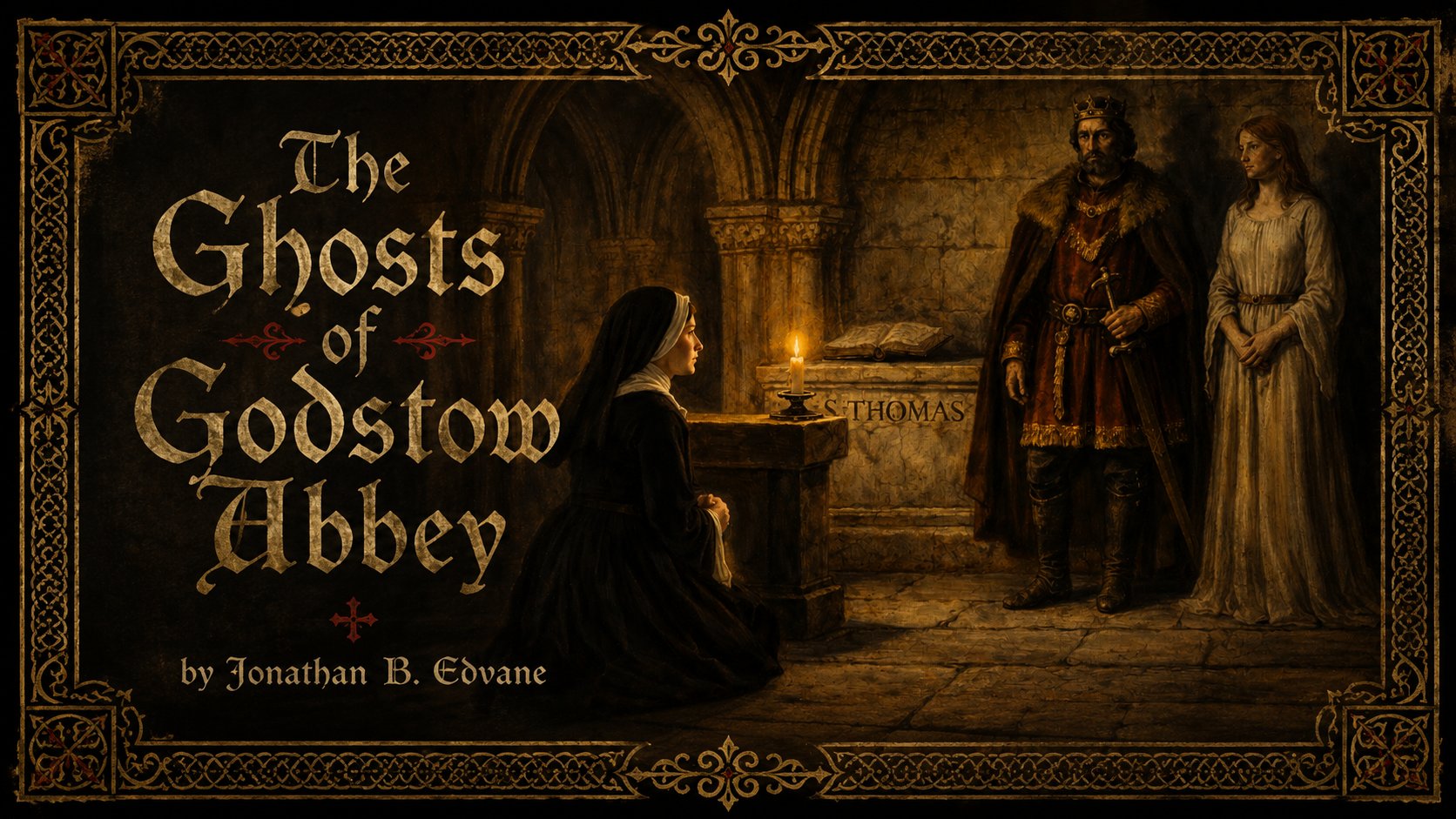
The chapel of St Thomas received her with its usual quiet. The altar was pale, yet the carved name of the saint still declared itself. It had once been a statement of endurance, but that night it felt like a challenge set in stone.
She knelt, but her desire to pray gave way to thinking. Her thoughts were unsteady, and she tried to commune with the Lord, but found only the King’s face in her mind. Why did God tolerate his wretched will and his hunger for certainty? This man refused to bend where others might have calculated the cost. She had heard men speak of the reforms as cleansing, and then of houses being emptied in the name of it.
The candle flickered, and she assumed at first that a draught had found its way under the door. The flame bent low, then lifted again. Katherine rose slowly. The chapel did not seem larger, yet it felt occupied.
There were two figures near the side of the altar.
They did not shimmer or blur. They stood in the light as she did, their shadows cast against the stone. The man’s clothing was cut in a fashion she knew only from old tapestries. The woman’s gown fell in long, unadorned lines that belonged to no Tudor seamstress.
Katherine’s mind was searching for an explanation when the man looked at her and nodded in acknowledgement. “You need not be alarmed,” he said. His voice did not echo, yet it carried depth.
Fear hovered at the edge of Katherine’s composure, but it did not take her. She did not retreat. “That depends upon who you are,” she said.
The man regarded the altar of St Thomas for a moment before answering. “Henry.”
The woman looked up from the stone floor. “Rosamund.”
Katherine knew who lay beneath Godstow’s earth. She had walked above those graves in daylight. To stand before one of those names, mistress to the other, made flesh was another matter.
“If this be temptation,” she said, “it is poorly disguised.”
Henry’s face showed slight amusement. “I have been accused of worse disguises, Lady Abbess.”
“You are troubled,” Rosamund said.
Katherine smiled at the simplicity of the remark. “My house stands under the scrutiny of the crown,” she replied. “That is trouble enough.”
Henry turned fully to face her, and she saw more clearly the lines upon his face. This was not a ghost diminished by death. It was a man shaped by command and consequence. There was fatigue in him, but it had not lessened his authority.
“There is another Henry upon your throne,” he said.
“There is.”
Looking at his face, Katherine sensed calculation. “You fear what he intends?”
“I fear what he believes necessary.”
Henry’s eyes moved back to the carving of St Thomas. “Necessity,” he said quietly, “is a word kings use when their appetites require justification.”
“You speak boldly of your blood,” she said.
“I speak as one who has ruled,” he answered. “I believed once that order lay in drawing all obedience to myself. That a king’s will, if strong enough, was its own sanction.”
He did not look at her as he spoke. He seemed to be recalling something older than the chapel.
“That winter at Canterbury taught me otherwise.”
Katherine felt the saint’s name and his legacy hang between them, unspoken.
“You knelt,” she said.
Henry nodded. “I knelt because pride spoken aloud may drive men to acts a king never intended. And because I understood that if I did not bend, I would break more than a friendship. I would fracture my own authority.”
Rosamund watched him, and in her eyes there was no reproach. There was only knowledge and love.
“You regret that year,” she said softly.
“I regret the haste of anger and the distance I allowed to grow in its wake.”
Katherine felt as though she were intruding upon memories not meant for her. She wanted to withdraw, but she did not move.
“My King,” she began, then paused. The words felt unstable on her tongue. “The King believes himself correcting what his fathers left unresolved.”
Henry’s expression changed. “Correction is not annihilation. A king who tears at the altar imagines he strengthens his throne. He may find he has weakened the ground beneath it.”
“He seeks a son,” Katherine said. “He believes without one the realm is imperilled.”
“You had sons,” Rosamund said.
“More than one,” Henry replied, and the authority in his voice dimmed. “Enough to test a man’s pride and patience.”
“And one you did not,” Rosamund said.
The candle flame bent again. Katherine did not speak. The air between them felt taut.
“He was named Henry,” Rosamund continued. “He grew beyond these walls. He crossed to France and lived without courtly scrutiny.”
Henry’s eyes dropped to the stone floor, and in that movement, Katherine saw the only true softness in him.
“I did not know him,” he said. “I told myself there would be time to see him as I saw the others. There was always rebellion to quell, lands to secure, sons already at my table.”
“And so he remained elsewhere,” Rosamund said. “Free of rivalry and expectation.”
Henry looked at her, and the pride that had framed him seemed to settle into something quieter.
“I wronged you,” he said. “Not in loving you. In believing that gold and protection were equal to presence. In leaving you enclosed when storms gathered.”
Rosamund’s hand rested upon the stone pillar, her fingers tracing its worn edge. “You loved me,” she said. “That did not end when you turned from me. It altered, yet remained.”
Henry closed his eyes briefly. “The sons I knew wounded me more deeply than the son I did not,” he said. “Ambition breeds where favour is divided.”
“And yet,” Rosamund replied, “you shaped law. You steadied a realm fractured before you. That is the legacy that outlived those quarrels.”
Henry looked back to Katherine. “A king’s legacy is not secured by heirs alone,” he said. “It rests upon what he builds that does not depend upon his temper.”
Katherine understood the words as permission to have doubts. “My King builds by dismantling,” she said. “He believes the Church an impediment to his will.”
Henry’s voice did not rise. “I challenged the Church, but I did not seek to unmake it. There is a difference between contest and eradication.”
He stepped closer to the altar of St Thomas, though he did not touch it. “If he believes himself greater than altar and conscience, he mistakes strength for dominance. A crown is steadied by what it acknowledges beyond its power and reach.”
Rosamund’s eyes drifted along the chapel walls. “Stones remember quarrels long after the quarrelers are dust,” she said.
“Will this house fall?” Katherine asked, the question escaping her before she could restrain it.
“I endowed this abbey,” Henry replied. “I believed favour could secure its prayers for generations. I did not account for the will of men yet unborn. No house stands forever when a king determines otherwise.”
That certainty struck Katherine harder than any of the words in Cranmer’s letter. “Then what remains to us?”
Rosamund offered clarity, not consolation. “How you bear it.”
Silence gathered in the chapel. The candle flame burned low, wax spilling down its side. Katherine felt the centuries pressing through the narrow space.
Henry turned toward Rosamund. “I cannot amend what was,” he said. “I can only speak truth and accept it.”
“And I can stand beside you in it,” she replied.
There was no spectacle in their closeness. No blaze of light. Only the quiet of two figures whose histories had burned down to something elemental.
Katherine blinked, unsure of whether the candle smoke had stung her eyes. When she looked again, the space before the altar was empty. No footsteps marked their departure. No gust of air followed. The chapel was as it had been, stone unbroken, carving untouched.
Katherine remained standing, listening for some echo of a voice, but none came. She crossed herself slowly while contemplating the weight of what had passed. Nothing in the visible world had altered, yet she felt something had been laid bare.
Kings rise, believing themselves ordained to reshape what they inherit. They are remembered for what survives them and for what does not. Houses endure until will turns against them, but love, flawed and concealed, will outlast every decree.
Katherine turned from the chapel and walked back to her chamber. The letter awaited her where she had left it. She unfolded it once more and read it again with a wiser eye.
She would not speak of what she had seen. No sister would hear it. No commissioner would extract it from her. It would remain her burden and her clarity.
She extinguished her candle and lay down fully clothed. Beyond the walls, the river flowed into its future, untroubled by Angevin regret or Tudor ambition. The abbey stood in the shadow of both.

I welcome polite comments. If you enjoyed this story, then you may also enjoy The Children of Bradfield Wood
Leave a Reply