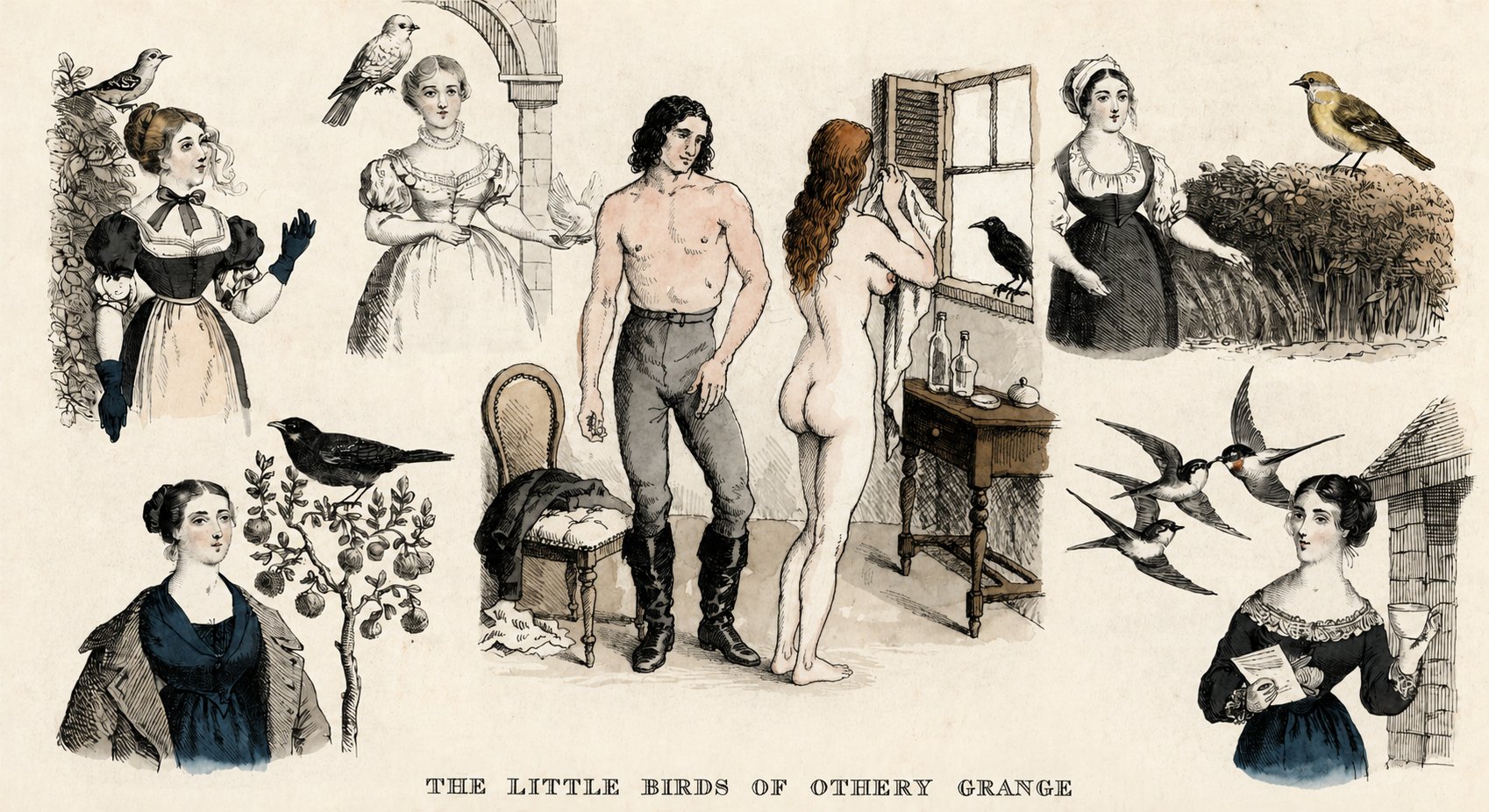
The Gardener Who Listened
1816 was the year without summer. Cold and unsettling. Othery Grange stood in its wet acres, pressed down by rain, its glowing fires burning day and night in the prolonged cold. The lawns held water, and the orchard paths were boggy underfoot. Beyond them, the flat country of the Somerset Levels lay dull, with ditches full, yet hedgerows loud with birds.
William Cox knew them by their calls. He knew the yellowhammer, the blackbird, the swallows, and the wren. He was twenty-four years old, handsome in the rough way that made maids glance twice and wives pretend not to. The household treated him as useful, almost safe, because a gardener with mud on his boots could pass through gates, kitchens, orchards and women’s talk without seeming to enter any of them. Gardeners were expected to know the weather, the weight of soil, the temper of fruit trees, and the proper hour to cut things back. If William knew more than that, nobody asked him.
Mrs Young from the laundry said that he had his grandmother’s ear for birds because William had taught the house to say it. Mrs Goodridge, who was still more Sarah Saunders in William’s mind than she would ever be Sarah Goodridge in his heart, had smiled at that across the gravel. It was the sort of smile a young mistress gave to a servant she believed useful and harmless.
William had once been pleased to seem harmless. It let him stand nearer than the other men. He had bowed beneath it, though he had once wanted that same face turned towards him with hunger in it. “Birds can tell anyone enough if they trouble to listen,” he said. Sarah had looked at him, only for a moment, and William had felt the old lie stir.
The saying, like most of the grandmother, had improved in the telling. There had been an old woman once, half-blind and fond of rooks, but she had left William no treasury of rhymes. He had made the rest because dead women lent honesty to words a young man could not safely own. She had told him that birds carried no mercy and no malice. They did not bless a wedding because a bride wished to be blessed, or curse a field because a farmer deserved hunger. They answered according to their own court, and the wise kept quiet until they knew whether they had been asked to hear.
William had invented that distinction once he learned how readily people obeyed a warning if it seemed older than desire. He had broken it before he was old enough to understand that a lie told in the language of omen does not end when the listener believes it. It goes on living in the choices that follow.
By the spring of 1816, the Grange had grown used to his silences. Thomas Goodridge would call him Cox and ask after the espaliers. Sarah would ask whether the damsons might yet recover from the cold. The maids sent him with notes between houses, baskets of rhubarb, little messages of courtship, condolence and complaint. Women trusted him with errands because he listened without smiling. Men trusted him because they did not see how long he looked after the door had closed.
He pruned. He planted. He watched. He chose.
Above them all, the birds kept their own business. Men and women mistook that business for judgement. Judgement was what they feared the most, and William knew how easily a sign could be made from longing, and how hard it was, once made, to bury it again.

A Wren In The Hedge
John Tucker killed the wren on the first dry morning after six days of rain. He had come to Othery Grange with mud on his boots and impatience in every line of him, riding too fast along the lower path. William Cox was cutting back dead wood from the old plum when he heard the animal shy. There was a scraping sound, a sharp curse, and then John’s riding crop cracked into the hedge.
The wren fell almost at William’s feet. It was so small. A scrap of brown feathers, a pinched beak, and one foot curled tight around nothing. For a moment, even John looked surprised. But then he laughed. “Little devil near had me off,” he said, gathering the reins while the horse stamped and tossed its head. “You keep too much life in these hedges, Cox.”
William crouched and lifted the bird from the wet leaves. Its body still held warmth. A wren was useful because everyone already half-feared it. William had learned that much from wren-boys, hedge gossip and the stupid bravery of country songs. By the time he gave the fear a grandmother’s voice, nobody thought to ask where the old woman had heard it. Even those boys who hunted one at Christmas did so with song, ribbons and begging words, making a ceremony of the offence so that it did not stand naked before the world.
John saw him looking and smiled with the charm that made women forgive him before he had finished being cruel. William hated him for that ease, and envied it too, because John took notice from women as naturally as other men took breath. “You look as though I have murdered a bishop, Cox.”
“No, sir,” William said, closing his palm around the bird.
John leaned forward in the saddle. “What then?”
William felt the small heat fading against his skin and, beneath it, the meaner heat that came whenever a gentleman wasted what women had freely given him. “Something older than a bishop.”
He took the wren to the border behind the stable yard, where the soil was loose from last year’s leaves. John Tucker followed at first from amusement, then from irritation when he saw that the gardener meant to make a solemn business of it.
“For God’s sake, Cox, it is only a bird.”
William knelt and worked a narrow hole with the point of his knife. “Yes, sir. I know.”
John laughed, but there was less ease in it now. “What makes this one so particular?”
William laid the wren into the earth, and it looked smaller still. Almost nothing among the crumbs of black soil. “My grandmother would have said there is a right way to take a wren.”
John rested one gloved hand on the wall and looked down at him. “And I failed in etiquette?”
“You failed in the asking, sir.”
The young gentleman’s face darkened. Men of his sort liked plain speaking only when it came from their equals. From a gardener, it became insolence before the sentence had cooled. “Take care, Cox,” John said.
William covered the bird slowly. He ought to have stopped there. He knew it even as his fingers pressed the wet earth flat. But John’s smile had returned, and beyond him, across the yard, the sound of women laughing had already drawn his eye.
“My grandmother had a saying,” William said, and felt the old woman rise obediently in his mouth, exactly where he had put her.
John looked bored again. “Had she indeed?”
William kept his hand over the little grave. “The wren is the king of all of the birds. Harm its feather, speak no words.”
For a moment, John did not answer. His smile remained, but it no longer knew what to do with itself. “That is peasant nonsense,” he said.
“Yes, sir,” William replied.
Only when John had turned away did William understand that he had not offered a warning. He had chosen the wound and told the harm where to enter. He remained beside the small dark patch of earth, listening while another wren sang from somewhere inside the hedge.
Elizabeth Palmer had not meant to look at John Tucker twice, which was why she looked at him so often. She was staying at Othery Grange with an aunt who believed fresh air, wet shoes and silence at breakfast could improve a girl. Elizabeth had arrived pale from Bath and bored by the country, yet by the second week she had found reasons to walk where John was expected to ride, to pause where his horse might slow, and to ask after the hunt with a carelessness that deceived nobody.
John received it all beautifully. He found reasons to offer small services. A gate held open, a fallen glove retrieved, a shawl carried back from the terrace with more ceremony than it deserved. He let his hand rest too near hers on the back of a garden bench, and when she did not move away, he knew she wanted him to stay there.
William saw them from the border where he was tying in a climbing rose. He watched Elizabeth make room for John beside her, in her talk, in her pauses, and in the careless turning of her hand. John accepted it all lightly, and William disliked him for wasting what another man would have used. John liked the distance before surrender, the glance before permission, the warmth of a woman not yet certain she was safe to want him. He liked hunger best when it was still half-denied.
Then, one grey afternoon, Elizabeth ended the chase. It happened by the summerhouse after yet more rain. William was wheeling cut laurel towards the compost ground when he heard Elizabeth ask John whether he meant to marry her. Elizabeth touched John’s arm with the confidence of a woman who believed she had been invited to do so.
John recoiled before he could make himself polite. His shoulder struck the door-frame. His face formed an expression William had once seen on a boy who had put his hand into rotten fruit. “My dear Miss Palmer,” he said, and his voice was all manners over panic, “you mistake me very strangely.”
Elizabeth did not cry, which made it worse. She lowered her hand, and John stepped past her into the wet garden, rubbing at his sleeve as though her fingers had left something there.
After Elizabeth Palmer came Mary Parsons. Mary was older than Elizabeth and knew enough of John Tucker to make danger part of the invitation. She let him come close, and to believe she had measured him and chosen him anyway. That should have pleased him. For three weeks, it did. He followed her through parlours and wet lanes, watched her mouth when she answered him, and grew restless whenever another man made her laugh.
Then Mary accepted him.
The change was not neglect to begin with. That would have been ordinary. It was revulsion wearing the clothes of courtesy. When Mary leaned towards him after supper, John turned his face aside before her mouth came near his cheek. When she took his hand under the card table, his fingers lay dead in hers. The next morning, he sent a note so smooth and empty that Mary read it aloud to her sister, laughing before tearing it in two.
Ann Carter finished what Mary began. She was the final engagement, the one everyone agreed must cure him because she was beautiful, well-connected and calm enough to make refusal look childish. John pursued her hard and won her openly. At a wet evening party at Othery Grange, with Ann’s family present and half the parish already placing them at the altar, she linked her arm around his in the passage outside the drawing room and called him hers. William had come in with a basket of stems for the housekeeper and witnessed what followed.
John’s face changed before he could command it otherwise. He looked down at Ann’s hand with naked disgust. The room did not fall silent all at once. Each whisper died as one person, and then another understood what they had seen.
Ann let go of him, but John bowed too late. Whatever apology he attempted came out weak and formal, already useless. Ann stood beside him with her colour high and her hand at her side, and William knew then that the wren had not struck precisely. It had not punished only the man who killed it. It had made a wound of every woman brave enough to show wanting, and William knew that was why the thing both pleased and sickened him.
By Monday, the engagement was broken, and the story had passed through every kitchen, pew and stable within five miles. John Tucker kept to his room. Ann Carter left for her aunt’s house before the week was out.
Elizabeth Palmer left the Grange two mornings later, but not before William met her once in the passage by the closed flower room. She had looked at him differently. Perhaps as someone who had seen her shame and not laughed. That was enough. William said nothing of John Tucker. He only opened the flower-room door when she touched his arm, and when she came out again, her bonnet was tied badly, and she had the fixed, careful expression of a woman determined to call her own choice comfort. William watched her carriage leave before breakfast and understood that the wren had given him something too.
In the hedge above the lower path, another one sang after rain, small and furious and unseen.

The Wedding Doves
Hannah Coles’s betrothal was announced on a morning so cold that the servants’ breath smoked in the passage and the breakfast-room fire had to be rebuilt twice before noon.
George Baker stood beside her while Mrs Goodridge offered congratulations. She was pleased, if a little damp from the ride over. He was a second son with a tolerable income, a good name and no habit anyone could object to. Hannah’s mother had spent three weeks calling him steady, by which she meant safe, but by which Hannah understood chosen.
William Cox had been sent in with a tray of early rhubarb for the kitchen and was crossing the side hall when the news reached the servants. Mrs Young said it would be a comfortable match, and one of the younger maids asked whether comfort was what girls prayed for now. No one answered her, because Hannah passed the open door just then with George at her side. He had her hand tucked through his arm, as though she were something already promised to his keeping. Hannah walked with her chin raised, but when Charles Hill came in from the rain at the far end of the hall, carrying his gloves in one hand and shaking water from his hat, William saw her fingers strengthen their hold on George’s sleeve.
George noticed nothing, but Charles did. He stopped only long enough to bow. “My congratulations, Miss Coles,” he said, and William heard in the restraint what George had not. A man swallowing what he wanted because witnesses were present.
“Hannah, surely,” George corrected, laughing.
Charles looked at her, waiting to see whether she would allow it.
“Hannah,” she said, and made it sound like a concession.
That afternoon, two doves began carrying straw into the broken stonework above the porch. By supper, half the house had heard of it. Mrs Young declared it a blessing. William, standing below with his pruning knife, watched one bird force the other aside to reach the nest. The cock pushed in with another straw. The hen shifted, received it, settled, and shifted again. It was instinct, labour, and the stubborn making of a place from which neither bird had ever thought to flee.
William saw Hannah approaching along the gravel path. He ought to have gone on, but a woman unhappily promised was a door left on the latch, and he had never been good at passing such doors. A gardener saw many things by accident and kept most of them under his tongue. But there was something in Hannah’s stillness that held him there.
“They return to the same mate, do they not?” Hannah said.
William had not realised she knew he was there. “The doves? So people say, miss.”
“People say it as if that makes them happy.”
He looked up at the nest. One dove had got its wing caught for a moment against the broken stone. It freed itself with a hard, ugly flick. “Happiness is not a thing birds are much consulted about,” he said.
Hannah turned. There was colour in her face, and something sharper underneath it. “Nor girls, Cox.”
He should have bowed and left her with that. Instead, he looked up at the two birds above the porch. “Doves are faithful creatures,” he said, giving her the word everyone else had used and turning it until the edge showed.
“That is what everyone keeps telling me.”
“Yes, miss. Though faithfulness is not always the same as choosing.”
Hannah looked back at the nest. The cock pressed in beside the hen, crowding her against the stone until she shifted to make room for him.
“No,” she said quietly. “I am beginning to understand that.”
The weather stayed mean and wet, but a certain heat came from the rooms where Hannah Coles had to sit beside George Baker and be admired for accepting him. He was kind in the way careful men are kind, noticing every draught, every damp hem, and every plate she had not quite finished. He wrapped her shawl about her shoulders before she asked for it, praised her quietness to Mrs Goodridge, and touched her hand only where everyone might see. By the end of a week, Hannah flinched from his gentleness more than another woman might have flinched from anger.
Charles Hill arrived often enough to be useful and not often enough to be accused. He brought letters for Thomas Goodridge, stood in the hall with rain on his coat, and spoke to Hannah with caution. He knew that every servant could become a willing witness. That caution did not cool the thing between them, though. It fed it.
William saw them in the passage by the closed breakfast room, where Charles had stepped aside to let Hannah pass, and neither of them had moved. There was no embrace. No word that anyone could carry to a drawing room. Only Charles lowering his hand from the door frame, slowly, until his fingers almost touched the ribbon at Hannah’s wrist.
“Miss Coles,” he said.
“Mr Hill.”
William stood with a basket at his hip and knew he should make himself heard, but he let the silence shelter them. Desire was easiest to steer when people believed it still belonged wholly to themselves. He watched Hannah turn her wrist slightly, not enough to invite the touch, but enough to show she knew it was there. Charles withdrew first, with the look of a hungry man leaving bread on the table.
Above the porch, the doves shifted and fretted in their nest, and that night, one of them began calling long after dark.
On the morning fixed for Hannah Coles’s wedding, one dove sat alone above the porch. William saw it before anyone else. The house was already bright with movement. Maids went quickly from room to room. Mrs Young scolded over ribbons. George Baker’s carriage stood in the yard, washed clean for the day, while George himself waited inside with the nerves and pride of a man about to receive what had been properly promised.
The dove called once, and then again. William looked for the mate along the guttering, in the ivy, and on the low roof above the scullery. He found a smear of down caught on the stone and, beneath the laurel, three pale feathers pressed into the mud. A cat, perhaps. Or a hawk. Some common violence with no lesson in it. He closed his hand around the feathers, but Hannah came out before he could hide them properly. She was dressed in white, though the morning gave the colour no kindness. Behind her, George called that they must not be late. She did not answer him. Her eyes went first to William’s hand, then to the empty place beside the dove.
Charles Hill stood at the far side of the yard, hat in hand, rain dark on his coat. He had no right to be there and every reason to leave, but he watched her as though the carriage were carrying away something already half his. When Hannah looked at him, he bowed. It was a proper bow, deep enough for the yard, and harmless enough for witnesses, but he did not raise his eyes from her until she had seen him do it.
“My grandmother would have called it readily enough,” William said. “\When the lone dove weeps for love undone, dark grief shall fall on everyone.” The old woman was useful on wedding mornings. She could say what William wished to be planted and leave no young man’s fingerprints on it.
Hannah took the feathers from him. For a moment, her fingers closed around his, hard enough to hurt. “Then Mr Baker should pray it falls late,” she said. She placed the feathers inside her bridal glove, folding them against her palm where George would later take her hand and feel nothing but kid leather and obedience. “Or that it learns to enter by another door,” she said.
Then she walked to the carriage. George helped her in, while Charles bowed again from across the yard. Hannah did not turn her head, but William saw her hand close around the hidden feathers.
Above the porch, the remaining dove called until the wedding party was out of sight.
The younger maid who had laughed at comfort came to the yard after the carriage was gone, sent for nothing she could say when Mrs Young asked. She found William by the laurel, washing pale feathers from his hand. “You frightened Miss Coles,” she said, but admiringly so, for him having power enough to do it. William told her that brides were frightened already and only needed the proper words to learn why. She should have disliked him for that, yet she stayed. Later, behind the coach house, while the wedding bells were still dull in the wet air, she let him kiss her as if he had proved some dangerous cleverness she wished to test for herself. By supper, she would not look at him, which William preferred to gratitude.

The Devil’s Yellowhammer
Selina Coombes heard the yellowhammer while binding barley at Larksmeadow, where Samuel Bristow had ordered the lower field cut because another week of rain might leave him nothing to cut at all.
No one was certain it was wise. The men felt the soft give of the stalks under their hands and said nothing. Jane Bristow watched from the kitchen door, knowing her husband had chosen action because waiting had begun to look like surrender. Even William Cox, sent down from Othery Grange to ask after a broken gate, could see why Samuel had ordered the cutting. Another week of rain would flatten the barley into the mud.
But Samuel wanted the work done. He stood at the headland in his shirtsleeves, calling the pace while the girls moved bent-backed through the wet. When Selina straightened, he watched the damp linen pull against her shoulders. “Less listening, girl,” he called. “More cutting.”
She had not known she was listening until he said it.
The yellowhammer sat on the hedge above the ditch, bright against all that grey, and gave its little song over and over. Most people heard a country joke in it, bread and no cheese, hunger made harmless by repetition. Samuel heard mockery. “Fetch a stone at that thing,” he said. No one moved. The men kept their eyes on the barley. Jane Bristow watched from the kitchen door.
Selina lowered the stalks in her hand. “Leave it be,” she said.
Samuel turned on her. “Did I ask you?”
Selina looked at the bird. It sang again, with its yellow head lifted towards a sky that had given nothing warm for weeks.
“My grandmother had a saying.” William Cox, standing by the broken gate, looked first at them all and chose the place where the words would bruise. “The yellowhammer drinks the devil’s blood. Kill it, and frost shall choke every bud.” For a moment, only the bird answered, and William felt the field waiting for him to make weather, hunger and failure simple enough to blame.
Then Samuel laughed, and the nearest men laughed because he did. “Well, that explains the colour of the little bastard.” He stooped, took up a clod of wet earth, and weighed it in his hand while Selina looked at him as if he had already thrown it. The clod burst against the hedge below the yellowhammer, wet earth spattering the leaves while the bird lifted, flashed yellow in the dull air, and settled a little farther along as though the attack were only another kind of weather. The men laughed because missing a bird held more humour than the state of the field. Samuel laughed with them, but his neck had gone red above his collar. “Devil’s blood, is it?” he called, glancing towards the kitchen door where Jane Bristow stood with her arms folded. “Hear that, Jane? We’ve had the devil farming Larksmeadow in a yellow coat.”
Selina bent again to the barley, wanting the matter buried under work, but Samuel had found the part of her that could be worried before witnesses. He came down the row slowly, letting the workers feel him pass. “Tell us then, Selina. Does it speak only to you, or may any girl with mud on her hands take messages from hell before dinner?”
The men kept their faces lowered. None wished to be the first to defend her. Selina said, without looking up, “I only told you to leave the bird be.”
“No,” Samuel said, close enough now for her to smell the sour ale beneath the morning cold. “Cox gave us the rhyme. You gave us the face to put with it.”
William felt the truth of that land like a hand at his throat. He had not meant to save Selina. He had meant to see what Samuel would do with fear once it was handed to him. He had spoken the words. Selina had only been foolish enough to look frightened by them.
“I told you to leave the bird be,” she said.
“And now you tell me twice.”
Samuel was pleased because she had given him a door, and he meant to enter through it. Behind him, the yellowhammer sang again from the hedge, bright and untouched, while every eye in the field stayed on Selina Coombes.
The yellowhammer was found dead three mornings later by Jane, who had gone out early to shake crumbs from the kitchen cloth and saw the little body beneath the hedge. Its neck was crooked, and one wing lay open in the mud, its bright feathers dulled by the wet. She covered the bird with the kitchen cloth but called for no one.
William Cox came down before noon to finish the broken gate. By then, the bird was gone, and Jane was whitening the kitchen table with flour, her hands moving too hard over the dough. She had looked over at William’s face when he came in, and he knew she had not missed how young he was, nor how little her shame could be trusted on a good-looking man. She told him that if he had brought more sayings from his grandmother, he had better leave them in his pocket.
“I brought none,” William said.
“That never stopped harm before.”
He found Selina tying up a bundle of cut stalks. She would not meet his eye. The whole field had taken on the colour of old pewter. Where there should have been green life still pushing through the season, there was a bitten look to every edge. The leaves hung blackened. The young shoots at the ditch-side had collapsed, and the barley nearest the hedge seemed choked.
There had been frost in the night. Everyone said so. By evening, they all knew it had come only to Larksmeadow. Samuel walked the rows with a face that dared any man to pity him. When Selina passed with her bundle, he caught her wrist and held it just long enough for William to see. “Well,” he said, “you knew where it would fall.”
Selina pulled free. No yellowhammer sang.
By the next market day, no one laughed at Selina Coombes. They all knew William Cox had spoken the rhyme. That did not save her. Words from the gardener could be laughed off as old woman’s nonsense, but Selina had been the one who steadied her work and told Samuel to leave the bird alone. She had been afraid before there was proof, and afterwards the parish found that harder to forgive than the rhyme itself. Mockery had at least allowed her to stand among them as something human. Fear put space around her. The women now let their talk die when she came near. A boy carrying eggs crossed the lane rather than pass her. Jane Bristow gave her bread without letting their fingers touch, then rubbed her hands on her apron as though shame could be wiped away with flour.
Samuel said little of the yellowhammer. He had lost too much barley to invite another man’s pity by naming a dead bird as the cause. He resolved to drive the field harder, keep the girls bent longer, and let Selina feel every spoiled row as if she had laid the frost over it herself.
William came down from the Grange with a note for Jane and found Selina rinsing mud from a pail with water cold enough to redden her hands. She did not ask him to defend her. “You said the words,” she told him. “But I am the one they heard.”
William had no answer. That was the craft of it. He could speak from the hedge and let a woman stand in the field wearing the consequence. He could have told her that fear was a cowardly thing and always chose the person easiest to wound, but Samuel called from the barn that Selina had work enough without charming gardeners too. William let the insult stand.
That evening, when Selina left Larksmeadow, no one walked with her. The hedge gave only sparrows and rain. William found her on the drove road before the light had properly gone. She was carrying her bundle under one arm and warily walking as if every hedge had ears. He told her she should not be alone after what people had made of her, and she laughed, asking whether he had come to protect her from the words he himself had spoken. He said he had come because he knew what it was to be blamed for seeing too much. That lie served him better than offers of comfort. By the time she reached her aunt’s cottage beyond Stathe, William had mud on his coat, and Selina would not turn her face towards the candle when the door was opened. He left before anyone could ask why he had walked so far.
The yellowhammer’s place remained empty, and for years after, no one said the bird’s name without saying hers next.

A Blackbird in a Pear Tree
Esther Green heard the blackbird at six each evening, whether the sky held rain, mist or the insipid grey light that passed for summer that year. It sang from the old pear tree at the edge of her garden, the one Joseph had meant to cut back before the fever took him. Two years had gone since his burial, yet the ladder still leaned in the shed with his thumb-mark darkening one rung, and Esther still kept his coat on the peg by the door because cloth, like grief, could learn the habit of a body.
The neighbours called her faithful. They said it with pity when they found her outside at the same hour, hands still from work, her eyes fixed on the tree. Esther let them have the word because it cost her nothing. Faithful sounded better than hungry.
William Cox came on Thursdays with herbs from the Grange garden and sometimes a message from Mrs Goodridge. Esther let him stand at the gate because he was young, quiet, well-made, and did not pity her aloud. He never interrupted the song. That was why Esther tolerated him there while others were made to knock twice and wait. William knew the value of being the man a woman allowed to remain when better men had been dismissed.
On the first Thursday in August, he found her standing barefoot in the wet grass, her sleeves rolled above the wrist, soap still clinging to one arm where she had left the wash unfinished.
“He is early,” she said.
William set the basket down. “Only by a little.”
“He was always impatient when rain was coming.”
The blackbird sang again. It was only a bird. William knew that. He knew it with the part of him that named pruning cuts and weather signs. Yet he also heard how carefully Esther listened, how she received each phrase as if Joseph Green himself had risen and put his mouth near her ear.
When the song ended, she breathed out slowly. “There,” she said. “Now I can finish the day.”
Edward Hunt began with decency, which made him harder to refuse. William recognised the method and disliked him partly for practising it so openly. He brought Esther split kindling after three days of rain, mended the latch on her back gate, and carried a sack of meal from the cart when the lane was too soft for wheels. He did not press her at first. That was the danger of him. He knew how to make patience look like virtue and waiting look like love.
The parish approved. A widow could mourn long enough to prove she had loved her husband, but not so long that men began to feel judged by it. Edward had good hands, steady work and a mother who needed little tending. Mrs Young said Esther could do worse, and Esther answered that most women had. William had heard that at the gate and very nearly smiled.
Edward came one evening while the blackbird was singing. He had brought a repaired hinge wrapped in cloth and stood with it in both hands while Esther listened from the path. The song held her there in a way no living man had managed. It entered the garden, settled over the wet grass, and made Edward wait outside a marriage he could neither see nor forbid.
When the last note ended, Esther thanked him for the hinge.
“Does it always sing at this hour?” he asked.
“Yes.”
“And you always come out to hear it?”
“When I can.”
Edward gave a small, reasonable nod, the sort of nod men use when granting permission to things they intend to alter later. “It must be a comfort,” he said.
“It is more than that, Mister Hunt,” Esther said.
William, standing by the pear tree with his pruning saw, felt his grandmother’s rhyme rise in him. He should have let Edward misunderstand the evening in his own way. But, sensing the opportunity, he wiped rain from the saw teeth with his thumb and spoke quietly enough that Esther might mistake it for garden talk.
“My grandmother would have said the blackbird’s song calls the mourning ghost home. When grief is your bride, you are never alone.” It was a good lie because grief had already half-written it for him.
Edward heard him. Esther did too, and for a moment, the garden held only the sound of water dripping from the pear leaves.
“That is an ugly little saying, Cox,” Edward said.
“Yes, sir. From my grandmother.” William replied.
Esther’s hand had closed around the gate latch, and Edward looked at the tree. William knew then that he had not explained Esther’s grief. He had shown Edward where it lived, and some men could not see a locked room without thinking themselves robbed.
Henry Brown sent for William the following Tuesday and did not trouble to pretend the errand was his own. “Mr Hunt has spoken with Mrs Goodridge,” he said, standing at the yard gate with his hat kept on. “The pear tree at Esther Green’s cottage is to come down.”
William had a grafting knife in his hand. He wiped it clean, though it was already clean. “It still fruits.”
“It leans over the path.”
“It has leaned there ten years, sir.”
Henry Brown frowned. He disliked being asked to give reasons for another man’s wish. “It is wanted down, Cox.”
So William went.
Esther was not at home when he reached the cottage. Edward had seen to that. There was washing left in the tub, a shawl over the chair by the door, and on the peg inside the threshold Joseph Green’s old coat hanging where Esther had kept it for two years. The pear tree stood at the garden edge, but the blackbird was not singing.
William set the saw against the trunk and waited long enough to hate himself properly, which was not long enough to stop him.
Edward came from the lane carrying a coil of rope. He spoke softly, almost kindly, saying it was better done before she returned, better not to make her watch, better to free her from the thing while she still had strength enough to be freed.
“That is not freedom,” William said.
“No,” Edward answered. “It is kindness, when she has not the sense to choose it.”
The first cut sounded too loud in the small garden. By the third, the blackbird broke from the upper branches and went hard over the hedge. Edward flinched at the suddenness of it, then steadied himself.
William kept sawing.
When Esther returned, the tree was already down. She said nothing to Edward. She only took Joseph’s coat from the peg and shut the cottage door between them.
For three evenings afterwards, Esther Green did not leave the cottage. Edward Hunt came twice, once with broth and once with a parcel of mended linen, and both times he found the door barred. He spoke through it in the low, patient tone men use when they believe patience will one day be counted in their favour. He told her he had acted for her own good, that the tree had kept her ill, that Joseph would never have wished to see her wasting herself beneath it.
From inside the cottage came no answer.
On the fourth evening, William brought a bundle of kindling and set it beside the step. The garden looked larger without the pear tree and crueller for it. The stump sat pale in the wet grass. The blackbird had not returned. Even the sparrows kept to the hedge.
Esther opened the door before he could leave. She wore Joseph’s coat over her dress, the sleeves turned back because his arms had been longer than hers. There was no wildness in her, which made the damage harder to look at.
“I should not have cut it,” William said.
“No.”
The word was plain, and because it was plain, there was no way past it.
“Mrs Green, if I could mend it…”
“You cannot.”
Edward’s name did not pass between them. William had brought the rhyme, Edward had brought the rope, and between them they had taken the branch where grief came home.
Esther lifted the kindling from the step and carried it inside. She did not speak to Edward Hunt again that week, but she opened the door to William because he brought no broth, no mended hinge, nor instruction for her recovery. He stood with his cap in his hands and let his shame look like service. She asked whether he had come to confess or to be forgiven, and he said neither, though both answers would have been truer than he deserved. When she let him inside, Joseph’s coat still hung from her shoulders, and William had the sense not to touch it. The restraint won him more than apology would have done. He left at dawn by the back gate, with pear sap still dark beneath one fingernail and no blackbird singing anywhere.
The next spring, William planted a young pear beyond the far hedge, where no one from the cottage would see it by accident. He pressed the soil firmly with both hands and told himself it was not forgiveness he was planting. It was only a place for a bird to land, should one ever choose to. That was what he told himself, for he had become skilled at giving selfish things the posture of penance.

Swallows and Sailors
The swallows came late that year, as most things did in 1816. For seven years, Martha Martin had watched for them at the cottage on the far edge of the Grange land, where the drove road gave way to wet pasture, and the wind came clean across the Levels. Her husband Thomas had gone to sea with his name stitched into two shirts and a promise to come back before the swallows forgot the eaves. The first year they returned, four of them, and Martha had taken it as a kindness. By the third, she had made it a rule. By the seventh, no one in the parish could mention the birds without thinking of Martha Martin, who kept Thomas’s place at the table because the swallows still came home.
William Cox was sent there with bean poles and a packet of seed from Mrs Goodridge, though Martha’s garden was more salt wind and stubbornness than soil. Martha had never looked at him as some of the younger wives did, which made her trust more irritating to him than suspicion. He found her outside with her sleeves pinned back, mending a cracked nesting ledge beneath the thatch.
“You are early with repairs,” he said.
“They are late with coming.”
She did not complain, though, lest it be taken for doubt. Martha worked the mud smooth with two fingers and pressed a little straw into the join.
That afternoon, the first swallow cut low over the lane, and Martha stood so suddenly that the seed packet slipped from William’s hand. The bird took the turn beneath the eaves, vanished, returned, and called.
“One,” Martha said.
By supper, there were four, yet she did not cheer. She only set Thomas’s cup back on the table, where it had stood empty through seven summers, and wiped the rim carefully with her apron.
William felt the words approach and, as always, dressed appetite as duty before letting his grandmother wear it. “My grandmother knew what this meant,” he said. “The swallow returns, but the promise is dead. You welcome back summer, but winter’s ahead.”
Martha’s hand stilled on the cup. “Then I shall welcome what summer we have while it is here, Cox,” she said.
William had no answer to that. The four swallows called under the eaves, and Thomas Martin’s clean cup stayed on the table.
By the second morning, Martha knew there were only three. She had been up before the Grange bells, standing under the eaves in her shawl and nightdress while the birds cut quick, dark turns above the cottage. One had fooled her the evening before, slipping twice through the same broken corner of thatch so fast that hope had made two birds of it. Daylight corrected her. Three came and went, called under the roof and left their little marks on the whitewash. The fourth place remained empty.
William arrived with willow withies for the beans and found Thomas’s cup on the table outside the door, clean as a church plate and filled with rainwater. He said it would wet the wood through, because people begin with useless things when the useful ones are too cruel, and Martha answered that it had stood worse weather than this. The swallows crossed above them. Martha counted but stopped before the number became a word.
William felt the rhyme sitting between them, though he did not need to speak it again. He had said enough the day before, when four birds seemed to have come home. Now the missing fourth did the work for him.
Martha’s hand closed around the cup. She told him he was fond of killing what little people had, and William took that because it was near enough to the truth to hurt. The third swallow slipped into the nest above the door. For a moment, the cottage waited for the missing wingbeat, the small dark body that should have followed. Nothing came.
Martha poured the rainwater from Thomas’s cup into the grass and set it back on the table, mouth-down. “There,” she said. “Let him knock if he wants it.”
For the next four days, Martha Martin counted the swallows as if arithmetic might be worn down by use. She counted them at dawn, when the eaves dripped steadily into the water butt. She counted them at noon, with bread cooling untouched on the table behind her. She counted them in the evening, when the three birds came low over the lane and skimmed the puddles for flies. One, two, three. Then the small pause where the fourth should have entered, and the whole day seemed to wait with her.
The parish noticed. Of course it did. A woman could keep faith with a husband gone seven years and be called touching, but there was less comfort in watching hope lose its manners. Mrs Young said someone should persuade Martha indoors. Jane Bristow said nothing good came from staring at eaves. Edward Hunt, who had his own reasons now for speaking against women’s grief, called it unhealthy.
William heard all of this in the service yard and carried none of it to Martha. He had done enough carrying. That was another of his comforts. To name the moment when he stopped doing harm and mistake it for mercy.
On the fifth evening, he went to the cottage with mint from Mrs Goodridge. Martha was outside again, bareheaded in a fine rain, her dress dark at the shoulders. Thomas’s cup still stood mouth-down on the table by the door. She did not greet William. She lifted one finger as the first swallow came in, then another for the second, then the third.
William set the mint on the step. He wanted to say that birds were only birds, that sea took what it took without consulting hedges or roofs, but those were a coward’s words, and Martha had no use for them.
At last, she folded her hand shut and said, very quietly, “He is not late now.”
William left before she could thank him for nothing.
The letter came a fortnight later in Richard Davis’s coat pocket. He arrived at Othery Grange near noon, asking for the Martin cottage with the stiff unease of a man who had often carried bad news in his pocket across Somerset and beyond. William was in the yard setting bean poles by the wall. Mrs Goodridge would have sent a maid, but Richard said the matter was for Martha Martin herself and not for telling in the kitchen passage.
William walked him as far as the drove road.
The three swallows were hunting low over the ditches when they reached the cottage. Martha was sitting outside with Thomas’s cup in her lap, her thumb moving over the rim. She did not rise when Richard gave his name. Nor did she take the letter quickly. She let it rest in his hand until the poor man had to say that he was sorry, though he did not yet know how little use his sorrow would be.
Thomas Martin had died at sea before Christmas. Fever, the letter said. Buried before landfall. His effects, if any had survived the voyage, would be sent when the ship next made port.
Martha read it once. The swallows passed above her, three quick cuts through the wet air.
Richard began to explain how the letter had been delayed, how the captain had put it ashore with other papers, how no neglect was intended. Martha folded the page along its old crease and said she knew.
That was all.
William felt the shame of having expected collapse. He had wanted the proof of his words to show itself in her body, in tears, in some visible yielding. Martha denied him even that. He had mistaken quiet for waiting, then waiting for ignorance. Martha had been widowed by the eaves before any clerk put ink on paper.
When Richard left, Thomas’s cup remained in her lap. After an hour, she cleared it from the table and put it away.
William went back to the cottage after Richard Davis had gone, though no one had sent him. Martha was outside holding the folded letter as if paper could be kept from speaking twice. She did not ask why he had returned. Perhaps she knew. Perhaps she had known since the first day he gave the swallows words and made himself part of her waiting. “You like being right,” she said. William answered that he had never liked it where grief was concerned, and Martha laughed. She turned and went inside, but left the door open behind her. He followed after a moment, and when he came out again, the three swallows were gone from the eaves. Thereafter, Martha would tell anyone who asked that Thomas’s cup had been put away for good.
The Bird at the East Window
By the end of the season, Othery Grange had learned to keep its windows closed, and William Cox worked late in the walled garden most days.
The house had grown quieter after the summer’s little harms. John Tucker no longer rode the lower path. Hannah Baker’s letters came sealed in a hand that made Mrs Goodridge pause before sending them upstairs. No yellowhammer sang at Larksmeadow. Esther Green’s cottage had kept its door shut for three days after the pear tree came down. Martha Martin had taken Thomas’s cup inside.
The birds had answered, people said.
William knew better. Birds answered nothing for people’s comfort. They sang, nested, struck, returned, and then vanished. Men and women did the rest with their fear, and a man who understood fear could make a bird of almost anything.
He was setting spoiled apples aside when Sarah Goodridge came through the garden gate. The sight of her still undid him, though not gently. She was nineteen, married, watched, desired, and nearer to him in the garden than she had any reason to be. That was the private shame beneath all the others. Not that he had loved Sarah Saunders too well, but that he had wanted her and failed. She had not died. No fever had taken her. No carriage had broken on the Langport road. She moved through the Grange every day in pale muslin and household keys, nineteen years old and already addressed as mistress by women twice her age. The loss William carried was not her death. It was the insult of her continuing untouched by the wanting that had once made him reckless.
She asked whether the pear tree at Esther Green’s cottage had truly needed cutting, and William said it had been wanted down. Sarah heard the difference, as she often did. She said Mr Hunt had a manner of arranging kindness so that no one could refuse it without appearing ungrateful.
William kept his hands busy among the apples.
“You are quiet, Cox.”
“Yes, ma’am.”
“You are always quiet after birds, I remember.”
That should have warned him, but it opened the old place in him.
Sarah Saunders had been seventeen when he first lied to her. Thomas Goodridge had not yet secured her. There had been another possibility. Not William, which was the part he could not forgive. A clerk from Bridgwater had made her laugh by the east orchard wall, and Sarah had laughed back with her whole unguarded face. William had seen them together once by the east orchard wall and felt something in himself turn mean.
The next morning, he told Sarah that a bird had struck the glass at dawn, but there had been no bird. He had said his grandmother knew such signs, though by then the grandmother was no more than a shawl thrown over his own desire. A bird at the east window, he told Sarah, warned a girl from a road that would not bring her home. He had made the words sound old and wise. Sarah had listened because she liked him then, trusted him, and found him grave and useful and safe. She had not wanted him. That was the wound he had refused to understand.
Within a month, the clerk was gone. Within six, Sarah Saunders was Sarah Goodridge. William had not won her. He could not. That had been the shame of it. He had spoiled the road and still been left outside the door.
In the walled garden, Sarah drew her shawl closer against the wet evening and said that there were fewer birds than there had been in spring. William answered that some had gone where they were meant to go.
“And some?” she asked.
He thought of the false bird at the east window, the one he had invented and set loose into her life.
“Some are only said to have been seen,” he replied.
This time she did understand. He saw it arrive in her face. The east window. The warning. The clerk from Bridgwater. The life that had closed around her after one young gardener had spoken in an old woman’s voice.
“There was no bird,” she said.
William did not answer.
The garden had gone very still around them. Sarah looked towards the house, where Thomas Goodridge sat among ledgers and candles. William had waited years to see her know him. It was not forgiveness in her face. It was the knowledge that no one inside the house would understand what had passed between them, or why she had let herself be alone with him now.
Above the wall, a small bird called once from the darkening hedge.
“Your grandmother?” Sarah said.
William stepped closer. “No, ma’am.”
The gate stood open behind her, but she did not move towards it.
By the time the house bell rang for supper, the garden was empty. Sarah Goodridge returned by the side door with damp on her dress and no apples in her basket. William Cox stayed among the espaliers until dark, listening to a bird he had no need to name.

I welcome polite comments. If you enjoyed this story, you might also enjoy The Severed Heads
Leave a Reply