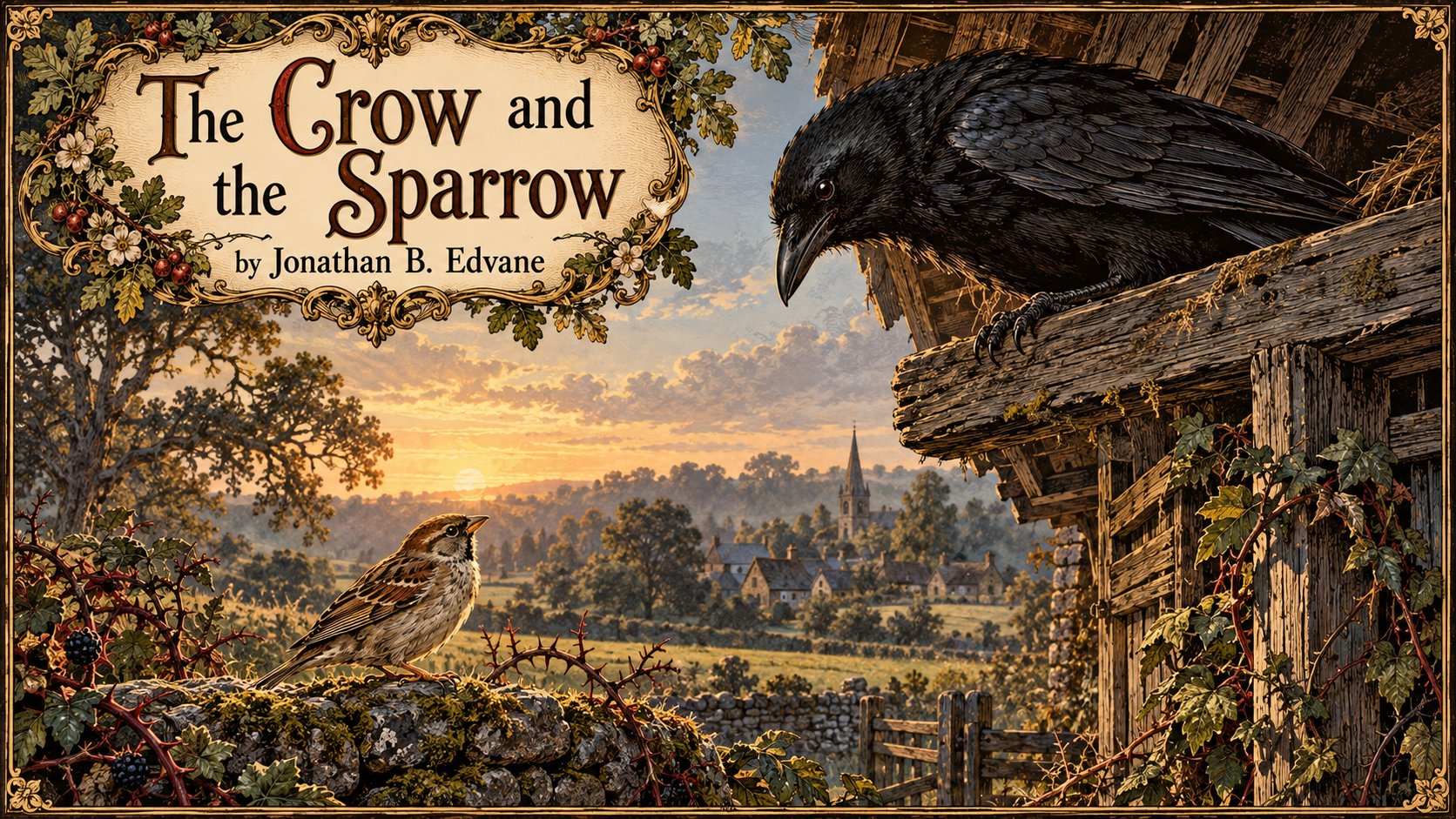
The first tale I ever wrote was a play about a Crow and a Sparrow. I had learned how to make a cereal box theatre from an old Weetabix box and had made characters on lolly sticks and background scenes drawn on card and paper. Many of them were different birds I had drawn, copying the plates in an old Observer’s Book of Birds I was given.
But I wanted a story, and so my first writing, The Crow and the Sparrow, was born. It was not the tale you will find here. I don’t recall what I came up with, but I wanted to breathe new life into the imaginings of a six-year-old back in 1973. And this is it.
Voscur was a crow. He had been coming to the hedgerow since the first warm days of spring. The sparrows treated him as they treated every larger bird, with alarm and distance. He would settle on the barn roof or the dead branch above the ditch and sit there, his black feathers lifted by wind, watching the quick brown movements below. If the sparrows stayed beneath the hawthorn and ivy, he could do little. If one strayed into the open, he followed it with his head until it vanished again.
Then the nests began to fail.
The first was high in the ivy where the farmhouse wall had cracked around an old window. Voscur tore the nest apart and carried away two naked chicks. The parents screamed after him until he crossed the field, then returned to what remained. A week later he found another beneath the barn eaves. After that the sparrows learned the sound of his arrival, and their chatter stopped before his wings had finished beating.
Sasper was a small cock sparrow. He had his own nest beneath a broken roof tile on the old stable. His mate had chosen the place because the entrance was narrow and hidden by moss, and they had raised young there before. Three chicks filled the nest that year, blind at first, then feathered and clamorous, their mouths opening whenever either parent returned.
Voscur watched them discover the world.
Sasper saw him on the barn one morning and drove himself at the black shape with such fury that his fear disappeared. Voscur barely moved. He turned his head, looked at Sasper, and opened his beak.
Sasper fled.
Later, when he returned with a crushed insect, the roof tile lay on the ground. His mate was alive. She clung to the gutter and called until her voice roughened, but the nest had been pulled into the open. One chick lay dead beneath the wall. Another was gone. The third had fallen among the nettles and was still moving. Sasper dropped down nearby.
Voscur came down before he could reach the chick. There was no chase. One black foot pinned the fledgling against the soil. Sasper struck at the killer but was thrown aside by a single blow of its wing. By the time he recovered, Voscur was already rising, the chick hanging from his beak.
After that, Sasper stopped calling when the crow appeared. He watched instead.
Several days later, Voscur was feeding beside the ditch when another crow crossed the far field. The change was immediate. Voscur abandoned his food and flew straight towards the intruder, calling harshly. Sasper watched from beneath the thorns. Here was something Voscur feared.
Sasper began to follow Voscur whenever he could without being seen. He learned that the crow favoured the barn roof in the morning, the ash tree beyond the ditch when the sun was high, and the field behind the stable towards evening, where beetles and worms rose close to the surface. Voscur seemed careless when he fed, but Sasper soon understood that this was an illusion. The crow noticed movement at extraordinary distances and would lift his head at the smallest disturbance. Yet one thing always drew his attention. Whenever another crow appeared beyond the eastern hedge, Voscur changed. His body stiffened, his wings opened, and whatever lay beneath his beak ceased to matter.
One crow lived beyond the pasture, where an abandoned orchard sloped towards a stream. Sasper discovered this only after several days of watching. He followed the stranger as cautiously as he followed Voscur and learned that it too kept to familiar places. It fed among the old apple trees and perched upon a lightning-struck oak close to the stream. Between the two territories lay a rough strip of grass crossed by a stone wall, and neither crow seemed willing to tolerate the other there. Their meetings were brief and violent. Sometimes one merely called and drove the other back. Other times they struck at each other in the air before separating, each returning to its own ground.
Sasper began to recognise the wall’s importance. He watched Voscur walk beside it after rain, searching the grass, but never crossing when the other crow was visible. He watched the stranger behave in much the same way from the opposite side. Neither bird feared Sasper, nor any of the sparrows that moved through the hedges around them, but each feared losing ground to the other. What interested Sasper the most were the things they kept. Voscur had a hiding place beneath loose straw beside the barn where he pushed scraps of food and bright objects he had taken from the yard. The other crow had something similar beneath the roots of the old oak. Sasper saw him carry there a strip of red cloth, part of an eggshell, and once a small piece of metal that flashed whenever the light struck it.
For several mornings Sasper did nothing except watch. He learned when Voscur left the barn and when the other crow crossed the orchard. He learned how long each remained away and how quickly either returned when disturbed. By the end of the week he knew their habits better than they knew his, and for the first time since the nest had been torn apart, he no longer watched Voscur only to know when to hide.
Sasper began with something Voscur would notice but could not immediately understand. While the crow fed beyond the stable, he slipped beneath the loose straw beside the barn and found the shell fragment among the things Voscur had hidden there. He carried it across the pasture in short flights, resting twice beneath the hedge, then dropped it close to the roots of the oak where the second crow kept his own cache. He did not stay to see what happened. The danger lay not in the carrying, but in being caught with something that belonged to either bird, and Sasper knew that no plan was worth dying for before it had properly begun.
The following morning Voscur searched beneath the straw for several minutes. He scattered the loose pieces with his beak, stepped back, then returned and searched again. Sasper watched from the guttering above the stable. Nothing more happened that day, but on the next he saw Voscur cross towards the stone wall and remain there far longer than usual, staring towards the orchard. When the second crow appeared among the apple trees, Voscur called at once. The stranger answered, and the sound carried across the pasture with an anger that had not been there before.
Sasper waited another day before moving something in the opposite direction. From beneath the oak roots he took a strip of the red cloth, dragging it free with some difficulty, and carried it back towards the barn. The weight forced him down over the grass, and once he almost abandoned it when Voscur crossed overhead on his way to the ditch. He remained motionless beneath a clump of nettles until the crow passed, then completed the journey and pushed the cloth beneath the edge of the straw.
This time the reaction was immediate. Voscur found it, seized it, shook it, then flew with it towards the wall, landing on the highest stone. The second crow appeared within minutes. Sasper could not tell whether the strip itself meant anything to them, but its presence was certainly important. Each bird had found something from its own ground where it did not belong, and neither had any reason to imagine that a sparrow had carried it there.
After that, Sasper stopped moving objects and began moving the crows themselves. He learned that Voscur would descend quickly if he spied him feeding in the open, especially near the barn where the nests had once been. Sasper began showing himself there deliberately, remaining just long enough to draw attention before fleeing eastward. At first he led Voscur only a short distance, but each successive attempt carried him closer to the wall.
The second crow could be drawn in much the same way. Sasper discovered this after dropping a small crust beside the orchard edge and fluttering conspicuously above it. The crow came down, claimed the food, and followed when Sasper retreated towards the pasture. For several days he repeated these small provocations, never enough to force a meeting, only enough to make each bird aware of the other near the boundary.
By the end of the week their calls began before they could see one another. Voscur crossed the pasture more aggressively and spent longer periods on the wall, while the other crow abandoned the deeper orchard and watched from the nearer trees. Sasper had changed nothing they were not already prepared to believe. He had merely given suspicion somewhere to settle, and now both crows guarded the boundary as though something had already been taken from them.
By the time Sasper decided the crows were ready, Voscur had become restless enough to abandon food at the first distant call. The other crow was no better. Each spent more time near the stone wall and less in the places where it had once fed, as though the boundary itself had become more important than hunger. Sasper waited until late afternoon, when both birds were active and the pasture lay open, then returned to Voscur’s hiding place beneath the straw and took the brightest thing he could carry. The bent strip of metal that flashed whenever it was turned toward the light.
He carried it eastward in stages, keeping beneath the hedges wherever he could, until he reached the orchard. The second crow was feeding among the fallen apples. Sasper dropped the metal beside the roots of the old oak, then rose noisily into the branches and fluttered out towards the pasture. The crow saw the flash almost at once. It came down, struck the metal with its beak, and lifted its head towards the wall. Sasper crossed the grass and began calling.
Voscur answered from the barn.
Sasper flew back towards him, passing close enough to be seen before turning again for the boundary. Voscur followed, catching up with Sasper rapidly, and Sasper felt the rush of black wings behind him before he dropped beneath the stones and vanished through a narrow gap. Voscur swept over the wall just as the second crow rose from the orchard.
Neither withdrew.
They met above the pasture with a violence Sasper had never before witnessed. Their bodies struck together and separated, only to wheel and collide again. Beaks snapped at faces and throats. Claws seized feathers and tore them free. Voscur drove the other crow down towards the grass, but it twisted beneath him and caught one wing, dragging them both to the ground. They rolled among the weeds in a confusion of black feathers, each striking wherever flesh was exposed.
The other crow broke away first, stumbling across the grass with one wing hanging low. Voscur followed and drove his beak into the back of its neck. The other bird fought to rise, failed, and struck once more at Voscur’s face before the blows stopped.
For several moments Voscur stood over it, breathing hard. Blood darkened the feathers beneath one eye, and one leg trembled when he tried to put weight upon it. He opened his wings but could not lift himself from the ground.
Sasper remained beneath the wall and watched until Voscur stopped trying.
When the sky began to darken over the pasture, Voscur had dragged himself several yards from the body of the other crow and now rested beside the wall, one wing held awkwardly away from his body. Each attempt to stand ended the same way. His injured leg folded beneath him, and his weight sagged back into the grass. The strength that had once seemed inexhaustible had become fragile and temporary, leaking away with the blood that darkened his face.
Sasper left the shelter of the stones and crossed the ground towards him.
Voscur saw him at once. His head lifted, and for a moment the old danger returned. He opened his beak and struck forward, but Sasper was beyond his reach. The movement cost Voscur more than it gained him. He settled again, breathing heavily, one eye fixed upon the sparrow.
Sasper stopped a short distance away. He had imagined this moment often during the days of watching and carrying and waiting, though he had never known what he expected to feel when it came. Seeing Voscur broken brought little relief. His nest remained empty, and the chick taken from the nettles would not return because the crow had been brought down.
Voscur tried to rise once more, and Sasper moved closer.
He darted in and struck at the wounded side of the crow’s face, then sprang back before the beak could catch him. Voscur lashed out blindly. Sasper came again, this time at the eye, and the crow gave a hoarse cry unlike any sound Sasper had heard from him before. The next attack was easier. Voscur could no longer judge the distance between them. Sasper continued until the crow stopped defending himself.
When it was over, he stood beside the black body and wiped his beak against the grass. Across the pasture, the hedges had begun to fill with the evening movements of smaller birds returning to cover. None came near him.
Sasper looked towards the barn, then towards the broken nest beneath the stable roof. For the first time in a long time, no crow watched from above.
Voscur believed Sasper was too small to matter. He saw only a creature to frighten, rob, and drive from its nest, and never imagined that every cruelty taught the sparrow something in return. Sasper learned Voscur’s habits, his hunger, his temper and the boundaries he would defend. In the end, Voscur was not defeated because Sasper became stronger. He was defeated because Sasper understood him better than he understood Sasper. Yet that victory came at a cost. To destroy the crow, Sasper had to learn the crow’s ways, and when the killing was done, some part of what he hated had entered him too.
Leave a Reply