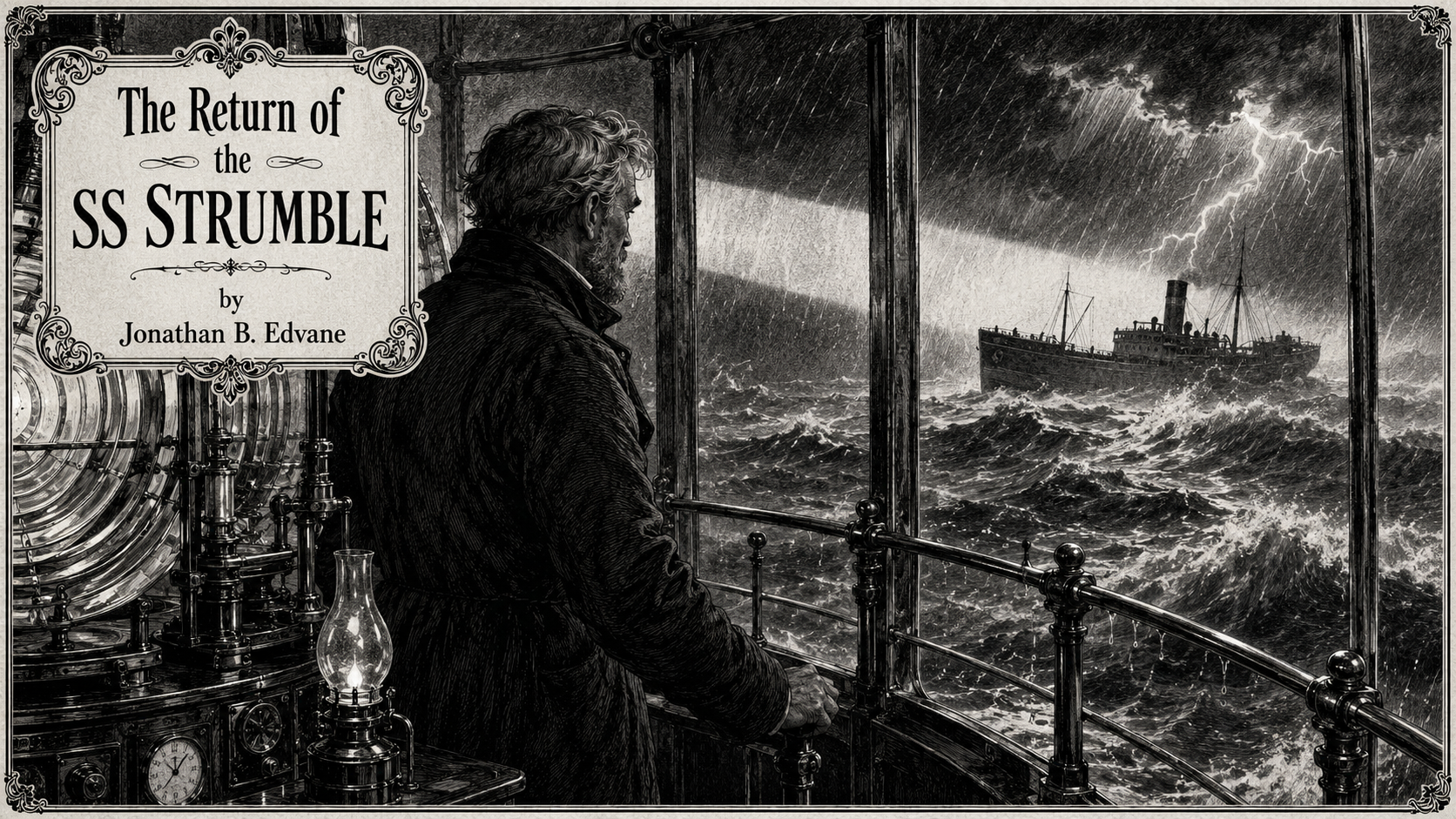
The sea had risen high enough against White Head to make the lighthouse seem besieged by the cliff. Every few breaths, a wall of water struck the rock below and sent a tremor through the tower, up through the iron stair, the oil room, the service chamber and into the lantern where Thomas Darling stood with one hand resting against the brass rail of the great lens.
He had seen worse seas as a sailor, or that is what he told himself and anyone else who cared to listen. Men grew boastful about weather once they had survived it. Yet this storm had a will in it. It came out of the black west in hard, heaving assaults, each gust shouldering at the glass. Pounded by something vast and blind that wanted the light put out. The lamp burned steadily despite it, drawn tall and clear behind the lens, and Thomas took comfort in it. The lamp was his duty, and therefore something he could hold on to when all else moved.
He had kept White Head for seven years, and he knew every honest sound of it. The clockwork turning the lens, the scrape of the gallery door in a gale, the faint complaint of the warmed iron, and the rush and fall of rain in the gutters. That was why the new sound troubled him. It was too slight to belong to the storm and too regular to be part of the tower. A ticking seemed to pass through the stone between one crash of sea and the next.
Thomas stood still and listened until it vanished.
“Old fool,” he muttered. “It is only the works.”
But the works were above him, polished, inspected and obedient. The sound had seemed to come from below.
He turned back to the glass and watched the beam sweep across the water. For a moment, it opened a pale road through the rain, often toward memories he could not keep down. The deck of the SS Strumble, soaked with spray. Men shouting into a night much like this one, amidst the ugly iron roll of a ship he had once served and had no wish to remember. The Strumble had been gone for years, wrecked and recorded, her dead committed to talk and ink. Thomas had been the single soul to survive her, but he had not quite left her behind.
A sharp metallic clang rose from below, and he looked toward the stair. At first, he thought some loose fitting had shifted in the gale, but then the sound came again, frantic and irregular. The bell at the lower door was ringing? No one could have reached that door by the cliff path in such weather. The steps would be slick as soap, the lower rocks surely drowned in surf, and the track from the keeper’s cottage always running like a stream. Still, the bell rang with the rhythm of a desperate, living hand.
Thomas took the storm lantern from its hook and descended. By the time he reached the lower passage, water was running under the door. He lifted the bar, braced himself, and forced the door inward against the gale. A man fell across the threshold, half-drowned, one boot gone, and weed tangled in his beard.
Thomas dragged him inside and slammed and barred the door. The stranger coughed seawater onto the flags, then seized Thomas’s sleeve with fingers cold as iron.
“Put out the light,” he whispered. “Before she sees it.”
He helped the man into the watch room, where the stove had been banked low, and the air held the day’s last, ebbing warmth. He laid him on the settle, stripped the soaked coat from his shoulders, and wrapped him in two coarse blankets kept for shipwrecked men and fools who ventured too near the cliffs. The stranger fought him at first, weakly, and with the panic of a man who thought himself still in danger.
“Lie still,” Thomas said, pressing him back when he tried to rise. “You have swallowed half the Atlantic. If there is a ship out there, shouting at me will not bring her in faster.”
The stranger gripped his wrist. He was younger than Thomas had first thought, perhaps no more than twenty-five, with narrow cheeks and dark hair pasted to his brow. There was no seaman’s mark about him, no tar under the nails, nor calluses on his hands. His clothes were decent beneath the ruin of the sea. Town clothes poorly chosen for rough weather. Thomas took his measure. Not crew. Not a passenger either, unless he had come aboard by a door no purser had opened.
“You were on her?” Thomas said.
The man’s eyes fixed and stared back. “Below her.”
“A stowaway, then.”
The accusation seemed to steady him, and he pulled the blanket higher, shivering so hard that his teeth clicked. “Call it that, if you like.”
“I shall call it what it is until you give me reason not to. What ship?”
The stranger closed his eyes. Thomas thought he would refuse, or faint, or die with the answer locked behind his teeth. Then he said, “Do not listen to the ticking machinery.”
Thomas frowned. “Answer plainly. Where was she bound?”
The wind struck the tower so fiercely that the lamp chain trembled on its hook. Thomas glanced upward by instinct, listening for the trustworthy rhythm of the works above. He heard them, steady and familiar, but beneath them there seemed to be something else. He told himself it was the man’s teeth chattering, or the stove settling, or rain driven through some crack in the masonry.
“What machinery?” he asked.
The stowaway opened his eyes. “In the hold. In the locked case. Brass things. A clock that does not keep the hour. They were supposed to have calculated tides, cargo risks, insurance losses, anything men paid to know before other men knew it. But they do not calculate. They listen ahead.”
Thomas stared at him. “You are fevered, sir.”
“I was greedy,” the man said. “I regret it now.”
That, at least, sounded honest. Thomas poured a measure of Black & White into a tin cup and lifted it to the man’s mouth. He drank too quickly, coughed, and clutched the blanket until his knuckles whitened.
“I hid aboard at Bristol,” he said. “There were rumours of a private consignment. No customs mark, no manifest, guards paid not to ask questions. I thought it was gold, bonds, diamonds, something a man could carry under his coat and become someone else with. I waited until we were well out before I found the hold.”
“And the crew?”
The stowaway’s eyes moved toward the black panes of the watch room window. “At first, they laughed at it. Then they wagered on it. The machines would tick and print little slips, and the slips were right. A dropped mug. A boiler fault. A squall before the glass fell. Then larger things. Names. Dates. Deaths. Men began going below alone. After that, they stopped laughing.”
Thomas set the cup down. There was enough nonsense in the account to dismiss it, and enough fear in the telling to prevent him from doing so comfortably. “And what became of them?”
“I don’t know,” the man whispered. “One morning, there was breakfast laid and no one to eat it. Boots by the bunks. Pipes still warm. The wheel lashed, engines turning, and the ship keeping her own course. Only that infernal ticking below remained, louder than before.”
Thomas felt both irritation and foreboding. “Ships do not keep their own course.”
“This one does.”
“What is her name?”
The stowaway flinched as though struck. Outside, the storm roared against the walls, and above them the lamp continued its slow, dutiful sweep over the sea.
“Tell me the name,” Thomas insisted.
The man looked at him with naked pity. “She is the Strumble,” he said. “The SS Strumble. And she is coming for your light.”
Thomas did not answer at once. He stood with one hand on the back of the chair and the other still near the cup, telling himself he had misheard and this was surely a mistake. But the name had gone through him more cleanly than any knife. For years, the Strumble had belonged to his past and his guilt, and the merciful silence of men who shied from asking questions of a survivor. Now this soaked thief, this shaking stowaway with fear whitening his lips, had spoken it aloud beneath Thomas’s own light.
“You have heard that name somewhere,” Thomas said. “In a dockside beerhouse, perhaps. Men tell stories when they have nothing better to sell.”
“I saw it on the stern,” the stowaway replied. “I saw it when the lightning opened the rain. I did not know what it meant, only that the others were gone by then, and the ship was still moving.”
Thomas looked toward the stair. Above him, the lens continued its patient revolution, casting its warning across the sea whether men believed in ghosts or not. The keeper in him knew what had to be done. A vessel was out there in murderous water. A man did not extinguish a lamp because a half-drowned criminal brought him a tale of clockwork prophecy and vanished crews. Yet the sailor in him, the man who had once stood on the Strumble’s deck with both hands burned by rope and sea water in his mouth, found himself listening for that thin, impossible ticking under the storm.
The stowaway must have seen the decision forming in his face. “Do not guide her in,” he said, struggling up on one elbow. “If she sees the light, she will follow it.”
“That is what lights are for.”
“Not for her.”
Thomas took the lantern. “Stay here. If you rise, you will surely fall.”
The man laughed, a broken little sound. “Then I shall be in good company.”
Thomas left him and climbed. Each turn of the iron stair brought the storm closer, until he reached the lantern room and the whole night opened around him in glass and violence. Rain lashed the panes in sheets. The lamp burned unwaveringly at the centre of the lens, and beyond it lay the convulsed dark of the sea.
For several sweeps, he saw nothing. Then the beam moved eastward and caught something.
Iron.
A ship stood beyond the outer rocks. She was farther out than he first thought, then nearer, then impossibly clear as lightning tore across the sky and showed her from funnel to stern. Black hull. Low bridge. Forward mast shortened by old damage. A list to port that Thomas knew before his memory returned it. She rose on the swell and came down again with no sign of panic, no rush of men at the rails, and no figure at the wheelhouse glass. Her navigation lamps burned with a faint, spoiled colour, not green and red as they ought to have been.
Thomas gripped the rail. The Strumble had gone down in 1891, eight years before, yet here she was, steaming in late without explanation or apology.
He seized the signal shutter and sent the old instruction. Hold off. Dangerous rocks. Stand to seaward. The beam broke and reformed through the storm. No answer came from the ship. No lamp replied. No whistle sounded. She kept coming, slow and certain, turning her bow toward White Head as though the lighthouse were not warning her away but calling her home.
Below, faint but distinct through the frame and glass, a cry rose from the watch room. The stowaway was shouting something Thomas could not make out. It might have been his name. It might have been another warning. But Thomas’s eyes were on the vessel, and with the dreadful loyalty of a sailor to any ship in peril, even a dead one, he adjusted the shutter and gave her the safer line through the broken water.
The Strumble responded with movement only. Her bow altered by a few degrees, as she passed the outer teeth of rock where no uncrewed vessel should have, and slid through the black wash between reef and headland, coming inward under the turning light. Still, there was no hand on deck, no face at a porthole, no human shape braced against the storm. Only iron, lamps, rain and the steady beat of engines that should long since have gone cold.
When she grounded at last, it was not with scream and ruin. It was a low, heavy settling. She had meant to come exactly there. She lay in the lee of the rocks below White Head, close enough for boarding at low water, intact enough to mock the grave.
Thomas stood in the lantern room until the next sweep of the light found her name across the stern.
SS Strumble.
And beneath the gale, beneath the lamp works, beneath even the hammering of his own heart, he heard the ticking begin again.
◆
By the time the tide had fallen enough to uncover the lower rocks, the storm had drawn back from its first fury, though it had not subsided. It moved now in long, hard breaths, worrying at the tower and dragging the rain sideways across the cliff. Thomas waited until the Strumble’s deck lay a little below the broken line of the old landing, then took a coil of rope, a boat hook and the storm lantern, and went down by the service path with the stowaway’s warning following him.
The young fellow had tried to rise when Thomas passed the watch room, but his legs betrayed him before his courage did. “You’ll hear it before you see it,” he said, clutching at the blanket. “That is how it gets in. You think you are counting, then you are remembering, then you are obeying.”
Thomas told him to save his breath and left him there, though the words unsettled him. He had heard enough clockwork in his life to know that no machine had ever yet made a man do anything he had not wished to do.
The Strumble lay wedged in the black water below, her hull rising and falling with a slow, reluctant motion. Rust streaked her plates. Weed hung from the chains. Old scars stood in places Thomas remembered, and one long split in the starboard rail had been mended with a crude iron brace that halted him, for he had seen that damage made by a loose cargo boom off Anglesey in ’88. He had been the one ordered up to secure it afterwards.
He crossed by rope and hook and dropped onto the afterdeck. No one challenged him. No boots struck the planks. No voice called from the bridge. The ship received him in a silence so complete that the sea itself seemed to fall away once he stood aboard her.
“Strumble,” he said, not loudly. It was foolish to address iron, but he had seen old sailors do worse.
He moved forward, past the empty boat davits and the hatch covers shining with rain. The bridge door stood open. Inside, the wheel was lashed with a length of tarred rope, and the engine-room telegraph pointed to ahead slow, though he knew no hand had set it there that night. A pipe lay in the corner with black ash still packed inside the bowl. The chart table held a damp-stained course sheet, but the markings on it did not belong to any passage Thomas knew. Lines crossed and re-crossed the North Sea, the Channel, the Baltic, and farther places until the plotting seemed more like a web.
Below, the companionway waited.
Thomas descended, and his lantern showed the mess first. Tin plates sat where men had left them. A mug lay on its side, its contents dried into a brown crescent. Oilskins hung from pegs. A boot stood under a bench, one lace untied. There was no disorder, no sign of struggle, and that was the worst of it. Men had not fled. They had simply stopped being there.
He passed the crew berths and paused at one narrow bunk before he could stop himself. The frame had been repaired near the foot where the wood had once split. His repair. His knife marks were still there, three uneven cuts made during a calm watch with nothing to do but carve and think of home. The sight of them hit him harder than any corpse could have done. The ship had kept his absence. It had carried proof that he had once belonged to it.
Then the ticking began again.
It came from beneath him, the sound of a hundred pocket watches, buried in cotton. Thomas shut his eyes before he knew why, and in the dark the sound arranged itself into patterns. They were neither speech nor music, nothing he could recognise. Yet he somehow knew a promise was being made.
He opened his eyes and forced himself down another ladder to the forward hold.
The cargo had been bolted into place beneath canvas and iron strapping. There were six machines, each housed in polished brass darkened by damp, each mounted inside a crate built too carefully for ordinary freight. Glass dials caught his lantern light. Mercury trembled in sealed tubes. Thin needles shifted over enamelled faces marked with dates, names, distances and symbols he could not read. One mechanism fed a strip of paper through a narrow brass mouth, and though no hand wound it and no steam line fed it, its wheels moved with confidence.
Thomas leaned closer before he remembered the warning. The paper advanced, but the ink was only a blur. Then the letters cleared beneath the trembling lantern flame, forming words he could see.
October 1904. Dogger Bank. Hull trawlers. Russian guns. War before dawn.
Thomas read them while the machinery ticked all around him. The words should have meant nothing. They were five years distant and absurd. Yet the machine turned again, and the next line appeared.
One signal misunderstood. One signal corrected.
The ship groaned beneath him, settling deeper into the rocks. Thomas put out one hand to steady himself against the crate, and the ticking changed. For an instant, he was no longer in the hold. He saw a black North Sea scattered with fishing lights, he heard foreign guns in fog, saw newspapers slapped wet onto London stones and boys in naval caps running through streets before dawn. Then the vision folded back into brass, ink and lantern light.
Thomas stepped away, breathing hard. The stowaway had been wrong about one thing. The danger was not that a man listened and believed the machines. The danger was that he listened and wanted them to be right.
A smaller instrument had been fitted to the side of it, no larger than a ship’s chronometer, held in place by two brass catches and a locking pin. It too trembled as paper also advanced from it. Thomas knew he should leave it where it was. He knew that if the stowaway had warned him of one true thing, it was that nothing aboard the Strumble ought to be carried ashore. Yet the strip in his hand named men who had not died yet, and perhaps need not die at all. With shameful care, Thomas pressed the catches, drew the little mechanism free, and wrapped it in his scarf to dull the ticking. It did not stop.
He hurried back through the stricken ghost. Through the companionways, the mess, the bridge and the deck. All passing around him in fragments, each made sharper by the ticking he had both left behind and also brought with him. By the time he crossed back to the rocks and hauled himself up the service path toward White Head, he had one hand clenched around the strip of paper and the other carrying the sequence of signal marks he had taken from the machine’s dial, and the smaller mechanism.
The stowaway was awake when Thomas entered the watch room. He had drawn himself upright on the settle, and one look at Thomas told him enough. “You heard it.”
“I saw an instrument print words. That is all.”
“No,” the young man said. “That is never all.”
Thomas laid the strip on the table and smoothed it with shaking fingers. The ink had not run despite the rain. The letters remained neat, black and clear. October 1904. Dogger Bank. Hull trawlers. Russian guns. War before dawn. Beneath it, in smaller print, was the second line. One signal misunderstood. One signal corrected.
The stowaway looked away. “Burn it.”
Thomas almost laughed at him. “If there is truth in this, burning it may condemn men not yet born.”
“If there is truth in it, keeping it may condemn more.”
“You speak as if you know.”
“I know what happens to those who keep listening.”
Thomas went to the stove and stirred life into the coals, but when he held the paper over the faint red glow, his hand would not lower. He saw the cold scatter of fishing lamps again in a future fog, men hauling nets under a foreign gun, a mistake swelling into orders, orders into mobilisation, mobilisation into war. Perhaps it was trickery. Perhaps the machine had taken his own fear and printed it with the confidence of scripture. Yet if there were even a little truth in it, if one warning sent through the right hands could keep one sea from becoming a graveyard and one quarrel from becoming a century’s first conflagration, what sort of man would choose ignorance and call it virtue?
He did not burn the strip. He copied the signal sequence into the back of an old navigation manual and wrote three letters. One went to a former shipmate now employed at Trinity House. One went to a retired naval lieutenant who had once trusted Thomas with his life in a fog off Lundy. The third, unsigned and with no explanation, went to the Admiralty, containing only the date, the fishing ground, the warning that Russian nerves might turn British trawlers into imagined enemies, and the corrected lamp sequence the machine had given him. He gave no account of the Strumble. He named no engines. He made himself, as far as the ink allowed it, absent from the event he hoped to alter.
At first light, he went down to the rocks again, taking the same rope and hook, though he could not have said whether he meant to salvage, confess, or just prove that the night had happened. The tide had drawn back from the ledges below White Head, but here was no Strumble in the lee. No torn iron on the reef, no coal scum, no splintered boat, no line scarred where he had crossed from rock to rail.
When he climbed back to the watch room, the blankets lay folded on the settle, dry and undisturbed. There was no salt on the floor where the stowaway had coughed up half the sea, no bootless track, no cup left where shaking hands had held it, and the bottle of Black & White was full and sealed. Thomas stood in that neat, impossible room and felt the strip of printed paper inside his coat with a horror colder than death. Either the storm had carried away every witness but him, or the world had already begun correcting itself. For the rest of that morning, he grappled with both thoughts, but could not decide which terrified him more.
◆
Years later, when the report came in the newspapers, Thomas read it alone in the watch room with the door shut. British fishermen had been fired upon in the North Sea. Men were dead. Hull had names to mourn. Russia had explanations to make. London had anger enough for war, and yet war did not come. There were inquiries, compensations, speeches, denials, and all the machinery by which nations step back from the edge while pretending they had never approached it. The papers called it outrage, blunder, provocation, and restraint. None of them called it what Thomas feared it was.
A lesser disaster.
That night, he unlocked the cupboard where he had hidden the navigation manual and opened it to the copied sequence. The paper from the Strumble lay folded inside, still black, still dry, still certain. For the first time since White Head had received its impossible visitor, Thomas allowed himself to believe he might have saved lives. The thought ought to have comforted him.
Instead, from the room below the lamp, where no clock had been wound, and no mechanism should have moved, the ticking began again.
For several minutes, Thomas did not move. He stood with the old navigation manual open beneath his hand, the newspaper folded beside it, and the little strip of paper from the Strumble lying between them. Outside, the sea moved under a calm October moon, indifferent now to the storm that had once driven a dead ship beneath his light. The world had continued. Lamps were lit in cottages. Men slept inland who did not know their sons might have gone to war. The century had taken its first steps and, because of him or in spite of him, had not stumbled where the machine had said it might.
The ticking came again. It did not hurry him, accuse him, or beg to be heard. It merely persisted. Thomas took the lantern and climbed toward the service room beneath the lamp, where the part he had removed from the Strumble lay locked in a tin-lined chest under a coil of spare wick. He had told himself for years that he kept it hidden because no ordinary man had the right to such knowledge. Yet he had not thrown it into the sea. He had not smashed it with a hammer. He had preserved it, quietly believing he might one day need it again.
The chest was cold when he lifted it onto the table. Inside, the brass mechanism sat dull and dry, smaller than he remembered. No spring had been wound. No hand had touched the key. Still, the needle quivered on its enamelled face, and the paper tongue had advanced a little from the narrow slot.
Thomas bent over it, meaning only to look long enough to refuse. The first line had already formed.
June 1914.
The lantern flame stirred, though there was no draught. The needle shifted again, and the next words crept out with the same neat politeness that had once named Dogger Bank before the world had known to fear it.
Royal blood. Sarajevo. Treaties awakened. Trains east and west. Europe entire.
Thomas closed his eyes, but the words remained, arranged now behind the lids in lines of smoke and steel. He saw no single battle clearly, no map, no face he could trust as real. Only movement. Timetables. Crowds. A pistol raised in a street he had never walked. Old men signing papers that sent young men into the mud. Lamps going out across coasts far beyond White Head.
He opened his eyes and found his hand resting on the mechanism. Below him, the sea breathed in the dark. Above him, the lighthouse turned its honest warning over the water, saving any ship that would be saved. Thomas thought of the stowaway, long gone from his station and perhaps from life itself, and of the warning he had brought half-drowned through the storm.
Do not listen to the ticking machinery.
But Thomas had listened, and men were alive who might not have been. Or else the machine had given him fear and then rewarded him with coincidence. Or else it had used him to move one piece so that some larger board might be set.
He could still burn the paper. He could bury the mechanism in the cliff. He could send another letter and begin again. Each choice stood before him, claiming to be mercy.
The ticking continued.
Thomas folded the new strip without reading further and held it over the lantern flame. The corner browned, curled, and smoked. For one moment more, he kept it there, close enough for fire to take it, not close enough to burn.
Then the light turned in the great lens above him, swept across the room, and left him standing between darkness and warning, with the future trembling in his hand.

If you enjoy ghost stories, then you might also enjoy another one I wrote. The Ghosts of Godstow Abbey
Leave a Reply