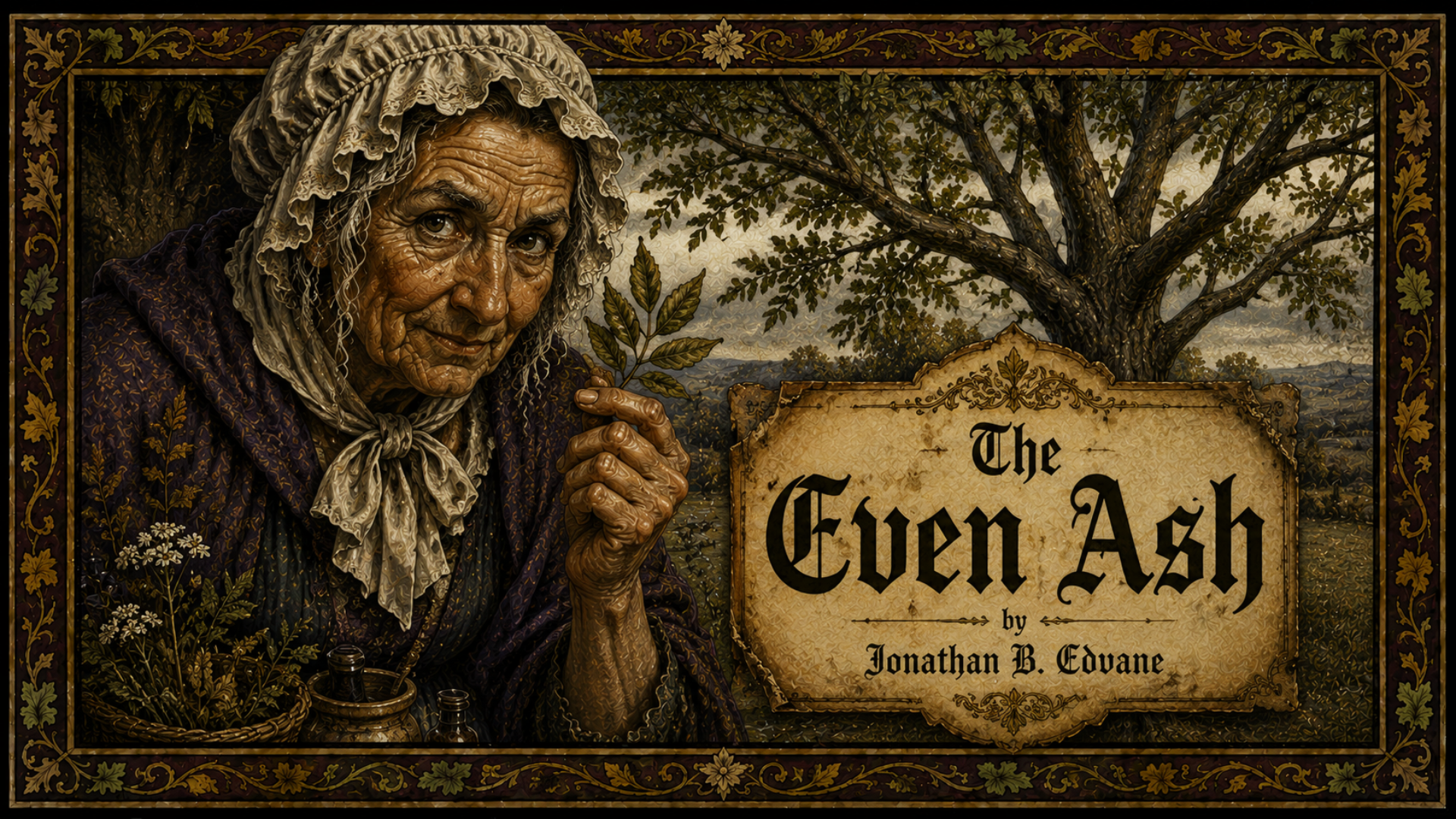
This even-ash I double in three,
The first man I meet my true love shall be.
If he be married let him pass by,
But if he be single let him draw nigh.
The Last Piece of Thomas Shaw
The fair had come to Ripon under a colourless sky, and by noon, the field beyond the market was churned black with hooves and boots. Drovers bawled over cattle. A knife-grinder sang against the shriek of his wheel. Women fingered ribbons they would not buy, boys stole looks at girls who pretended not to see them, and every mother with an unmarried daughter had the sharp, measuring face of a buyer before a stall.
Alice Harper stood with her aunt beside the pie woman’s board and heard herself discussed between the mutton and the mustard.
“She is not plain,” her aunt said, as though granting mercy. “Only quiet. Quiet girls do well enough, if a man has sense.”
Her mother sighed. “Sense is rare in men with land.”
Alice looked down at the mud on her hem and wished that someone would want her before he had judged her.
At the end of the row, beneath a strip of green cloth pegged against the wind, Mother Greenwood sold her simples. Feverfew hung from one cord, rue from another. Little horn pots of salve sat beside packets of dried leaves folded into paper. She was tying a bundle with brown thread when Alice came seeking a balm for chapped hands.
“Hands heal quicker than hearts,” Mother Greenwood said.
Alice flushed. “I said nothing of my heart.”
“No,” said the old woman. “Yet that is often how I hear it best.”
Alice should have gone, but she watched Mother Greenwood place the balm in her hand.
“There are old ways of asking,” the woman said. “Not forcing. Asking. Find the even ash by the ditch beyond the fair field. Fold it clean. Say the words plain. But mind this, child. Ash gives back what it is asked.”
Alice found the ash where Mother Greenwood had said it would be. Beside the ditch where boys had thrown apple cores, and a broken trencher lay half sunk in the mud. The fair still muttered behind her, though its music had diminished to a pipe’s tired squeal and the dull knock of barrels being loaded. Above her, the ash held its leaves in a cold, trembling light.
Most were ordinary. She almost laughed at herself for expecting otherwise, but then she saw it, on a thin branch, a leaf balanced wrongly. No little spear at the end. No single point to make the number uneven. It looked neat, paired, and waiting.
She plucked it quickly, afraid someone might see her and call out. She folded it once, then again, then a third time, and whispered the rhyme Mother Greenwood had given her.
“This even-ash I double in three, the first man I meet my true love shall be. If he be married let him pass by, but if he be single let him draw nigh.”
Alice crushed the folded leaf in her fist and hurried back.
At the road’s edge, a man stood where no man had been earlier. He held his hat in both hands and looked at her with such startled gratitude that she stopped dead in her tracks.
“Miss,” he said. “Would you tell me the way back?”
His name was Thomas Shaw, or so he told her, though he had paused before saying it. He came again the next morning beside the baker’s stall, and again the day after near the pump, and by the week’s end Alice had stopped pretending to be surprised. He was gentle in all things. He stood aside for women carrying pails, spoke softly to children, and listened to Alice with such complete attention that it made her feel almost frightened. No one had ever looked at her in that way. Not for beauty, not for dowry, just for herself.
“You have no people here?” she asked him once.
Thomas smiled. “I have you to speak to.”
“And others? Family?.”
“No,” he said, and seemed troubled by the fact. “You are the nearest I have to family now, Alice.”
Her mother thought him odd, but clean and courteous. Her aunt said a quiet man was better than a loud fool. Only the mastiff at the smithy growled whenever Thomas passed, and Nan Peters crossed herself after hearing him laugh.
“That sound belonged to my brother Edmund,” Nan muttered. “Dead these twelve years.”
Alice told herself grief made old women foolish. Yet small things gathered. Thomas’s right hand was always cold, his left almost fever-warm. In sunlight, his shadow thickened, threatening to part before it remembered itself. When Alice asked where he had been born, he said, “Under water,” then frowned and said, “Under earth,” then shut his eyes and whispered, “Under ash.”
She drew back at that, and he reached for her with such naked panic that pity overtook fear. “Do not send me loose again,” he said. “I was pieces before you called. A breath drowned in the Skell. A hand buried without its man. A want left starving in the roots. You folded me, Alice. You made me near enough.”
His fingers trembled around hers. “Near enough for what?” she asked.
Thomas looked at her with three hungers behind one face. “To be loved whole.”
By dusk, he had worsened. Alice saw it in the delay between his lips and his voice, in the way each hand reached for a different part of her, one for her wrist, one for her cheek, one for the ribbon at her throat. Beneath the ash, his shadow divided cleanly at last, and each piece leaned toward her with a hunger of its own.
“I cannot bear,” Thomas said. “A man needs a last piece.”
Alice thought of every girl at the fair with a ribbon bought for her by some smiling fool. She thought of her mother’s sigh, her aunt’s soft pity, the long humiliation of being left unchosen. Then Thomas touched her face with his cold hand and said, “Only you saw me.”
It was almost enough.
“What must I give?” she asked.
His warm hand moved to her mouth. His cold one found her heart. The third shadow rose behind her and slipped its fingers into her hair.
“Your name first,” he whispered. “Then your breath. Then the part that wants.”
Alice now understood Mother Greenwood’s warning. Ash gave back what was asked. She had not asked for a good man, nor a kind one, nor even a whole one. She had only asked to be chosen, and loneliness had done the rest. She tried to say no, but he kissed the word from her mouth before it formed.
In the morning, Alice Harper was found beneath the ash, alive and white-haired, with her ribbon knotted around a branch above her. She remembered the fair. She remembered the rhyme. She remembered Thomas Shaw’s three shadows leaning over her. But when her mother held her and wept, Alice felt no answering pull. When young men later spoke kindly to her, she heard only noise. Whatever part of her had once ached to be wanted had gone walking out of Ripon before dawn in Thomas Shaw’s newly steady chest.
After that, she told every girl who would listen never to ask an ash for love while hungry for proof. Most laughed. One even asked where the tree stood.
Alice showed her the ditch, but not because she wished harm on her. Because warnings did not keep fools from roads. They only marked where the road began.
The Debt of Samuel Clarke
Knaresborough fair stood loud beneath the castle crag, with the Nidd running dark below and the market place crowded thick with beasts, cloth, pies, ribbons and men who looked too long at girls with money in their sleeves. Sarah Hyde moved through it as though the fair had been arranged for her passing. She had her mother’s good gloves on, a blue ribbon at her throat, and Jane Barrington laughing at her side.
“You could have had Howard Cavendish twice over,” Jane said.
Sarah smiled. “Then I am twice wise to have refused him.”
“And Mark Beresford?”
“Too fond of his own teeth.”
Jane laughed, and Sarah laughed with her, bright enough for two apprentices to turn their heads. Mistress Hyde, walking a little behind, pretended not to hear, though she winced a little whenever Sarah dismissed another name.
“You will not laugh when all the decent men have chosen elsewhere,” she said.
“Then let the indecent ones make better offers,” Sarah replied.
At the herb stall, Mother Greenwood was laying out feverfew and rue, her hands brown and neat among the tied bundles. She did not look up, but her listening seemed to settle over them.
Jane, still merry, said, “You were not always so hard to please. Do you remember Samuel Clarke?”
Sarah’s smile cooled. “I remember a foolish boy who thought a girl’s kindness was a promise.”
“He never stole from Master Pilling,” Jane said. “He stitched that token for you.”
Sarah’s colour rose. “He had no right to make it.”
“And you had no right to show Howard Cavendish and Mark Beresford until they laughed him into a thief.”
“I did not accuse him.”
“No,” Jane said. “You only let them do it.”
Mother Greenwood placed a packet of dried ash seeds beside the rue. “Shame keeps poorly,” she said. “Sooner or later, it asks to be taken out and named.”
Sarah might have answered sharply, but Mother Greenwood held out a little paper of crushed violet and southernwood, saying it was for sweetness, though she knew some faces needed less sweetening than their tongues. Jane looked away to hide a smile. Mistress Hyde paid, and while the coins passed from glove to brown palm, Sarah found herself watching the old woman’s basket. Among the salves and dried roots lay a spray of ash leaves pressed flat between two scraps of linen.
When Sarah asked if they were for fevers, Mother Greenwood said they were for asking. If a girl had courage enough for an answer.
“What should I ask?” Sarah said, still smiling.
“What proud girls ask while pretending they do not. Whether love has kept its eyes on them.”
Then Mother Greenwood told her the rhyme, with Jane leaning close. She spoke of an ash above the river path, where the Nidd flowed deep over the dark below. Now and then, she said, it put out an even leaf. Fold it in three, say the words plain, and let married men pass.
Jane murmured that it sounded harmless, but Mother Greenwood only tucked the coins away and said most snares did, until something stepped in.
Near sunset, while the fair packed itself into carts and quarrels, Sarah found the ash. The even leaf waited. She folded it and spoke the charm while Jane looked on, half laughing and half ashamed of listening.
“This even-ash I double in three, the first man I meet my true love shall be. If he be married let him pass by, but if he be single let him draw nigh.”
The first man they met on the castle path was well-dressed, composed, and watching her already. “Sarah Hyde,” he said. “Do you still pass private gifts from hand to hand?”
She knew him before she allowed herself to remember him. The line of his mouth had hardened, and his coat was good dark wool now, not the patched brown he had worn in Master Pilling’s yard. Yet the scar beneath his left eye remained where Howard Cavendish’s ring had caught him years before.
“Samuel Clarke,” Jane said.
He bowed as though the name had been offered in kindness.
Sarah felt the folded ash turn damp in her glove. She might have passed him with a nod and made nothing of it, but Mistress Hyde came up behind them and saw only a composed young man with clean cuffs, steady eyes and no wife at his side. Samuel spoke well. He had been in service near York, he said, then in trade, and had returned on business of his own.
After that, he appeared wherever courtesy could explain him. He carried Mistress Hyde’s basket when the handle split. He retrieved Jane’s dropped glove from the muck. He bought Sarah a length of blue thread from the very stall where, years before, she had laughed over the little stitched token he had made her.
“For your careful hands,” he said, placing it in her palm.
Jane went pale. Sarah closed her fingers around it until the thread bit her skin.
“You remember too much,” she said.
“I have had little else to keep.”
His courtship was faultless, and faultless things leave no room for complaint. Mistress Hyde found him improved. Jane begged Sarah to tell the truth and be done with him. But Sarah had built her prettiest self on being believed, and Samuel knew it. He never accused her. He only stood near, patient and single, the man no decent family had taken after she let his shame ripen.
At night she heard Mother Greenwood’s words again.
Shame keeps poorly.
By the third day, even Sarah understood that the charm had not brought back love. It had brought back a witness.
He brought her to the river path at dusk, below the castle crag, where the fair sounds came dimmed by distance and water. Jane followed far enough to see them turn beneath the ash, then stopped, frightened by the stillness of the place.
Samuel took the blue thread from Sarah’s hand and held it between them. “Say what you let them make of me.”
Sarah looked back toward the market, where clean gloves, decent offers and useful silences still waited. “I was a girl.”
“You were listened to.”
She turned and left him there, hurrying back, anger carrying her until Howard Cavendish saw her near the cloth stalls. His smile began, then failed. He stared at the air beside her and went white. For a moment, Sarah knew what he saw. Samuel, as he had been five years before, blood beneath one eye, her stitched token in his hand, theft on every tongue while she said nothing.
Mark Beresford saw it next and crossed himself. Master Pilling turned his back before she reached him. One by one, those who had laughed, accused or listened saw the old shame standing with her.
Samuel’s voice came from the river path, “The ash named me first. It will keep naming me until you do.”
By Sunday, all Knaresborough knew. Sarah Hyde stood before the church door and confessed the token, the laughter and her silence. Samuel Clarke was cleared, but he did not marry her. He bowed once and left town.
Afterwards, when girls asked Mother Greenwood’s rhyme for sport, Sarah told them love was not always the man who wanted you. Sometimes it was the one you owed.
Nathaniel Cooper’s Fourth Peg
The fair at Appletreewick had more beasts than ribbons. Men had come to buy cattle, hire drovers, settle accounts and shout over weather none of them could mend. It was not a fair made for girls to be admired, which suited Becky Walton well enough, though Henry Harris, her guardian, had brought her there with marriage in mind and spoke of her future while prodding the leg of a lame ewe.
“Nathaniel Cooper will be here by noon,” he said. “A sober man. Good acres. Good house. No children to trouble you.”
Becky kept her hands beneath her shawl. “He has had wives enough to trouble him.”
Henry gave an impatient sigh because he firmly believed that gratitude should arrive before fear. “Three burials do not make a villain. Mary was delicate. Elizabeth caught a fever. Anne was always melancholy, poor soul.”
Across the way, beneath a patched canvas, Mother Greenwood was laying out feverfew, rue and her little horn pots of grease. At the names Mary, Elizabeth and Anne, her fingers paused only once before moving on, but Becky saw it. Henry did not. He had returned to his talk of girls without fathers, chances that did not come twice, and houses warm enough to make questions look like pride.
Becky crossed to buy salve for his winter cough. Mother Greenwood looked at the cracked skin of her knuckles, then at her face.
“Some houses cure hunger,” she said. “Some only teach it to sit quietly.”
Becky had no answer for that. The old woman wrapped the salve and slipped a pressed ash leaf between the paper folds. “There are old ways of asking whether a man should draw near.”
Becky did not use the leaf at once. She kept it inside her glove through the afternoon, while Henry spoke with drovers and watched the road as though Nathaniel Cooper might arrive carrying her deliverance in both hands. By four o’clock, the rain had become a cold mist, and Becky walked beyond the last pens, past the hurdles and the trampled straw, to where an ash leaned over the drove road with its roots showing white through the bank.
She unfolded Mother Greenwood’s paper and found the pressed leaf inside, with its paired leaves lying evenly against one another. The sight of it made her feel both foolish and afraid. She could still go back. She could hand the salve to Henry, listen to Nathaniel Cooper speak sensibly, and let a warm house close over her life.
But she folded the leaf in three and said the words as Mother Greenwood had taught her, and knowing she was asking a question she dreaded hearing answered.
“This even-ash I double in three, the first man I meet my true love shall be. If he be married let him pass by, but if he be single let him draw nigh.”
A hoof struck the stone behind her. Nathaniel Cooper had come along the drove road, leading a grey horse by the bridle. He was neither old nor handsome enough to make a girl foolish. His coat was dry despite the weather, his gloves clean, his face composed.
“Becky Walton,” he said, with a bow measured exactly to her station. “Mr Harris told me I might find you here.”
She hid the folded leaf in her fist. “Are you married, Mr Cooper?”
“Not now,” he replied.
Henry Harris could not have looked more pleased if Nathaniel Cooper had arrived with a deed already sealed. He praised the horse, then the man, then the mercy of providence in sending sober neighbours along the same road. Nathaniel received all of it with a modest lowering of the eyes, and by supper Becky had been invited to see his house at Hanlith before the week was out.
It stood above the lane, square and well kept, with its garden cut back hard for winter and every window latched against the damp. Nothing rotted there. Nothing trailed. Nothing leaned. Henry admired the stonework and said a woman could live quietly in such a place, which made Nathaniel smile.
“Quietly is best,” he said. “A house should not have to raise its voice.”
Inside, the rooms were clean enough to shame a church plate. Becky saw a sampler above the settle, though the middle had been unpicked until only a border of red flowers remained. Nathaniel said Mary had made it before her nerves failed.
In the parlour, a bible lay open on a small table, its family names written in a neat hand, but Elizabeth’s had been scraped so thin the page had nearly torn. Nathaniel closed it gently and said fever made disorder of many things.
By the hearth stood a chair with a faded cushion and no sign that anyone had sat there in years. Anne’s chair, he called it, and added that melancholy women often loved corners.
Jane Brooks came to the back door while Henry was admiring the dairy. Becky knew her only as a neighbour, but Jane caught her sleeve before she could step away. “Mary sang,” she whispered. “He stopped that first. Elizabeth had letters from her sister. They went into the fire. Anne used to stand at the upper glass with both hands flat, not waving, only waiting for someone to see.”
Becky looked towards the parlour, where Nathaniel was setting the chair straight, though no one had touched it. “Why did no one speak?”
Jane looked about her. “A house like this swallows sound. Mind you do not mistake full cupboards for safety.”
Nathaniel found her in the little room behind the parlour, where three pegs stood bare on the wall, and three pale marks showed where names had once been painted above them. Mary. Elizabeth. Anne. Someone had rubbed them almost away, but not enough.
“A wife brings disorder from her father’s house,” he said from the doorway. “Old songs. Old letters. Old griefs. Kindness is teaching her to lay them down.”
Becky turned with Mary’s red thread in her hand. “They died of being made quiet.”
His face altered. “They died wives.”
Then she understood why he had answered the charm so easily. He was single because no woman remained herself long enough to stay beside him. His house did not keep wives. It finished them.
Henry called from the passage, asking whether all was well, and Nathaniel stepped aside with perfect courtesy, offering Becky the open door and the warm rooms beyond it. “You may keep hunger and gossip,” he said, “or take my name and be settled.”
For a moment, she saw how easy it would be. Full cupboards. Dry sheets. A place no one could send her from. Then Jane Brooks’s warning rose stronger than Henry’s need.
Becky walked past Nathaniel and spoke loudly enough for the house to hear. “I will not be the fourth you rub away.”
Henry cursed her ingratitude all the way back to the fair. Nathaniel Cooper left before dusk, sober, composed and single still. Becky kept her own name, her cold room and Mary’s thread, and told any girl who listened that a safe house was no shelter if it asked you to vanish inside it.
The Borrowed Name of Miles White
At Helmsley fair, Lydia Smith trusted neither love charms nor the women who sold them. She stood beside her mother at the herb stall while Isabel worked a loose thread from her cuff and stared at the old woman’s basket, where dried ash seeds lay in a little linen heap among the herbs.
Emily Smith had come for rosemary and a salve for cracked lips, but she spoke, as mothers did, of daughters while pretending to speak of weather. Lydia was too sharp with men, she said. Too ready with questions. A girl could question herself out of every decent offer if she were not careful.
“A decent offer should bear a question,” Lydia said.
Mother Greenwood smiled and wrapped the rosemary in brown paper. “Some questions save a girl. Some only make the snare neater.”
Lydia asked about the ash charm unprovoked. She had never trusted a pretty answer, and she questioned this one as she would test a knot before trusting it to stay true. What if the first man were cruel? What if he were promised elsewhere? What if he had debts? What if he already belonged to another woman?
Mother Greenwood was a little taken aback, but smiled. “If he be married, he passes by,” she said.
“But only if married?”
“The rhyme says what it says.”
Isabel moved closer to Lydia and whispered that the old woman’s basket smelled like old graves. Lydia looked down and saw only herbs, paper, dried ash seeds and Mother Greenwood’s hands resting still among them.
Mother Greenwood slipped one even ash leaf beneath the rosemary. “Mind your words, child. Old truths mind them better than most folk do.”
Lydia did not use the leaf while her mother could see her. She kept it beneath the rosemary until the fair began to thin, then walked past the horse lines and the last pie stall to where the church path met the road out of Helmsley. If the charm meant to make a fool of her, she thought, it could do so in daylight, on hard ground, within sight of decent folk.
The ash grew beside a wall where sheep had rubbed the stone smooth. Lydia unfolded the paper and found the leaf lying flat and even, neat as a little trap. She folded it once, twice, a third time, and spoke the words.
“This even-ash I double in three, the first man I meet my true love shall be. If he be married let him pass by, but if he be single let him draw nigh.”
Before she had taken three steps back towards the market, Miles White came through the church gate with his hat in his hand and a ready smile on his face. He was pale, clean, well-dressed, and ordinary enough to be trusted by anyone not looking too closely.
“Miss Smith,” he said. “Your mother told me I might find you near the stalls.”
“Are you married, Mr White?”
“No.”
“Promised?”
“No.”
“Christian?”
“I have stood in church often enough.”
Lydia watched him as the bells stirred above them. “Is Miles White your name?”
His smile just about held. “It is what I am called.”
Isabel, waiting by the rosemary stall, began to cry before Lydia reached her. She could not say at first why she was crying. She only clung to Lydia’s skirt and watched Miles White over the cloth of it, her face wet and pale with fear. When Lydia made her speak, the child whispered that Mr White had smiled at her without moving his mouth, and that his shadow had bent down beside her.
Emily Smith called it nonsense brought on by fair-noise and hunger. Miles White gave no cause that any sensible woman was willing to speak of. His voice was calm, he paid fairly, carried parcels without being asked, and stood aside for older women at the church door. If his answers were too exact, Emily called it honesty. If Isabel hid whenever he entered the stall row, then it was simple childishness.
Lydia watched harder.
Milk soured after he touched the jug at the inn. A horseshoe above the smithy door gave him no pause, though he looked at it with faint amusement. He knew where the Smiths lodged before Lydia had told him, and when Isabel dropped her doll in the mud, Miles picked it up and hummed the cradle tune Emily had sung only inside their house.
“You know that song?” Lydia said.
“I know many things mothers sing,” he replied.
She went to Pastor Burrows. He disliked gossip, but he disliked unfinished records more, and after Lydia pressed him, he opened the parish book in the vestry. There was a Miles White written there, twenty years before, but the ink had run through the baptism line. The mother’s name was clear. The father’s name was clear. The child’s Christian name ended in a black stain.
John Thatcher, mending hurdles by the churchyard wall, heard the name and spat into the grass. There had been a White child once, he said, or something laid in a White cradle. The mother swore it was not hers after fever took the babe.
“They made her hush,” John said. “Then it grew. Learned a name. Learned boots. Learned church.”
Across the market, Miles White stood beside Isabel, holding her doll by one arm. Lydia crossed the market before Miles could lift the doll any higher. Isabel broke from him and ran to her, but the arm remained between his fingers until Lydia set her own hand over his and felt how cold the skin was beneath its human neatness.
“Give it back,” she said.
Miles smiled with the same patience he had worn since the church gate. “You asked poorly. Not married. Not promised. Called Miles White. Standing in church. All true.”
Pastor Burrows had followed close enough to hear, and John Thatcher came after him with a hurdle peg still in one hand. Emily Smith stood behind them, pale now, while the market quieted around them.
Lydia could now see that Miles had not merely come for a wife. He wanted a household to make him lawful, a mother to welcome him, a younger child to fear him, and a parish to pretend the old cradle had held nothing strange. The charm had not lied. It had simply left every door open that Lydia had failed to shut.
“No,” Lydia said, louder than she felt. “I asked whether you were married. I asked what folk called you. I did not ask the thing I should have asked.”
The smile faded from his face.
She turned so the question belonged to everyone watching. “What are you?”
Every horse in the market dragged against its rope, and the doll fell from Miles White’s hand into the mud. Pastor Burrows looked at the unfinished name in his parish book and asked the same question aloud.
Miles looked from face to face, waiting for one of them to lend him an answer. None did.
His neatness began to fail. The mouth loosened first, then the line of his jaw, then the pale skin at his throat, as though the shape of Miles White had only ever been pinned there and the pins were being drawn out one by one. Something inside him gave a pathetic cry. Then the wind took him in strips, like old milk-skin lifted from a pail. His coat fell empty to the mud. His hat rolled once and stopped beside Mother Greenwood’s rosemary stall. She looked down at the empty crown, placed one dry ash seed inside it, and went on tying rosemary as though nothing had been lost but a sale.
Where his feet had stood, there lay only Isabel’s doll with one arm cracked through.
Afterwards, when girls whispered Mother Greenwood’s rhyme for sport, Lydia Smith told them to ask more than whether a man was single.
“Ask what he is,” she said. “Ask whose name he wears. Ask what door you are opening. Old charms answer the question spoken, not the protection wished for.”
So the old rhyme passed from fair to fair, though no girl who repeated it ever told the same tale twice. Some said the even ash brought love, some said it brought judgement, and others said it brought hunger wearing a man’s coat, or a house with room for everything except the woman who entered it.
But those who had suffered by it knew better. The ash had never promised kindness. It had never promised safety. It had only answered the words given to it. A lonely girl asked to be chosen and lost the part of herself that wanted. A proud girl asked for love and found the debt she had left unpaid. A poor girl asked for shelter and nearly vanished into a husband’s house. A clever girl asked whether a man was single and learned too late that some things stand outside marriage because they stand outside mankind.
After Helmsley, Mother Greenwood was seen less often. A woman like her was noticed near Northallerton, selling feverfew. Another was said to have crossed the moors with a basket full of rosemary and ash leaves. At Ripon, an old man swore she had died years before. At Knaresborough, a girl claimed she had bought salve from her that very spring.
No one ever proved where she went.
Only this was certain. Wherever fairs gathered, wherever girls spoke carelessly of love, and wherever an ash tree put out one even leaf among the crowd, mothers warned their daughters to ask no questions unless they could bear the answer.

I welcome polite comments. Subscribe to be notified of new stories. Discover more of my work at edvane.world
If you enjoyed this story, you may also enjoy The Magpies of Hagley Stile
Leave a Reply