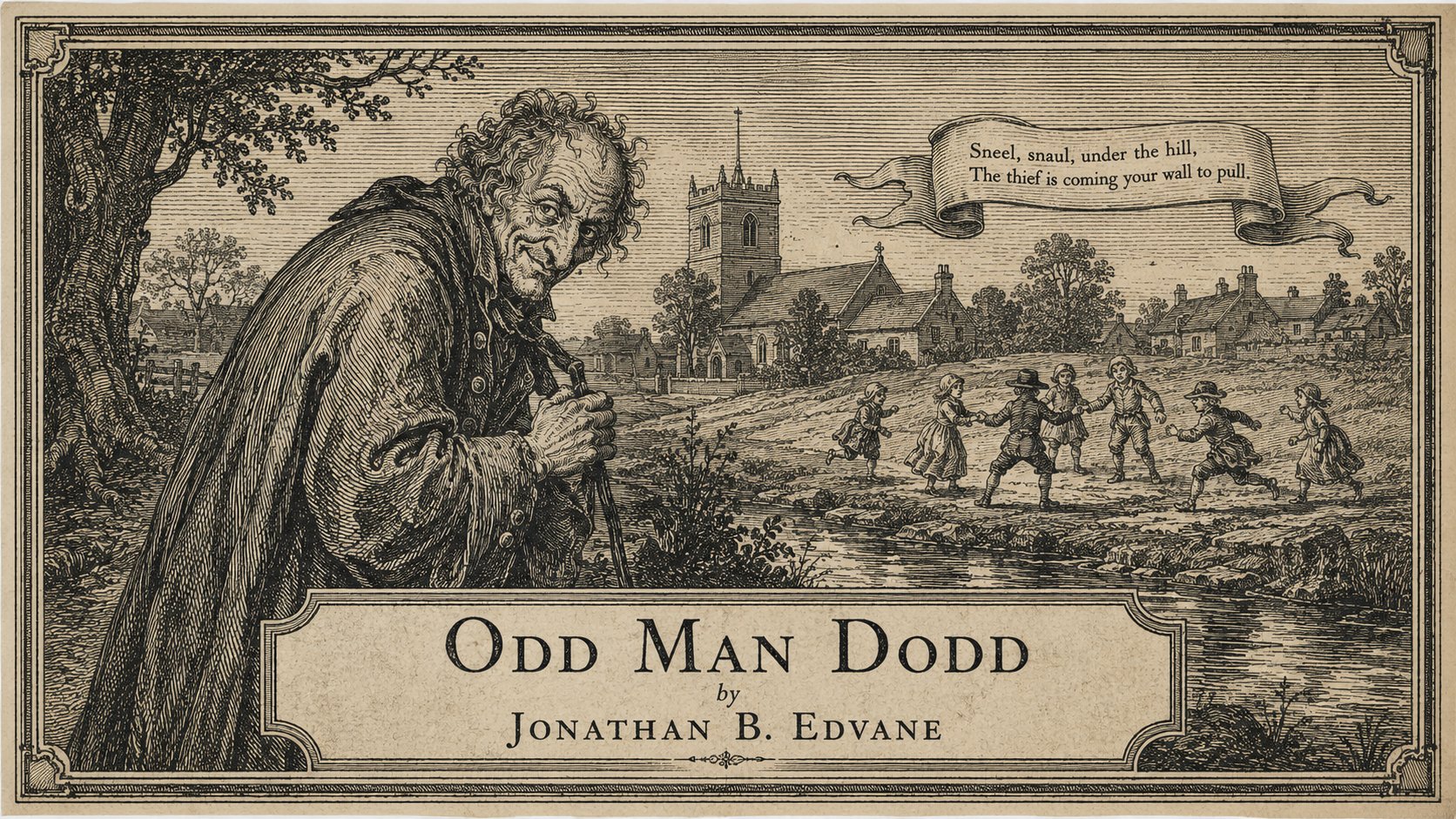
In G. F. Northall’s English Folk-Rhymes, published in 1892, there is an entry on the snail. Children across the English counties addressed it by many names. In Essex and Suffolk it was the Dodman or the Odmandod. They held it to candle flames and chanted verses at it, and when they crushed it, they played a game. “I’ve killed a man!” one would cry. “What sort of man?” the others asked. “A Dodman.” Northall recorded the words. He did not record what the children had forgotten, or what the rhyme had once been for. This story answers that.
I was born in Ruyton of the Eleven Towns when the old century still had some years to spend, and I have lived long enough since to see men forget what once kept them from sleeping. The parish was only one place to the mapmaker and the taxman. To those of us within it, it was eleven small worlds joined by narrow lanes, grudges, marriages and the River Perry, which passed through them all without caring where one township ended and the next began.
I learned my mother’s work young. By the time I was twenty, I was carrying the bag myself, and there was no cottage in any of the eleven townships whose door had not opened for me at some dark hour. A midwife belongs to the whole parish. She cannot choose which lane she walks or whose trouble she enters. That is how I came to know so much of what I am about to tell, and why my silence afterwards was not the silence of a woman who would not have been heard.
Each place had its own temper. Some were open country with cottages set far apart, some gathered themselves around a farm, a mill or an alehouse, and some seemed no more than a name given to fields so that men might quarrel over which parish owned the road. Yet all bent, in one fashion or another, towards the ruined castle at Ruyton. Its walls had been broken for centuries. No lord looked down from them, and no garrison kept order. The stones stood above were just the fragile remains of a forgotten command.
Custom governed where law did not, and silence governed where custom failed.
It was the children who named him Odd Man Dodd. I never heard a grown person call him so to his face, though I heard the name often enough behind doors. His true name had already gone missing by the time I was old enough to notice him. He kept a simple dwelling beside the Perry, built so close to the bank that every flood seemed likely to carry it off. Even in dry weather it looked temporary, with its dark roof pressed down among the willow and alder, and its door turned away from the lane. No smoke rose from it regularly. No tools hung outside. Nobody could say what trade he followed.
“He lives by finding what others lose,” one boy told me.
“No. He lives by knowing where they hid it,” said another.
Dodd walked between the townships at hours that belonged to neither labour nor worship. I saw him before dawn on the Shelvock road, at noon beneath the trees beyond Wykey, and once near Eardiston when honest men had long been in bed. I watched him more closely than I have ever admitted.
The children had a game about him even then, though they had not yet found all the words. I heard them begin it.
I said nothing.
◆ ◆ ◆
The first death was in Shelvock, though nobody understood it as a first death when it happened. Mistress Hannah Darby had been ill for so long that her illness no longer seemed like an event. Once she had kept hens and taken in mending, but by the winter of 1787 the birds were gone, the garden had risen into nettles, and her shutters stayed closed even on mornings when sunlight lay across every other window in the lane.
The people of Shelvock said they had done what they could. There was enough honesty in this to protect them from the bigger truth. Broth had been sent once or twice. A girl had carried kindling to the door until her mother decided that the sickness might travel home upon her clothes. The churchwardens spoke after service of arranging proper attendance, and when one asked what proper attendance might cost, the conversation passed swiftly to the church roof. I had attended her twice that autumn when the coughing worsened, though there was nothing in my bag for what ailed her. A midwife is called for beginnings, but in a parish too mean to keep a surgeon, she is called for endings too.
Her nearest neighbour, Thomas Powell, was some distant kin and expected to have the cottage when she died. He denied this expectation whenever it was mentioned, though his wife had already decided that the back room would take their eldest boy.
“I go when she has need of me,” Powell said one evening in the alehouse.
“She has need of someone every day,” I told him.
He considered this over his cup before answering that Mistress Darby slept through most visits and became fretful when disturbed. “There is no charity in troubling the dying merely to be seen beside them.”
It was a fine defence from a man who was frequently seen beside her door and seldom within it.
Dodd went inside regularly.
His visits began without anyone remembering when they had begun. He brought bread beneath his coat, onions and turnips in a sack, and sometimes a little meat tied in paper. Once I saw him carrying a dark glass bottle, though when the baker’s wife asked what medicine it held, he told her only, “The sort that does not cure.”
She laughed because she supposed he had made a joke, but Dodd did not laugh with her.
Nobody objected to his attendance. Indeed, people found comfort in it. Each visit he made excused one they had not made themselves, and the stranger his charity appeared, the more warmly they praised him for it. “There is goodness in every man somewhere,” the baker’s wife declared, and Powell agreed that Dodd had proved more Christian than many who made a show of kneeling on Sundays.
I watched him leave Mistress Darby’s cottage one wet evening when the rain had weakened to a grey drizzle over the fields. The door remained open behind him, and from within came the old woman’s voice, too faint for me to distinguish anything more than the familiar sound of weariness.
“You have eaten,” Dodd told her.
She answered something.
“No,” he said. “Enough is enough whether it be food or suffering.”
There was another murmur, and this time he bent towards the darkness of the room. Whatever she asked him caused him to remain still for several moments. At last he said, “There is no shame in wanting quiet.”
He drew the door closed when he came away. I stepped back behind the hedge before he could see me, though I have never known whether I hid quickly enough. He paused in the lane and looked towards where I stood. Then he turned for the river.
That was the only time I considered following him, but I found a reason not to.
Mistress Darby died three mornings later.
Powell discovered her beneath the blankets with her hands laid neatly upon her breast. Nothing in the cottage had been overturned. There was no wound upon her and no expression of distress remaining on her face. I was sent for to lay her out. The hands had been placed. The blankets had been drawn straight. I have prepared the dead often enough to know the difference between a body that has settled and a body that has been arranged. The parish decided that she had passed peacefully, and the word travelled so readily that by evening it had almost become the testimony of those who had watched her die.
At the burial the rector spoke of release and the mercy of the Lord. Powell stood with his hat lowered while his wife pressed a handkerchief to her dry eyes. When the service ended, someone said, “Poor soul, it is better so,” and another replied that no Christian could have wished her suffering prolonged.
I looked at those gathered around the grave and saw relief moving among them. They were not pleased that she was dead. I will allow them that. Yet their shoulders had loosened. The matter of who should feed her, who should sit with her and whether the parish must pay for her care had been resolved without expense or quarrel. Before the last earth had been levelled, Powell was asking a churchwarden whether any objection could be made to his taking possession.
“She would not have wanted strangers in it,” he said.
Within the week his wife had washed the windows, cut down the nettles and moved Mistress Darby’s chair into the yard because she disliked its smell.
I told myself that old women died. That long illnesses ended and that a man who brought food to a lonely woman should not be suspected merely because the rest of us had neglected her. Dodd’s words at the door might have been comfort. The bottle might have held cordial. The neatness of the bed might have been Mistress Darby’s own habit or Powell’s arrangement after finding her. Each explanation was possible, after all.
A few days later I heard the children of Shelvock beside the ditch. They had scratched a circle in the mud and were leaping across it while one boy crouched at the centre with both hands over his head. As they jumped, they sang:
“Sneel, snaul, under the hill, The thief is coming your wall to pull.”
One of them stumbled, and the others shrieked that Dodd had caught him. When I asked what the verse meant, a little girl stared at me as though meaning were a foolish thing to demand of a rhyme.
“It means he is coming,” she said.
“Who taught it to you?”
She glanced at the others. A larger boy answered that nobody had taught them. They had heard it, that was all.
“Where?”
He pointed towards the hill, then changed his mind and pointed towards the river. The children laughed and began the verse again before I could question them further. There was no proof in their song. No accusation a constable would hear. No honest man could condemn another because children had found new nonsense for an old game. By then Thomas Powell was eating his supper in Mistress Darby’s cottage, and all Shelvock had agreed that her death was merciful.
I said nothing.
◆ ◆ ◆
The second death was in Eardiston, and there was less pretence of sorrow.
John Meredith owned three cottages, two strips of meadow and enough of the lane beside them to make every tenant feel he crossed Meredith’s ground by permission. He raised rents after poor harvests, charged for repairs he never made and kept a tally of debts so small that payment seemed always possible and forgiveness therefore unnecessary. When Widow Corbett lost a pig, he took her winter coal in settlement. When Humphrey Jones’ youngest broke an arm falling through Meredith’s rotten loft, Meredith demanded compensation for the damaged boards.
Men wished him dead in the alehouse and did not mind who heard it.
“One morning we shall wake and find the Devil has collected his own,” Jones said.
Meredith, who had entered unheard, replied that the Devil would need to clear the arrears first. That was the sort of man he was. Even hatred pleased him if it proved his power.
I was in Eardiston through much of that month. Anne Humphreys was near her time, and the child sat awkwardly. I slept two nights in her cottage waiting for the labour to begin, and walked the lanes between visits when the waiting grew restless.
I had seen Dodd in Eardiston twice during the weeks after Mistress Darby’s burial. Once he stood beside the well while Meredith crossed the lane, and though neither man spoke, Meredith slowed and looked back after passing him. The second time Dodd sat outside the alehouse near dusk. He drank nothing. He only listened while Meredith’s name moved through the room.
Jones said Meredith had threatened to turn his family out. Someone answered that a landlord who did such a thing deserved to be found in a ditch. Dodd lifted his head then and asked, “Found dead, or merely left there?”
The room laughed. Jones told him either would serve, provided the ditch was deep.
Meredith was discovered three mornings later where the lane veered towards his upper meadow. His skull had struck a boundary stone, and one side of his face lay pressed into the mud. There was a wound beneath his ear and blood upon the grass, though less than people later remembered. His coat smelled of spirits. By breakfast, Eardiston had agreed that he had fallen while drunk.
The conclusion came before the examination.
“He walked that lane every night,” said the constable.
“Not straight either,” Jones added.
Another man remarked that frost had hardened the ruts, though there had been no frost. Nobody corrected him. Each person contributed some small piece until accident stood among them fully dressed.
Then Evan Atcherley said he had seen Dodd near the meadow after midnight and the room changed. Atcherley had spoken without calculation. He seemed surprised by the silence that followed and tried to soften the matter by adding that Dodd walked everywhere at strange hours. The constable looked towards Jones, Jones looked into his cup, and the landlord’s steward said there was no law against using a parish road.
“Did you see him with Meredith?” I asked.
Atcherley shook his head. “I saw a man by the hedge. It may not have been him.”
“You said it was.”
“I said it looked like him.”
That was enough for everyone, and I knew then, or believed I knew. Two deaths in two townships, with Dodd beside each before the parish found reason to be grateful. Yet knowledge is a demanding word. I had not seen him enter Meredith’s lane with a weapon. I had not watched him strike the blow. A despised man had fallen in darkness after drinking, and those who called it accident could point to every part of the tale except the hand that arranged it.
More than this, Meredith was dead, and the world did seem lighter.
Widow Corbett recovered her coal from his shed. Jones remained in his cottage. Men who had bent their heads when Meredith passed now stood upright in the lane. I found that justice, when it arrives without authority, resembles murder closely enough that a man may choose the name he prefers.
I chose justice.
The children had gathered beside the cornfield when I next heard them. They marched between the cut stalks, each carrying a stick like a sickle, and sang the Shelvock verse before adding another:
“Snarley-horn, put out your corn, The blades are sharp at four in the morn.”
A boy swept his stick across another child’s legs, and the fallen child lay still until the rest had counted to four. Then he rose laughing.
“What is a Snarley-horn?” I asked.
They told me it was the thing that came before Dodd. One said it sharpened his knife. Another insisted it was Dodd’s own horn growing from his head. Their explanations contradicted one another yet satisfied them completely.
The first verse had warned that something was coming. This one promised what it would do.
After Mistress Darby, I had said nothing because I was uncertain. After John Meredith, I said nothing because I was glad.
That distinction troubled me less then than it does now.
◆ ◆ ◆
The third death was in Wykey, though death is perhaps too certain a word for what we found there. There was no body in a lane, nor bed prepared for burial, nor blood for men to examine and explain away. There was only an absence, and because the person absent had been little regarded in life, even that took several days to become visible.
Her name was Sarah Benthall. She lived near the edge of the township and earned what she could by washing linen, gathering fallen wood and helping at harvest when stronger hands were wanted elsewhere. She had no husband, no children and no kin near enough to be troubled by her. People knew her face without knowing much that had ever passed behind it.
“She keeps herself to herself,” they said, which is often the praise given to those whose loneliness suits everyone around them.
I had delivered no child of hers. I had never been called to her door. In a parish where I had entered nearly every household, Sarah Benthall’s was one I could have passed without knowing a woman lived there.
Sarah attended church when the weather allowed and stood at the back without joining the groups that formed afterwards. She spoke quietly, paid what she owed and asked for little. Had she been cruel, troublesome or visibly wretched, Wykey might have found a place for her in its conversation. She was none of these things. She was merely present, and then she was not.
The first person to notice was a farmer’s wife waiting for linen that had been taken away three days before. She sent her daughter to Sarah’s house, and the girl returned saying the door was shut. The mother waited another day before going herself. She knocked, called through the window and complained aloud that Sarah had never before been so careless.
When the door was forced, the house was empty.
The bed had been slept in. A cup stood beside the cold hearth, and a little bread had hardened upon the table. Her shoes were gone, but her cloak remained on its peg. There was no sign that she had packed or intended to travel. The money she kept in a jar beneath the flour bin had not been touched.
The constable walked through the rooms and said, “She must have gone out.”
“Without her cloak?” I asked.
“It was mild enough.”
It had rained for two nights and the lanes were deep in mud, but nobody corrected him. A search was made along the Perry and through the nearby fields, though it had the quality of an obligation already expected to fail. Men called her name for an hour, then returned to their work. The river was dragged in one place where the bank fell steeply, and nothing was found.
Someone suggested she had gone to Oswestry. Another remembered hearing that she had relations in Wales, though nobody could name them. By evening, every explanation required less effort than admitting that a woman could vanish from among us without being seen.
I asked whether Dodd had been in Wykey.
No one recalled him.
This disturbed me more than if three witnesses had placed him at Sarah’s door. In Shelvock I had watched him tend the dying woman. In Eardiston he had been seen near Meredith’s lane. Here there was nothing because nobody had watched Sarah closely enough to notice who came near her. Dodd might have entered by daylight, shared her fire and left with her beside him, and the township would have carried on around them.
One woman objected that Sarah would not have trusted him.
“How do you know who she trusted?” I asked.
The woman looked offended, then uncertain. “She never spoke of him.”
“She never spoke of much to any of us.”
That ended the conversation.
Days passed. The washing remained unfinished. The farmer’s wife complained of the inconvenience before remembering to lower her voice. Sarah’s house was secured, then left standing. No burial followed because there was nothing to bury, and without a grave the parish found it difficult to perform grief. Her name dropped from speech with remarkable ease.
It was then that I understood the difference between the first two deaths and the third. Mistress Darby had been allowed to die because her death looked merciful. Meredith had been allowed to die because his death looked just. Sarah Benthall had been taken because no one had valued her enough to require an appearance at all.
The children were playing near the Wykey road when I heard the final verse. They had dug shallow hollows in the dirt and lay within them while one child walked between, stooped beneath an invisible burden.
“Father and mother are cold in bed, And the Dodman hides his heavy head.”
They sang all three verses then, one after another, with no pause between what had been learned in Shelvock, what had been added in Eardiston and what now belonged to Wykey. The rhyme sounded older than any child present. It sounded inherited.
I asked who had taught them the last words. A boy said they had always been part of the game.
They had not.
I knew that, and I knew something else besides. I had watched Dodd after the first death and suspected him after the second. By the third, I understood what manner of silence we had made around him.
I said nothing.
◆ ◆ ◆
Dodd was gone before winter.
No one saw him leave Ruyton. No cart came for his belongings, no neighbour heard a farewell, and no body was taken from the Perry. One morning there was no smoke above his dwelling, and by the next week people had begun speaking of him in the past tense.
His house stood empty beside the river.
For a time the parish waited, though for what none could have said. The churchwardens discussed whether the place should be searched, then decided that nothing there belonged to the parish. A farmer considered taking the timber but changed his mind after finding the door open and mud across the floor.
“There was something inside,” he said.
“What thing?”
He could not answer. He only repeated that something had been there before him and had left by the back wall, though the back wall had no door.
After that nobody touched the ramshackle cottage.
Bramble rose around it. Ivy entered beneath the roof and drew the tiles down one by one. The river took part of the bank, then left silt against the lower stones until the house seemed to have settled deeper into the earth. Within a few years the roof had folded, and the walls were green. Travellers passed without seeing that a man had ever lived there.
We saw it, but we chose not to look.
That is what age has taught me about Ruyton of the Eleven Towns. We were not ignorant. We did not possess proof, but proof was not what held our tongues. We knew enough. Three deaths in three townships, one man moving between them, and each silence made easier by the life that had ended.
Mistress Darby’s death spared us duty. Meredith’s spared us fear. Sarah Benthall’s spared us nothing because we had never given her enough place among us for her loss to cost anything.
I have turned the matter in my hands for forty years. I have told myself I lacked proof, the parish would not have listened, that three deaths, separately considered, did not demand one voice raised against them. Each time I have told myself these things, I have believed them a little less and needed them a little more.
I watch the children from the churchyard wall and think that if I had spoken after Shelvock, Meredith might have lived. If I had spoken after Eardiston, Sarah Benthall might still be washing linen for the farmer’s wife in Wykey. These are not certainties. They are the kind of thoughts that keep an old woman from sleeping and serve no one at all.
I called it vigilance. I know now what it was. It was the comfort of watching things happen to others and telling yourself that watching was enough. It was never enough. I have stood in rooms where women died bringing children into the world, and I have never once called that watching. I knew what it meant to act and what it cost to be too late. I had no such defence in the matter of Dodd. I was not too late. I was too willing to wait.
The rhyme will remain. The game will remain. Children yet unborn will repeat what we refused to say aloud. They will carry the name of a man the parish would not accuse, in a song the parish pretends it never made, and they will not know they are doing the only honest thing Ruyton of the Eleven Towns has ever done.
I do not ask forgiveness. I would not trust it if it came.
The children still play outside St John the Baptist, scratching lines in the dirt where the churchyard wall casts its shadow. One calls, “I’ve killed a man.”
The others answer, “What sort of man?”
“An Odmandod.”
Then they run, shrieking, while one of them stoops and follows with his head hanging heavily between his shoulders.
They do not know whose name they carry.

I welcome polite comments. If you enjoyed this tale, you might also enjoy Shall I Come Away?
Leave a Reply