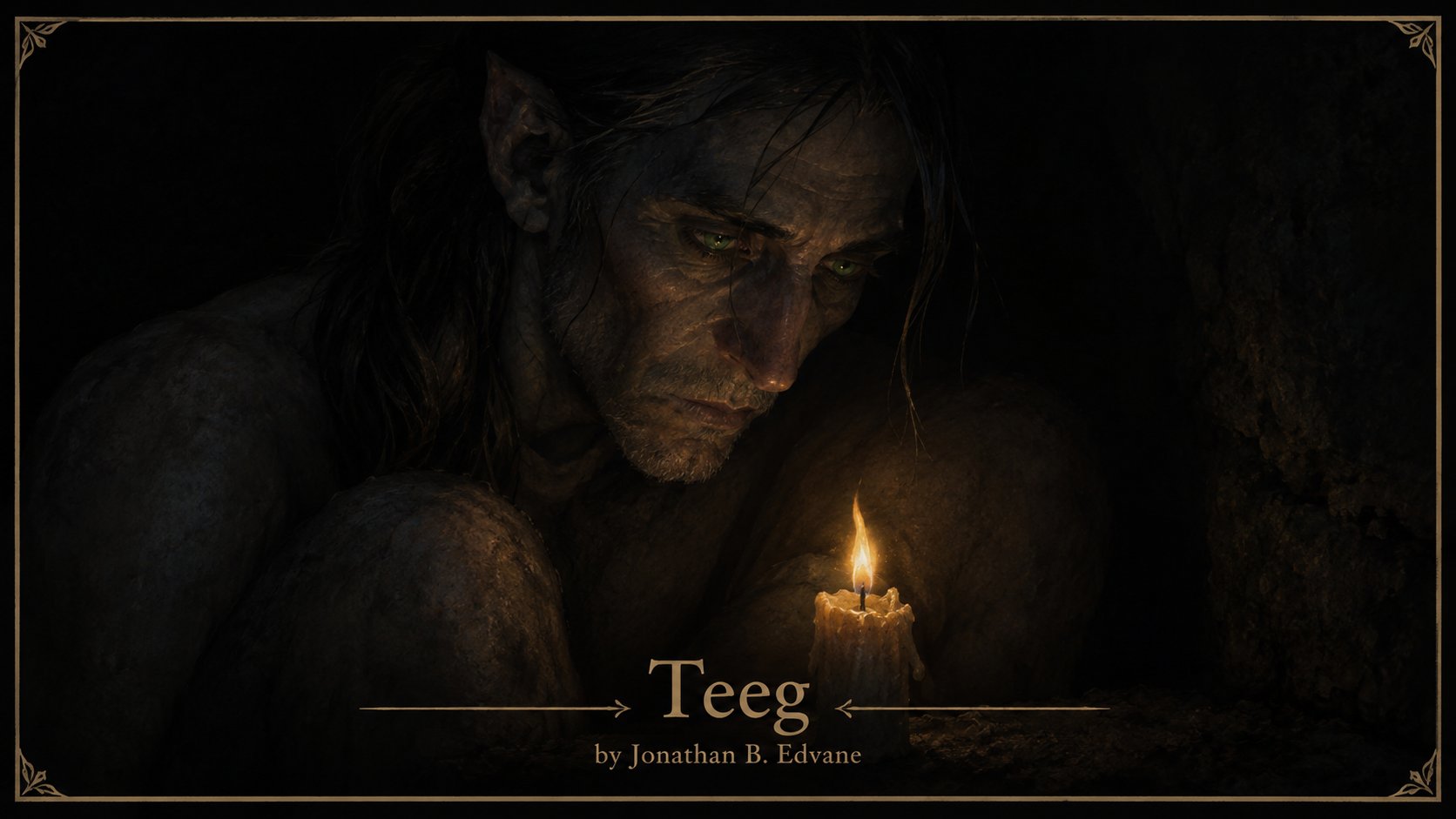
The candle had begun to weep.
A thick bead of wax clung to its side, swelling slowly before surrendering to its own weight and sliding down towards the little mound gathering around the base. Teeg watched its progress with considerable distaste. When it reached the stone, he grunted and drew his knees closer to his chest.
“Wasteful,” he muttered. “Perfectly good candle, and half of it running away.”
His voice travelled a little way into the darkness before the Echomaw swallowed it. There was no answering echo, despite the name, and this was one of the many indignities of the place on which Teeg had recently formed some strong opinions. Somewhere beyond the reach of the light, water dripped intermittently from the roof. He had once attempted to count them, but their intervals were so irregular that he had abandoned the exercise in disgust.
The damp was worse than the darkness. It inhabited everything, creeping through his skin until even his bones seemed to have acquired a disagreeable chill. His loincloth clung unpleasantly to his thighs, and the stone beneath him remained wet however often he changed his position.
“Fine accommodation,” he remarked. “I have slept in the hollow of a dead bramblehog with greater comfort than this. And that had fleas. Enormous things. One of them took a fancy to my ear.”
He chuckled, and the candlelight reflected from a mouthful of small, uneven teeth.
Leaning forward, he examined the flame. Its light illuminated his striking green eyes, making them appear almost luminous beneath the heavy folds of his brow. His face was narrow and withered, its skin drawn tightly across the bones, while his long fingers resembled the roots of some ancient tree. Only his hair seemed to have resisted the general ruin of his appearance. It remained glossy and brown, drawn backwards into a neat ponytail which he occasionally touched with a vanity quite at odds with his circumstances.
He extended one finger towards the candle, hesitated, and withdrew it. “No. Best leave you alone.”
He listened to the water and the faint, moist movement of his own breathing. “My father would have found this very amusing.” The thought appeared to improve his spirits. “Yent was a patient creature. Wonderfully patient. He could sit for an entire afternoon watching the silverwings gather beneath the orchard trees and consider the experience a day well spent. Imagine! An afternoon! Sitting!”
Teeg shook his head, although his smile suggested a fondness that survived the ridicule.
“He used to tell me that the world had room enough for every creature to accomplish something remarkable, provided he did not spend his life trying to accomplish it before supper. I never understood what supper had to do with anything.”
He remembered the gardens of his childhood, where trees grew in immense, sweeping terraces and waterways shone so brightly beneath the morning sun that one could scarcely distinguish their reflections from the sky. Beyond them lay the Vale of Issen, divided by a tremendous gorge whose opposite sides were joined by nothing more substantial than the flight of birds.
Upon the furthest bank grew a solitary bellfruit tree.
“It bore seven fruits each season,” Teeg explained, raising a finger. “Golden as a king’s breakfast and sweeter than anything you have ever tasted. The trouble was getting one. Everyone had tried. Climbers, gliders, those ridiculous fellows who fancied themselves engineers. All failures. One lost his wings, another his dignity, and a third went over the edge with a contraption so elaborate that we were still finding pieces of it the following spring.”
Teeg smiled broadly.
“Naturally, I was determined to succeed.”
His scheme had been ingenious, or so he maintained. With the assistance of a young acquaintance named Pel, he constructed a launching mechanism from woven vine and a wooden spindle, intending to propel himself across the gorge before the line became taut.
“Like a stone from a sling, you see. Beautifully simple. Pel thought it dangerous, naturally, but Pel thought drinking cold water was dangerous.”
The launch had been magnificent. Teeg remembered the rush of air against his face, the astonished cries of the spectators and the extraordinary sensation of sailing above an emptiness that had defeated generations. He reached the opposite bank, climbed the bellfruit tree and returned with three golden fruits.
“Three!” he exclaimed, almost rising from the stone. “Not one, mark you. Three!” He laughed, his shoulders trembling with pleasure.
Unfortunately, the spindle had shattered during his return. Pel, who had been operating the mechanism, was dragged towards the gorge and escaped only by catching hold of an exposed root. He lost two fingers in the process.
Teeg’s smile diminished a little.
“A regrettable business. Though I maintain that Pel should have released the handle sooner. He was always slow to recognise when a situation had become too challenging.”
Yent had been furious. Teeg could still hear his father’s voice demanding whether three bellfruits justified another creature’s mutilation.
“And I told him that the number of fruits was immaterial. It was the principle of the thing. The achievement. The demonstration that a difficulty need not remain a difficulty merely because everyone else has agreed to leave it alone.”
He considered this argument with evident satisfaction.
“Father said that being clever was a gift, but making other creatures pay for it was a disgrace.”
The words lingered in the damp air. Teeg rubbed his thumb across the knuckles of his opposite hand.
“He said many things of that sort.”
A drop of water struck somewhere behind him. The sudden sound made him turn, though nothing showed beyond the small circumference of candlelight.
“I wonder what became of his silver clasp,” he murmured. “The one with the blue stone. He wore it every day. I should have liked to have kept that.”
He looked towards the flame. Wax had gathered unevenly around the wick now, and a black curl of burnt thread leaned across its tip. Teeg shifted closer, arranging himself so that his shadow fell away from the candle rather than across it. Beyond his knees, the floor vanished into darkness.
“Of course,” he said, recovering a little of his former brightness, “Father was not the only creature who mistook caution for wisdom. There was Yatiz, for instance. Now there was a fellow who could turn the simplest question into an afternoon of perfectly useless conversation.”
He tucked his ponytail over one shoulder and settled himself upon the wet stone.
“A mystic, he called himself. Wasn’t what I called him.”
༺ ❦ ༻
“Yatiz,” Teeg repeated, savouring the name with distaste. “He believed that wisdom was best measured by how long a creature could speak without saying anything useful. An extraordinary talent, and one he practised upon me at every opportunity.”
He scratched at his shoulder, where the damp had irritated a fold of skin, and shifted his weight upon the stone. The candle had shortened perceptibly. Wax had set into hardened ridges around its base, while the flame occasionally inclined to one side before recovering its upright posture. Teeg watched this behaviour for a moment, then carefully moved his knees away from the little pool of light.
“You must understand that I was rather fond of the old fraud. Everyone was. He knew things, you see. Wonderful things. Where the silverwings went when winter came, why the waters of Ismar ran uphill beneath the full moon, and what lay beyond the mountains where even the cloud shepherds refused to venture. The difficulty was persuading him to part with any of it.”
Teeg smiled at the recollection.
Yatiz had lived in a dwelling grown from the intertwined roots of an enormous flowering tree. Its chambers were hung with crystalline vessels containing peculiar liquids, while the upper branches supported platforms from which the mystic observed the heavens. Teeg had spent many pleasurable afternoons there, generally without invitation, examining objects he had been forbidden to touch and troubling his host with questions.
“He once told me that the answer to every question could be found in the question itself. I asked him where he kept his money. That rather put an end to the conversation.”
His laughter rang briefly through the place.
It had been during one such visit that Teeg first questioned Yatiz concerning the Dharmug. He had heard their name spoken in several places, always with a curious reluctance, and had become fascinated by the lands they were said to inhabit. Beyond the eastern reaches of his homeland stood a succession of dark mountains, beyond which lay territories seldom visited and still less frequently described.
“Now, I had travelled further than most. There were very few places I had not seen, and those I had not were generally places somebody had taken great pains to prevent me from seeing. Naturally, this made them particularly attractive.”
He remembered asking Yatiz what manner of creatures the Dharmug might be, and receiving an answer so evasive that he immediately suspected the mystic of concealing something important.
“‘There are those whose dominion is not yours to comprehend.’ Imagine saying that to someone who had crossed the Vale of Issen! I informed him that comprehension was precisely what I intended to achieve.”
Yatiz had regarded him for a considerable time before asking why he wished to know.
Teeg had explained that a boundary was merely an invitation to discover what lay beyond it. His host disagreed. Some boundaries, he insisted, existed not for the protection of those who dwelt within them, but for the protection of everyone else.
“A very theatrical pronouncement,” Teeg observed. “I asked whether these Dharmug were imprisoned, in which case I could scarcely see why anyone should fear them, or whether we were forbidden to enter their country, in which case I wished to know who had forbidden it and by what authority.”
The mystic had offered no satisfactory answer. Instead, he spoke of obligations, of powers whose exercise demanded restraint, and of consequences that could not be recalled merely because their author had meant no harm.
Teeg frowned.
“He became rather tiresome about consequences. As though the world were some delicate ornament that must never be handled for fear of dulling its sheen.”
A cold drop struck the back of his neck.
He recoiled with a sharp cry, clapping one hand against the wet skin. For several moments he sat glaring upwards, though the ceiling remained invisible. Then he wiped his fingers against his loincloth and examined the candle. The flame had wavered when he moved, and he leaned towards it with such sudden alarm that his ponytail whipped forward over his shoulder.
“Steady,” he whispered.
The flame straightened.
Teeg remained motionless until he was satisfied, then withdrew his hands into his lap. “Where was I? Ah, yes. Yatiz.”
He had been preparing to leave when the mystic called him back. There was something peculiar about the old creature’s manner, a hesitancy quite unlike his customary confidence. He asked whether Teeg intended to make the journey alone.
“An odd question. I had mentioned no journey, only an interest in the territory. I told him I had not yet decided. He advised me to decide against it, which was rather like advising a fish to keep out of deeper water.”
Teeg’s expression darkened.
“Then he asked about Brig. Whether we were still companions. Whether we travelled together as often as before. At the time I assumed he was making conversation, although Yatiz had never shown the slightest talent for that.”
He rubbed his chin, considering the memory.
“Perhaps he thought Brig might talk sense into me. He was forever appealing to other creatures when he could make no impression upon me himself.”
The water continued its irregular dripping. Further away, somewhere beyond the small reach of the candle, there came a small, prolonged trickle, as though moisture were finding its way through a narrow fissure.
Teeg listened until it ceased.
“I did ask him one final question,” he said. “I asked what would happen if I crossed the boundary and discovered that all his warnings amounted to nothing.”
He remembered Yatiz looking suddenly weary.
“‘Then you will have been fortunate,’ he said. ‘But fortune is not the same as wisdom, Teeg, and there are mistakes from which no cleverness will deliver you.’”
For a moment Teeg seemed disposed to argue with the recollection. Instead, he gave a small, reluctant laugh.
“The infuriating thing is that I probably would not have listened if he had told me everything. I seldom did. Not when I had settled upon an idea.”
He glanced at the candle again. Its flame burned steadily, but the little wall of wax surrounding the wick had grown thin on one side, and another drop was preparing to descend.
Teeg watched it with mounting displeasure.
“I wonder whether he knew.”
The wax slipped down the candle. Teeg followed it with his eyes, his long fingers tightening around his knees. Then he shook himself.
“Still, what good is knowledge if one never puts it to use? Yatiz might have been content to sit beneath his flowering tree and grow old amongst his bottles, but I had rather more interesting things to occupy my time.”
His smile returned, though missing a little of its former conviction.
“And there was Challie, of course. Beautiful Challie. Now there was a girl who knew how to occupy a fellow’s thoughts.”
༺ ❦ ༻
“Challie,” Teeg said again, and a smile of quite another character settled upon his withered face. “Oh, she was a beautiful creature. Not that beauty was uncommon in my acquaintance, of course. I enjoyed rather more than my fair share of admiration in those days.”
He lifted his chin and smoothed a few stray strands of hair behind his ear. The movement drew him further into the candlelight, exposing the deep creases around his mouth and the loose skin gathered beneath his eyes.
“Not that anyone would believe it to look at me now.”
His smile faltered. For a moment he examined his long, knotted fingers, turning them over as though they belonged to someone else.
The candle was approaching half its original height, and the flame illuminated little more than Teeg’s immediate surroundings. Moisture glistened along a crack in the wall behind him. His shadow climbed the stone and disappeared above him into the blackness.
“Challie would have been quite horrified by all of this,” he continued. “She was particular about appearances. Not vain, exactly. She believed that a creature ought to take some pride in himself. Even when she was furious with me, she would stop to straighten my collar or brush something from my hair. A curious habit.”
He laughed softly.
“She once told me that I had the appearance of someone who had escaped from a very elegant disaster.”
It was during the Festival of Falling Stars that he first caught her attention. The gardens were crowded with revellers, and lanterns hung amongst the flowering branches, their reflections trembling across the waterways below. Teeg had entertained a gathering of admirers with an account of his expedition to the Vale of Issen, embellishing the more perilous moments sufficiently to provoke several gratifying expressions of astonishment.
“Challie listened for some time before asking whether Pel had enjoyed the adventure as much as I had. I told her that Pel had been rather unfortunate, and she replied that losing two fingers generally qualified as disastrous, even amongst the exceptionally stupid.”
Teeg chuckled at the memory.
“She had a wicked tongue. Wonderful thing. I decided there and then that I should like to know her better.”
Challie had proved considerably less susceptible to his charms than he anticipated. She laughed at his boasts, questioned his achievements and refused to accompany him on several excursions she considered unnecessarily dangerous. Yet she delighted in his company when he was not trying to impress her, and he gradually discovered the pleasure of sitting beside her without having anything remarkable to announce.
They wandered through gardens fragrant with night blossoms and watched the silver fish gathering beneath bridges. He remembered lying with her upon a grassy bank above the waters of Ismar, where the moon appeared so perfectly reflected that he had jokingly suggested they might reach it by swimming downwards.
“She told me that if I attempted it, she would wait until morning before deciding whether to rescue me. Said the peace and quiet might be worth the inconvenience.”
Teeg’s smile lingered.
For some while he said nothing. Water dripped steadily in the distance, and the damp air carried the unpleasant smell of mineral deposits and old, stagnant pools. A thin, wet stream began to creep toward the place where his foot rested. He drew it away, irritated by the intrusion, and pulled his knees up.
“She loved me,” he said at last. “I have never doubted that.”
His voice carried a note of defiance.
He recalled an evening shortly before his intended journey eastwards. Challie had found him examining charts and scraps of information collected from travellers, most of whom had never approached the dark mountains themselves. She recognised the country he was studying and asked whether he intended to seek the Dharmug.
“I told her that I intended nothing of the sort. I was merely satisfying an intellectual curiosity. She knew better, naturally. She generally did.”
Challie had asked him to abandon the undertaking. When he protested that he had made no arrangements, she pointed to the equipment gathered beside his travelling bag and observed that his intellectual curiosity appeared remarkably well provisioned.
Teeg smiled at her cleverness, though the recollection seemed to trouble him.
“She was frightened. I could see that. Not only anxious, as she had been over other adventures. Frightened in a way I had never seen before.”
He remembered taking her hands and promising not to cross the boundary Yatiz had described. Plenty of wonders lay to explore without trespassing on the territories of creatures who apparently resented visitors.
“And I meant to keep my promise,” he said.
He paused.
“Well, I meant to return. That was the important thing. Once I had returned, with whatever knowledge or treasure lay beyond those mountains, she would surely have forgiven me. I had always found that success was a remarkably effective cure for other people’s objections.”
He shifted uncomfortably, pressing his back against the cold wall. The stone yielded nothing to his weight, and yet more moisture seeped into the folds of his skin.
“She asked when I intended to leave. I told her I had not decided. Then she asked whether Brig would accompany me, and I said that he probably would, if I could persuade him.”
A faint frown gathered between Teeg’s eyes.
“I remember she looked away when I said that. Towards the garden, I think. There were birds singing. Such beautiful birds.”
He closed his eyes.
On another evening, long before their disagreement, Challie had found him asleep beneath one of the flowering trees. She had sat beside him until he woke, carefully removing the fallen petals from his hair. When he asked why she hadn’t disturbed him, she told him she liked to watch him when he was quiet, because then she could see the creature he might be if he didn’t feel constantly obliged to astonish the world.
Teeg swallowed.
“I thought that rather unkind at the time.”
The candle gave a sudden hiss. A fragment of blackened wick collapsed into the molten wax, and the flame dipped before recovering. Teeg’s eyes flew open. He scrambled forward, his fingers spread helplessly beside the candle, and remained crouched there until the little flame stood straight once more.
“Careful,” he whispered. “Oh, do be careful.”
He stayed beside it, breathing shallowly, and sat back at length.
“I should have listened to her,” he said quietly.
His gaze remained fixed upon the flame.
“Not because she was right about everything. She certainly wasn’t. But there are promises a fellow ought to keep, even when he has perfectly excellent reasons for breaking them.”
He rubbed his eyes with the heels of his hands, then pulled his ponytail over one shoulder and began untangling its ends.
“Brig, now. Brig would have understood the temptation. He always did. We had been companions since we were scarcely old enough to venture beyond the orchard walls, and there was not a dangerous place in all that beautiful country where the two of us had not contrived to find some trouble.”
He let out a small, affectionate laugh.
“Except, of course, the one place we should never have gone.”
༺ ❦ ༻
“Brig was a splendid fellow. Brave as a mountain boar and almost as stubborn, though I flatter myself that I possessed rather more imagination. He had a habit of looking at a difficulty and deciding whether it could be overcome. I preferred to overcome it first and consider the matter afterwards.”
Teeg laughed, but the sound emerged weakly from his throat. The candle had dwindled to a short stump, surrounded by a spreading crust of wax that had hardened in the crevices of the floor. Its light scarcely reached the wall opposite, and the rough stone above his head had long since vanished into darkness. A cold film of moisture covered his shoulders. He scratched at it irritably, then examined the flame, checking that his movement had not disturbed it.
“We were scarcely ever apart in those days. There was a time we sailed the upper reaches of the Ismar upon a raft made entirely of fallen blossoms. Beautiful things, those flowers, broad as dinner tables. Brig insisted they would sink once the petals became waterlogged, but we travelled for three days and nights before he was proved right. Quite an adventure getting home. Lost our provisions, of course. And my favourite hat. Brig nearly drowned trying to retrieve it, which was exceedingly decent of him.”
Teeg fell silent for a moment, rubbing his fingertips together.
“He was always doing things like that.”
It was Brig whom he had approached when his plans for the eastern mountains had finally taken shape. His friend had listened with unusual patience while Teeg described the route, the provisions they would require and the magnificent discoveries that undoubtedly awaited them. Yet instead of greeting the proposal with his customary enthusiasm, Brig had asked several questions about Yatiz and the warnings he had given.
“I told him what the old fool had said, or most of it. Brig wanted to know whether I had actually seen the boundary. I said I had not, which was rather the point of going. He then suggested that perhaps we ought to discover why the Dharmug disliked visitors before presenting ourselves at their doorstep.”
Teeg gave a contemptuous snort.
“As though they were likely to invite us in for refreshments and explain their peculiarities!”
Nevertheless, Brig had agreed to accompany him. Their journey carried them through the last inhabited valleys and into a country of extraordinary beauty. Teeg remembered the mountains rising against the morning sky, their summits shining, while beneath them lay forests of translucent leaves that chimed softly whenever the wind passed through their branches. Lakes were so clear that their depths seemed nearer than their surfaces, and strange white creatures moved among the distant trees without disturbing a single fallen leaf.
“Even Brig was impressed. We had seen wonders enough in our time, but this was something different. It was as though the world had been made afresh, with all of its ordinary blemishes carefully removed.”
They travelled for several days without encountering another living soul. The further they ventured, the less familiar the country became. Flowers grew in arrangements so regular that Teeg initially mistook them for cultivated gardens, although no paths or dwellings appeared among them. Streams divided and rejoined without apparent reason, and occasionally the two travellers found patches of bare earth where nothing grew, despite the abundance surrounding them.
“The silence troubled Brig. I remember that particularly. He said there ought to have been birds, insects, something making a noise. I told him that perhaps the creatures of that country possessed better manners than those at home.”
Teeg chuckled, then stopped. Somewhere beyond the candlelight, water was gathering in a hollow. He could hear its sluggish movement, followed by the faintest trickle as it escaped through some unseen opening. He listened until the sound subsided.
“We found the boundary on the fourth morning.”
It was not a wall, nor a river, nor any of the conventional obstacles Teeg had anticipated. Across a broad valley ran a narrow band of dark ground, extending between two distant hills. Nothing grew within it, and beyond it the beautiful landscape continued on.
“Brig wanted to turn back. Said we had gone far enough to satisfy any reasonable curiosity. I reminded him that reasonable curiosity had never revealed anything worth discovering.”
The two had argued. Teeg remembered his friend’s reluctance with irritation, though he admitted Brig had never shown such fear before. Eventually, he persuaded him to continue, insisting that they need only cross the barren strip and examine the country beyond before returning. At this point Teeg’s recollection became less certain.
“There were markings upon the ground. I thought them natural at first, but they were too regular. Great sweeping figures, all joined together. Yatiz had spoken of certain arrangements of lines, though I cannot remember precisely what he said about them.”
He rubbed his forehead, frowning.
“Brig told me not to touch anything. I remember that distinctly.”
Teeg had discovered a series of smooth stones embedded within the markings. Their arrangement suggested some intricate mechanism, and he had become convinced that moving one would reveal its purpose. Brig objected, but Teeg insisted that understanding the construction was the very reason for their journey.
“I shifted a stone. Only a little. It was scarcely the width of my thumb.”
He glanced towards the darkness beyond his knees.
“Something changed.”
For a long while he said nothing. His green eyes remained fixed upon the flame, whose light had begun to gutter unevenly against the rising edges of its own wax.
“I remember the silence,” he continued. “Everything seemed to stop. Even the wind amongst the leaves. Brig seized my arm and said we must leave immediately, but there was something I wanted to see. Something beneath the stone.”
His breathing became shallow.
“The Dharmug came. I do not know from where. I cannot remember their faces, if they had faces. Great confusion followed, and I heard Brig shouting my name. Then he was gone.”
Teeg stared into the darkness.
“I saw him running. I am certain of that. He crossed the boundary and disappeared into the trees, while I remained where I was. They took me, and he escaped.”
His voice hardened.
“He left me. Although,” he added reluctantly, “I suppose he had told me to run. Several times, perhaps. I was occupied with the stones, you see. I believed I had discovered something important.”
He looked down at his fingers.
“And he had always been quicker than me when it came to recognising danger.”
The candle shuddered. Teeg leaned towards it, his face contorted with apprehension, and held himself motionless until the flame recovered. When he spoke again, his voice was quieter.
“Brig knew which way to go. He did not hesitate. He seemed to know exactly where the boundary lay, even in all that confusion.”
Teeg considered this for some time.
“Perhaps he just kept his wits about him. He was good at that. A loyal friend, Brig. The best I ever had. Though I wonder why he came with me at all, when he had been so determined that we should never go.”
The thought remained with him as he lowered himself against the wet wall. The cold stone pressed into his narrow back, and the little candle lit only his knees, his hands, and the lower part of his face. Teeg ran it all through his mind again but couldn’t find another amusing incident with which to entertain himself.
༺ ❦ ༻
By now, the candle was little more than a wick embedded in a miserable puddle of wax. Its flame had sunk almost to the stone, and the light it gave was so feeble that Teeg could no longer see the wall against which he rested. He could feel it, though. Its cold had penetrated his back and shoulders, while the damp had settled into his joints with a persistence that made every movement uncomfortable. Somewhere above him, water collected and fell, though he could no longer tell where it struck. The sound appeared to come from everywhere and nowhere, and its irregular rhythm had begun to irritate him beyond endurance.
“Brig was a good friend,” he said at last, as though concluding an argument with someone who had challenged the assertion. “Whatever else may be said of him, he was a good friend. A little lacking in imagination, perhaps, but there are worse faults.”
He drew his knees closer and considered the small flame at his feet. It had acquired a faint blue colour near the base, and every so often the molten wax threatened to overwhelm it. Teeg watched these struggles with an anxiety he made no attempt to conceal.
“I remember the evening before we left. There was a gathering at Father’s house. Nothing unusual in that. Challie was there, of course, and Brig, and even old Yatiz had come down from his ridiculous tree to partake of the refreshments. I remember thinking what a pleasant evening it was, apart from everyone insisting upon discussing my affairs.”
The memory brought a reluctant smile. Yent had prepared a feast beneath the orchard branches, where lanterns hung amongst the silver leaves and the warm evening air carried the fragrance of ripening fruit. Challie had sat beside Teeg, occasionally squeezing his hand beneath the table, while Brig entertained the company with an account of their misadventures upon the Ismar. Even Yatiz had been amusing, though Teeg suspected that several of his jokes were borrowed from creatures with a better sense of humour.
“There was a great deal of concern about our journey. Father asked whether we had reconsidered, and Challie wanted to know whether I had sufficient provisions. Brig kept questioning the route, although we had discussed it a dozen times. I grew rather impatient with them all, naturally. One would have thought we were children venturing out of the orchard for the first time.”
Teeg scratched at his chin, his expression gradually changing.
“Yet there was something peculiar about it. I remember Challie asking whether we intended to approach the dark mountains from the southern valley. I had never told her about that valley. At least, I cannot remember telling her. It was one of several routes I had considered, and I had settled upon it only that morning.”
He thought it over for a time, then shook his head.
“She may have overheard me speaking to Brig. Yes, that must have been it.”
Yent had embraced him before the company departed, holding him rather longer than usual, while Yatiz had asked precisely when the travellers intended to cross the mountains. Teeg remembered answering irritably, explaining that their progress would depend on the weather and the condition of the paths. The mystic had persisted until Brig supplied an approximate day.
“An odd thing to insist upon, don’t you think? Yatiz had never shown much interest in the practical arrangements of my expeditions. Usually he contented himself with predicting disaster and looking pleased when something unfortunate occurred.”
Teeg shifted against the wall, disturbing a trickle of water that had collected beneath his thigh. He made an impatient sound and attempted to move away from it, but there was nowhere dry within the candlelight. For a moment he seemed ready to curse the Echomaw and everything within it. Instead, he resumed his recollection with increasing agitation.
“Brig knew where to go, though. When the Dharmug came, he ran directly towards the boundary. He did not search for it or stumble upon it. He knew. And when I think of the questions he asked that evening, and the way Yatiz watched him, I begin to wonder whether they had spoken together before our departure.”
The possibility was so offensive that he immediately rejected it. Brig had risked his life for him countless times, and Yent had never been anything but a loving father, however tiresome his advice. As for Challie, the very notion that she might have participated in some deception was intolerable. She had loved him with a tenderness he had never deserved, and he had loved her in return. Whatever suspicions arose from his memories, that much remained certain.
Yet certainty was proving difficult to preserve.
“Suppose they knew,” he murmured. “Suppose they had discovered something about the Dharmug that I had not. They might have wished to protect me. They might even have arranged for Brig to accompany me so that I should not face the danger alone.”
He considered this explanation with evident relief, though it offered no account of his companion’s extraordinary escape. Nor could he reconcile it with the uncomfortable recollection of Yatiz’s questions. If they had known the journey would end in disaster, why had they allowed him to undertake it?
A more dreadful possibility began to form.
“Unless,” he whispered, “they wished me to go.”
Teeg stared into the flame. Had Brig known what would happen? Had he accompanied Teeg not to share an adventure, but to ensure that he reached the appointed place?
“No. Father would never have permitted it. Challie would never have agreed. Not unless they believed there was some necessity greater than my safety.”
He found himself recalling Yatiz’s warning about boundaries established for the protection of others. At the time, he had assumed the mystic meant the dangers concealed within the Dharmug’s territory. What if he had meant something altogether different? What if the danger was not what Teeg might encounter, but what he might accomplish?
The thought appalled him. He had been reckless, certainly, and occasionally inconsiderate, but he had never intended to harm anyone. Even Pel’s unfortunate accident had been precisely that, an accident. Surely those who loved him understood the difference between mischief and wickedness.
He began speaking rapidly, defending himself against accusations nobody had made, until the effort exhausted him. His voice dwindled into an indistinct muttering, and he sat with his head bowed, listening to the dripping.
After a while, he remembered Challie beneath the flowering tree, gently removing petals from his hair while he slept. He could almost feel the softness of her fingers and hear her quiet laughter when he awoke. She had told him that she liked to watch him when he was still, when he was not striving to astonish everyone around him. He had thought her unkind, but now he understood that she had seen something in him which he had never troubled to recognise.
“Perhaps she wanted to save me from myself,” he whispered.
The thought brought little comfort. If Challie had participated in his capture, he could neither forgive her nor persuade himself that her affection had been false. He remembered the warmth of her hand beneath the table on that final evening and wondered whether she had already known he would never return.
The candle hissed.
Teeg looked down in sudden terror. The wick had bent into the molten wax, and the flame was struggling to stay alight. He crouched beside it, his green eyes reflecting its feeble glow, and extended his fingers as though he might somehow shield it from the darkness now closing in.
“Please,” he whispered. “Not yet.”
The flame recovered briefly, rising into a narrow yellow tongue that illuminated his face and the wet stone beneath him. Teeg remained motionless, scarcely daring to breathe. His thoughts had deserted the gardens, the mountains and the terrible possibility of betrayal. There was only the candle now, and the diminishing circle of light within which he had endured so long.
The voices of Yent, Brig and Challie seemed terribly distant, and he struggled to remember the sound of laughter beneath the orchard trees. For one desperate moment he wished that he had remained there, content with his father’s company and the modest pleasures of an ordinary life.
The wick collapsed. A tiny blue flame trembled upon the surface of the wax, contracted, and disappeared.
Silence followed.
Then, from somewhere within the absolute darkness, came Teeg’s frightened voice.
“What? Who’s there?”
I welcome polite comments. If you enjoyed this tale, you may also enjoy Night of the Broken Oath
Leave a Reply