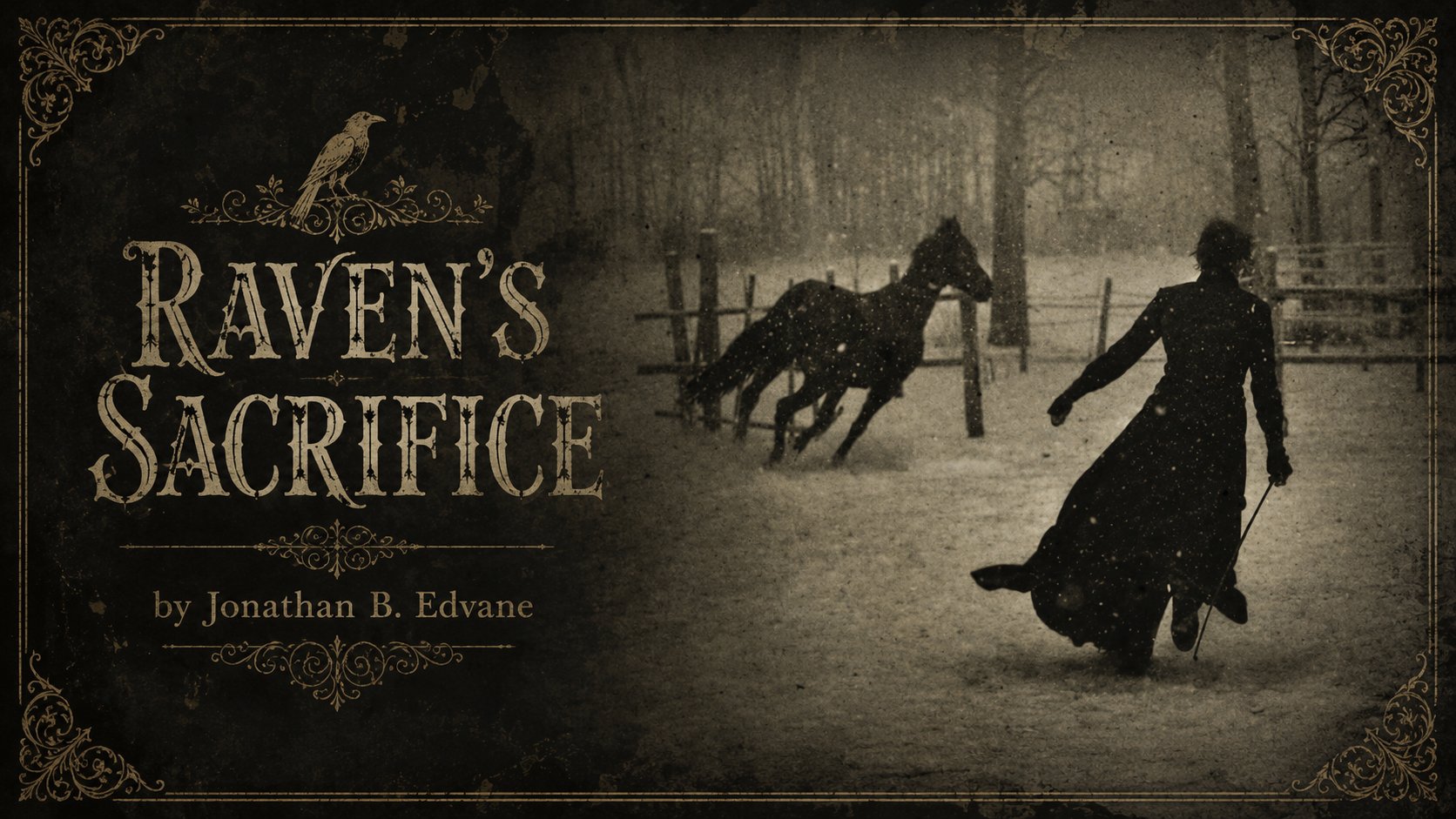
In 1899, the photograph, ‘Horse Training’ was shot by French photographer, Felix Thollier. Said to depict free lunging, no other context was ever given, and neither horse nor trainer were ever named. Until today.
Snow had been falling since before dawn, thick enough to soften the sound of boots and hooves but not enough to hide what the ground remembered. Blackhaven lay behind them, dark and quiet, its roofs already thick with white. Ahead, the paddock waited, marked by posts sunk deep into the frozen soil, while beyond it the valley rose in slow folds of shadow and timber.
Edda Rowen held the rope with both hands. The hemp burned through her gloves when it moved, though damp and stiff with cold. Raven stood quietly at her side, head down, breath steaming and her black coat wet with melt. He was taller than most of the horses bred in Blackhaven. He was notably heavier through the chest, and his neck was thick with muscle. His eyes were dark and steady on Edda, and he looked like he was waiting for something to begin.
Harker Bale and another man, a stranger she had never seen before, had taken their places at the fence. Harker leaned with his forearms on the top rail and his boots planted wide, while the stranger unfolded a tripod and began preparing his camera, his eyes never leaving the horse. Harker wore the same coat he wore every winter for this moment, patched, mended and darkened with old stains. Neither spoke as Edda led Raven into the open.
“Keep him moving,” Harker said. His voice was flat, already used to the cold.
Edda nodded and pulled gently. Raven responded and went with her, hooves crunching, head lifting as they crossed into the paddock, snow brushing his fetlocks. Edda had slept very little, and the valley had pressed on her dreams, the way it always did when a turn approached.
She walked him in a slow arc with the rope slack between them. This part mattered because calm mattered. She knew that much. The rule was simple enough to say aloud.
The offering must run willingly by the end. No dragging. No breaking. Just compliance.
Raven’s ears twitched, and his head turned, not toward Edda, but toward the trees. She felt the change before she saw it, a gathering under the skin and a tension along his spine. She shortened the rope, murmured his name and tried to keep her voice steady.
“Easy,” she said. “Easy now.”
He moved suddenly but not to rear or to shy. It was a surge forward that took the rope from her hands and instantly burned her palms before she could let go. Raven lunged past her shoulder, snow flying from his hooves as his body stretched into motion.
Edda stumbled, caught herself, and ran.
“Harker,” she shouted. “He’s early.”
“I see it,” Harker said, but he did not move.
Raven did not head for the far fence, not at first. He cut across the paddock, angling away from the prepared ground, toward a hillock where the snow lay thinner, and the posts were older. Edda chased him through fresh powder and frozen earth, her boots slipping perilously on the winter surface. The rope trailed behind him, a dark line against the white, bouncing and snapping along.
“Bring him back,” Harker shouted. “Before he breaks the line.”
Edda ran faster. The cold bit at her throat, snow filling her mouth when she gasped. She could hear Raven’s breathing, a deep, steady rhythm that did not falter. She angled and closed the distance enough to reach for the rope. Her fingers grabbed for it, numb and clumsy, but Raven veered enough to pull it out of reach again.
They reached the old fence. The rail sagged where past winters had bowed it. Raven took it easily, lifting and landing with poise. The rope snagged initially and then tore free, leaving a splintered post rocking in the snow.
Edda followed, and the fence scraped her thigh as she climbed, ripping through the cloth, her skin stinging beneath. She landed hard on the other side, the breath knocked out of her, but pushed herself up again and carried on.
Beyond the paddock, the ground dipped. Snow lay crusted over dark water, and Raven’s hooves broke through in places. Edda slowed, picking her steps, fear crawling up through her spine. The valley was closer here, and she could feel it.
“Turn him,” Harker called from behind, his voice further away now, muffled by both the distance and the falling snow.
Edda grabbed the crop from her belt and lashed out. The leather struck Raven’s flank with a wet crack, but he did not bolt or scream. He took the blow and kept running, his stride unbroken and his head lifting. So she struck him again, and this time the sound echoed strangely and was swallowed by the trees. And still he ran, gaining momentum, but choosing his path with apparent care.
“Raven!” she shouted, “Stop!”
Raven did not respond to her order.
Edda’s foot punched through the crust, plunging into icy water, and her ankle twisted. She went down on one knee, screeching in agony, her hands slamming into slush. The cold cut through her gloves instantly, biting to the bone. She dragged herself free with a further cry and stood there shaking, before resuming the pursuit, limping now, each step a jolt that sent fire up her leg.
The valley seemed to move around her. The trees seemed closer together, their bare branches knitting overhead, and the sound flattened. Even her own breathing felt distant, like it belonged to someone else. Raven slowed enough that she gained on him, despite the pain. She saw it then, just above his shoulder, where the hair parted unnaturally. A mark, dark and precise, and grown into his flesh.
Understanding came in a rush because she knew now that this was no mistake or unprovoked panic. Raven knew, and he always had.
“Harker,” she called hoarsely. “He’s marked.”
Harker said nothing. She glanced back and saw the two men at the edge of the paddock, small figures now, watching. They did not wave or call her name.
Raven slowed again, letting her close. When she reached for him, he turned his head and met her eyes. For a moment, there was no animal in that stare, only attention. And then he struck. The kick caught her in the side, a precise blow that cracked against her ribs. She flew sideways, hit the ground hard, and rolled. Pain exploded through her chest and she lay gasping, tasting blood, the world spinning as snow settled on her face and melted.
Raven stood over her, breath steaming, sides heaving. He did not trample her or flee further. He just waited.
“Willing,” she whispered, the word breaking apart as it left her mouth. She understood now that willing was not about the horse at all. It never had been.
Edda pushed herself up, crying out as her ankle protested and her ribs screamed. Raven stepped back, gave her some space, then turned and cantered away toward the deeper part of the valley.
Edda followed him, but each step was agony, and her vision was blurring. She focused on Raven’s hindquarters, on the steady placement of his hooves, and followed the way in which the land seemed to open for him. When she stumbled, the ground caught her in a way that did not break anything, and when she fell, it was onto snow, but she did not thank it. She pressed forward because there was nowhere else for her to go.
They reached the boundary as the light dimmed, a dull grey spreading through the trees. There was no marker, post or stone, and Raven just stopped. Edda caught up and stood beside him, swaying, fluids now rattling in her chest.
She thought of Blackhaven, of the fields that would flood if the thaw came too quickly, and of the graves that lay shallow in that frozen ground. She thought of Harker and the stranger, of their stillness and the way they had watched. She thought of the mark on Raven’s shoulder and of the quiet in his eye.
“I’m here,” she said aloud. Her voice was barely there. “I came.”
The valley answered without words. Warmth spread through the ground beneath her knees as she sank, strength leaving her at last. The snow fell more gently, and Raven turned away, his work done.
Edda lay where she fell, her breath gradually slowing and her clarity restored. There was no defiance left in her, no plea. Only the knowledge that this was what had been required, and that it would not always be a horse. Her breathing stopped, and darkness took her.
When the thaw came, Blackhaven breathed a sigh of relief, and the valley kept its own counsel. And sometimes, at the far edge of the fields, a black horse could be seen standing still, watching and waiting for winter to return.

I welcome polite comments. If you enjoyed this story, you might also enjoy another story inspired by a picture: The Severed Heads
Leave a Reply