Yarnulf had misjudged the distance between villages. What looked like a modest stretch of woodland and gorse from the ridge had turned into a slow and tiresome walk along a twisting road that seemed determined to wander before reaching anywhere useful. By the time the sun had begun its descent behind the western hills, the air had already cooled, and the shadows beneath the hedges grew longer toward evening. He lengthened his stride, mildly irritated with himself for trusting the casual directions of a farmer he had met hours earlier. The man had waved vaguely toward the eastern ridge and said the road would do the rest. The road had other intentions.
When the roof of a small alehouse appeared beside a crossroads, he felt a brief satisfaction. A warm light glowed inside, and smoke curled lazily from the chimney. It was the sort of roadside place that existed only because travellers occasionally passed through these forgotten stretches of country. He pushed open the door and stepped inside.
The room held only a handful of men sitting at a broad wooden table near the hearth. Their conversation faded as he entered, replaced by the quiet curiosity that strangers often drew in places where strangers were rare. He ordered a mug of ale and drank it near the fire, stretching his legs and warming his hands while conversations resumed behind him.
“I suppose the town lies another hour or so east of here,” he said after a moment, turning toward the table. “The road’s longer than it appears from the ridge.”
One of the men, broad-shouldered and grey-bearded, looked at him over the rim of his cup. “If you stay on the road, it’s closer to two.”
Yarnulf frowned. “Two hours would see me arriving well into the dark.”
Another man leaned back in his chair and shrugged. “There’s a path through the woods that cuts the distance. Saves near three miles if you keep a steady pace.”
“That sounds far more reasonable.”
The men exchanged a glance that carried an unspoken meaning that Yarnulf did not immediately understand. The grey-bearded man lowered his cup and rested both hands on the table. “You can take that path,” he said slowly. “But most folk hereabouts don’t use it once the light begins to fade.”
“Why not?”
The answer did not come right away. One of the younger men let out a short laugh. “Because that’s where she keeps her garden.”
Yarnulf smiled. “She?”
The grey-bearded man spoke the name without any hint of amusement. “Gossia. The pixie”
Another man added, “People say she’s patient with travellers who mind their manners.”
“And impatient with those who don’t,” the younger one muttered.
Yarnulf shook his head, amused despite their serious expressions. “Every village seems to have its hedge spirits and forest ghosts. I imagine the path is just poorly kept.”
A quiet man at the far end of the table lifted his head and said in a foreboding tone, “If you take the forest path, walk straight and don’t wander from it. And if you hear laughter in the woods, don’t laugh back.”
Yarnulf finished his ale and placed the mug on the hearthstone. “I’ll take my chances with the trees,” he said, adjusting the strap of his satchel. “Three miles saved is worth a little superstition.”
He stepped outside before anyone replied. The sky had dimmed further while he had been inside. The forest path began just beyond the crossroads where two leaning hawthorns formed a crooked arch over a narrow depression in the earth. Yarnulf entered it. At first, there was nothing unusual about the place. Gorse bushes lined the path, and their yellow flowers released a faint sweetness into the evening air. Yarnulf walked steadily forward, calculating how much time he might gain by taking the shortcut. The trees above grew increasingly dense until the sky became only a narrow ribbon of fading grey.
After a while, he noticed the absence of sound. The countryside had been alive with the sound of birds settling in hedges, insects moving through the grass, and the distant lowing of cattle somewhere across the fields. Here, there was only the soft rustle of leaves and the steady rhythm of his own breathing. He slowed slightly, listening. Somewhere ahead along the path, he heard what might have been laughter. It was a reedy sound that rose briefly on the breeze before fading again.
He paused and looked ahead between the trees. Nothing moved. “Branches,” he assured himself. “Nothing more.”
He continued walking, deeper into the quiet. A small bird had perched on a branch beside the path and watched him pass without flying away. Another appeared moments later. Then another. In their dark eyes, the fading evening light caught a strange, unmoving stare.
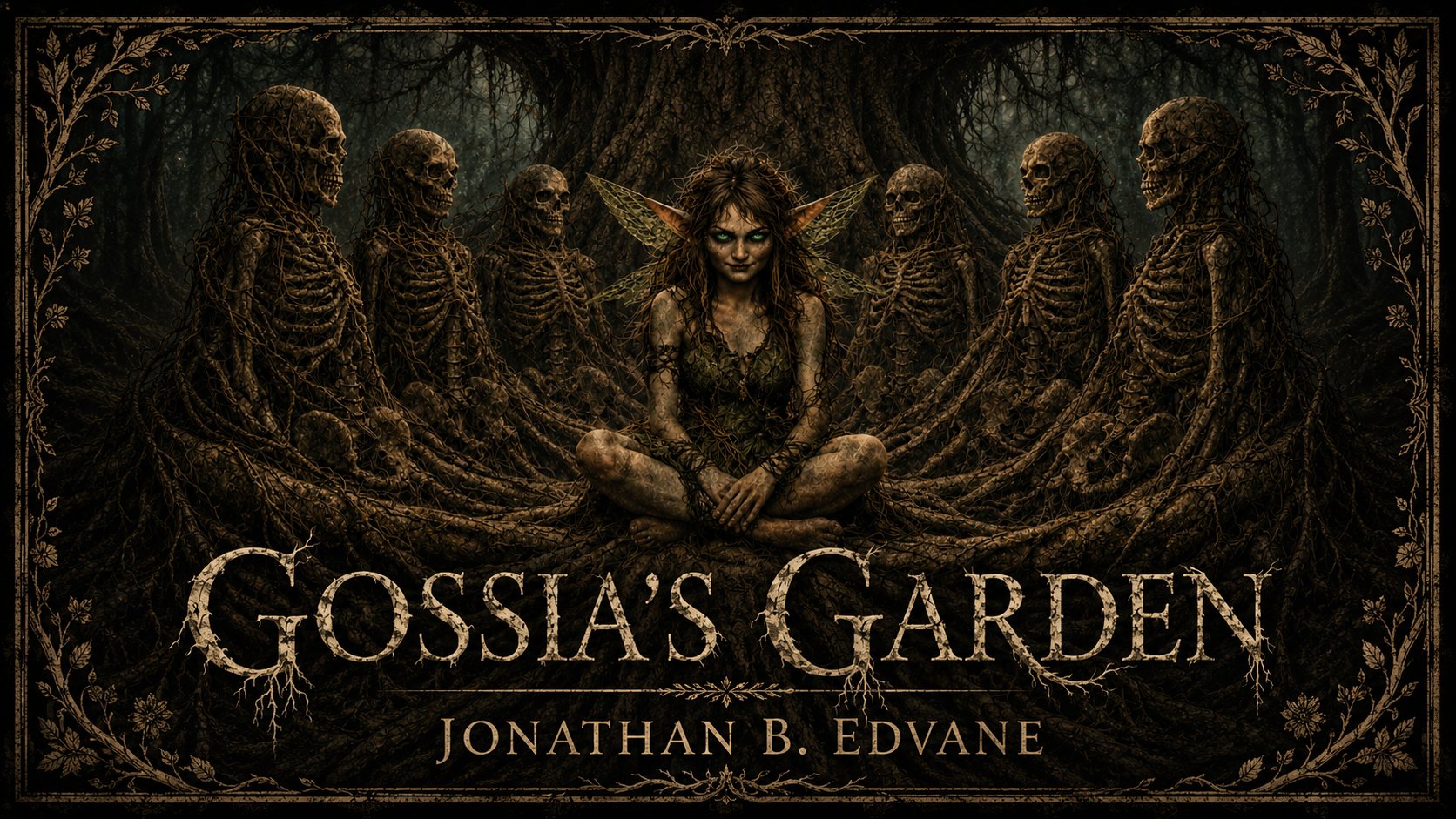
Yarnulf was beginning to feel a stir of unease when the trees opened into a small clearing. Rising above it stood a giant oak. The tree was vast and crooked, its trunk thick with age and its bark dark as iron. Its roots had forced their way through the soil in thick ridges that spread outward across the clearing. Briars clung to those roots in tangled coils, weaving between them in grasping patterns. He immediately noticed shapes among the roots. At first, he thought they were carved figures, perhaps some rustic attempt at decoration or warning.
Then he saw the bones. The figures were skeletons.
They had been fixed within the roots so that the tree itself seemed to be holding them upright. Briars threaded through ribs and joints, binding each frame in place. Their skulls had been arranged so that every face turned inward toward the centre of the grove. Their mouths had been fixed open.
Yarnulf stared at them, his mind struggling to accept what his eyes were seeing. There were many of them. Some had darkened with age and weather while others remained pale and looked newly cleaned.
The dry rattling laughter drifted through the clearing again. This time, he realised what it was. The wind moved through the branches above, and the skulls had knocked gently together. He turned slowly.
“I suppose you’ve seen enough to understand the arrangement.”
The voice came from somewhere behind him. He whipped around and saw her standing among the roots of the oak. She was small and narrow-limbed, hardly taller than a child, with hair the colour of dried leaves and pale skin. There was nothing hurried or threatening about her presence. She looked at Yarnulf with the calm attention of someone who had been observing quietly for some time.
“I didn’t see you,” he said after a moment.
“That happens often,” she replied. “People tend to look where they expect things to be.”
She looked toward the skeletons. “Not where they are.”
Yarnulf forced a smile. “I didn’t expect to find anything like this at all.”
“Most people don’t.”
She moved between the roots, the briars bending away from her, unwilling to make any contact. When she reached one of the skeletons, she placed a hand against its ribs with a familiarity that suggested long acquaintance.
“You called it a garden?” Yarnulf asked cautiously.
“That is what it is.”
“Those are people.”
“They were.”
Yarnulf felt a chill spreading through him. “How did they come here?”
“They followed the path.”
He glanced toward the trees behind him. “Like I did.”
“Yes.”
The wind moved again through the oak, and the skulls rattled again. “Long ago,” she said, “men chased me through the gorse. They found it amusing to hunt something small. They laughed when I hid from them. They laughed when they found me again.” Her fingers brushed the bark of the tree. “So I began keeping the laughter.”
Yarnulf felt a knot forming in his stomach. “You’re saying these were the men who hunted you?”
“Some were.”
“Others?”
“Others laughed as well.”
Yarnulf felt empathy toward her but understood that being a mortal man might be crime enough for this creature. “I didn’t hunt anyone.”
“No.”
“I’ve done you no harm.”
“That is also true.”
He felt relief begin to rise slightly. “Then I suppose there’s no reason I should stay.”
She looked at him for a moment. “Perhaps not,” she said. “But I have a question first.”
“What question?”
“When you stood in the alehouse,” she said, “and the villagers spoke my name… did you laugh?”
Yarnulf’s memory returned with uncomfortable clarity. The awkward pause, the embarrassed smiles, and his own brief amusement at what he had taken for harmless superstition. He hesitated. The skeletons around him seemed to be listening. “I didn’t mean anything by it,” he said.
“I know.”
“I thought it was just a story.”
“Yes.”
The wind moved through the branches again, and the skulls clattered. The sound was laughter now. She gestured toward the centre of the grove. “You have walked a long way tonight,” she said. “You should stay awhile and listen.”
Yarnulf looked at the circle of bones. A hollow laughter filled the clearing.
Time passed beneath the oak.
Long after night had settled over the woods, another traveller passed the crossroads and saw the entrance to the forest path beneath the leaning hawthorns. If he had followed the path, he might have found the clearing where the ancient oak stood. He might have seen the circle of skeletons arranged carefully around the trunk, each skull gazing upon the centre of the grove.
And among them, he might have noticed one more figure standing where the roots had grown to hold it in place. The bones were pale and newly cleaned.
Whenever the wind stirred the branches of the oak, Yarnulf’s skull knocked softly against its neighbours and joined in with the laughter that never left Gossia’s garden.
I welcome polite comments. If you enjoyed this story, you might also enjoy Emmie and the Black Orchard
Leave a Reply