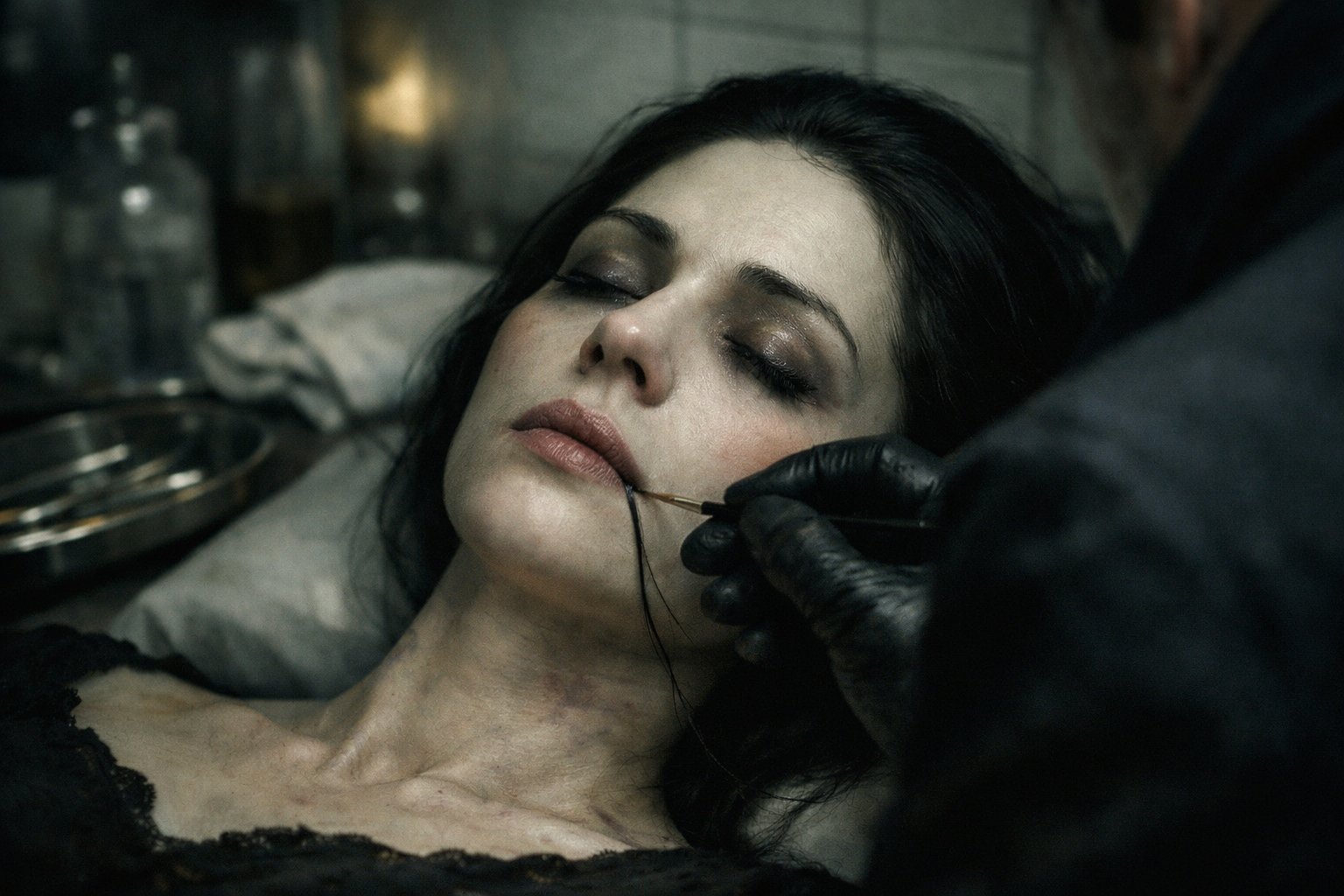
By the time the first carriage came up the eastern incline, Rhett Bormis had already laid out his brushes in their accustomed order and tested his lamps. In Streindarke, even the light that fell upon the dead was expected to conduct itself properly. Nothing in the chamber diverted it from its purpose. The white tiles, the glass-fronted cabinets, the silver instruments resting upon folded cloths, all returned the same composed impression. That here, at least, disorder had been persuaded to surrender.
Rhett moved precisely through the space, demonstrating his years of long practice. He was a thinner man now, though not yet old, with a face made sharper by years spent in regulated air and among company that offered no occasion for warmth. There had been a time when he took pride in his station. In those days, he had believed his skill might stand apart and be recognised. If his hand was careful, if the mouth were softened just enough, if the eyelids were settled with dignity and the bruised skin persuaded back toward something fit for remembrance, then perhaps he had done a good and merciful thing. He no longer thought in such terms. Streindarke had a genius for making lies appear charitable.
Yet habit remained, and something more than habit besides. The dead, whatever else might be said of the city, had ceased their pretences. Rhett respected them for that. They came to him robbed of office, ambition, slogans, petitions and rank, and if he could not return truth to them, he could at least spare them clumsiness.
Beyond the high windows, the upper face of the city stood in cold authority, all black towers and severe facades in both daytime and the yellow moonlight of its nights. Far below, a carriage door opened. Two attendants emerged first, then a sealed trolley under a dark cloth. Rhett watched. Another arrival. Another face to be corrected. Another private history condensed into a line of paperwork and a room so clean it might have passed for innocent.
From a wall-horn somewhere beyond the corridor came the measured voice of the civic address announcing the noon bulletins. The tone was calm, cultivated, and faintly paternal. It spoke of stability in the provisioning wards and of renewed vigilance against subversive contamination. Rhett turned away before the item was finished and reached for his gloves. The day, like so many others, had begun.
The docket arrived before the body did, carried in by a junior clerk whose face Rhett knew but whose name he had never troubled to learn. The young man placed the folded sheet upon the side table with both hands, then withdrew. Rhett glanced at the entry while fastening the second glove.
Female. Middle years. Transfer authorised from Civic Ward Nine. Public viewing permitted. Cause of death: cerebral haemorrhage.
There was nothing in that to delay him. Streindarke had a fondness for such phrases, neat enough to satisfy inquiry and broad enough to discourage it. Rhett had seen worse fictions set down in cleaner script.
The covering had been folded back to the collarbone, per his preference.
For a second, his mind refused the evidence of the face before him and offered him instead some trick of resemblance, some cruel alignment of mouth and brow. Then the last obstruction within him gave way, and he knew her.
Charlotte.
He did not speak the name aloud. To have done so would have altered the room too violently. Yet it moved through him with such force that he was obliged to set one hand against the table to steady himself. Death had refined her and showed no mercy. The years had gone from her all at once. What remained was the structure he had known when she was alive and laughing. The shape of her cheek, the intelligent firmness of her brow, the mouth that had once seemed incapable of saying anything half-heartedly.
The attendants withdrew, and the door closed. Rhett turned and walked toward a mirror on the opposite wall. He observed his own approach, and when he reached it, he pressed his face hard into the cold surface while fighting to contain his cries. Then he composed himself, walked back and looked upon her face again.
He had met her in these same buildings ten years earlier, when the varnish of vocation still shone upon him, and he had not yet learned the full obscenity of his elegant procedure. Charlotte had worked in administration then, one of those brisk and capable young women who seemed to move through institutional corridors having judged their order and found it only moderately impressive. She had possessed a beauty of her own, none of those deliberate arrangements by which some women announce themselves at a distance. Hers had been natural, brighter and perhaps more dangerous.
He remembered a winter evening when the two of them had remained late over conflicting registers and failed consignments, the outer offices already dark. She had laughed at some piece of mortuary jargon he himself had used without hearing it, then looked at him with that directness which had always disordered him. Before he knew it, he had crossed the little space between them. After that, the affair had gathered itself rapidly. Rooms borrowed, hours stolen, hands finding one another in corridors. There had been a recklessness in it which now seemed almost miraculous in Streindarke.
Then, as suddenly, came the moment she spoke of registering their bond. Not sentimentally. Charlotte had not been sentimental. She had spoken of it as one speaks of a door one means to pass through, not some decorative threshold to be admired from a distance. She had loved him, and in Streindarke love that wished to endure sought witness, and entry in the proper ledgers. Rhett, hearing it, had felt constriction. He had told her they were too young. He had said he was not ready. He had even managed, with that special cowardice available only to the self-regarding, to make reluctance sound like honesty.
Rhett drew a slow breath and looked again at the docket lying beside her. Cerebral haemorrhage. The words had not changed. Everything beneath them had. He stood for some moments without moving, then drew the trolley fully beneath the central lamp and began.
There were preliminaries which no emotion could excuse a man from neglecting. He checked the docket seal, compared the wrist tag, entered the time of receipt in the ledger, and only then folded back the sheet. Streindarke prized order above innocence.
Charlotte lay with the composure death lends to those who were never composed by nature. Her hair had been smoothed by another hand before she reached him, though not skilfully. A dark strand still clung near the corner of her mouth. Rhett removed it with the side of one finger and at once wished he had not, for the gesture recalled too vividly the old instinctive tenderness they had shared. He turned instead to his instruments, uncorked the restorative tincture, and began the slow business of inspection.
At first nothing declared itself beyond the common injuries of final illness and state handling. The skin had the usual drained quality. The lips required softening. There was slight discolouration at one temple which the paper’s diagnosis might easily be made to contain. But when he lifted her chin a little to judge the line of the throat, he paused.
There was a faint shadow there, evidence of a pressure applied with purpose and then respectfully concealed. He said nothing, of course. There was no one to say it to. He merely adjusted the lamp and looked more closely. Beneath one hand, the nails were imperfectly cleaned. They had clearly been attended to by someone in haste who did not understand what a trained eye might still observe. One nail was torn. Along the wrist, where the sleeve had been arranged to fall just so, there was a mottling too regular to be accidental. Rhett set her arm down.
Cerebral haemorrhage.
The phrase remained on the docket, bland as a coroner’s formula. Streindarke preferred lies that retained a slender technical possibility, smothering truth under sufficient correctness. Yet Rhett knew bodies too well. The dead did not become unreadable just because authority required a tidy sentence.
He moistened a cloth and worked at the corner of her mouth. As he did so, memory rose with such force that he nearly turned, expecting to find her behind him rather than beneath his hand. He remembered Charlotte seated cross-legged upon his narrow bed in the old rooms off Tobrim Court, laughing at the solemnity with which he had arranged cups and plates for supper. She had accused him then of behaving like a registrar of domestic peace, determined to certify comfort before permitting himself to enjoy it. He had kissed her to silence the joke, and she had caught his wrist, smiling, and said that one day he would either give himself properly or disappear behind his own caution.
She had been right.
He set down the cloth and reached for the pigments. A little warmth must be restored to the cheeks, though not too much. Streindarke disliked vigour in its dead. The illusion required serenity, not life. He mixed carefully, finding himself sickened by the familiarity of the act. Here was the old treachery again. Tenderness in the service of concealment. He had touched Charlotte’s face once for pleasure, later for refusal, and now for correction. Every stage had diminished her.
As the brush moved over her skin, he saw, in a broken rush, the evening she had spoken of registration. She had stood by the window in his rooms with the city lamps below and said she was tired of living like a smuggler of sincerity. She wanted their bond entered. Rhett had answered with patience, reason, youth, timing, all the bloodless instruments by which the selfish defend themselves from courage.
Now the final instrument lay in his own hand. By the time he had finished the first stage of preparation, he no longer doubted that the docket lied. He could not have said exactly how Charlotte died, nor in what chamber or under whose authority. Streindarke had many ways of bringing pressure to bear while preserving the dignity of its records. But he knew she had not drifted quietly into darkness. Something had closed upon her. Something had been done, and now the city expected him to make peace visible where none had been granted.
When the first layer had settled, and the last of the inspection notes lay entered in his narrow hand, Rhett stepped back from the table and understood that the remainder of the work would not be technical. Charlotte’s face was before him in its altered stillness, and all that remained was the city’s preferred miracle. The conversion of damage into submission. A little more colour, a little less truth, and Streindarke would have what it required.
Beyond the closed door, the building continued in its orderly life. Footsteps passed, paused, and passed on. Somewhere further off, the civic address resumed its measured recitation, a voice so composed it seemed incapable of sharing the same world as the body upon his table. It spoke of renewed confidence in the central wards, of vigilance, of necessary firmness in uncertain times. Rhett listened without paying proper attention, hearing in it only that old talent authority possesses for making force sound like care.
He looked again at the docket. His eye went from the paper to Charlotte’s face. He had softened it somewhat, but not fully. Another few strokes and it would lose the last trace of strain. The shadows at the throat might still be reduced. The injuries at the wrist could be hidden. He knew precisely how to do it, but that was the obscenity. For years he had performed this labour one after the other, face after face, all the old days of useful deception passing beneath his hands until disgust itself had become merely another condition of employment.
He set the brush down.
The decision, when it came, did not feel like courage. It felt like exhaustion reaching its natural end. He could not give Charlotte back the life he had refused to share. He could not undo what had been done to her. But he could refuse to make her agreeable to the lie.
Rhett removed what little he had added to the throat. He left the mouth as it was. He drew back from the body and now saw only accusation. For the first time in many years, the dead woman before him would not enter Streindarke corrected. When the attendants came to move her to the viewing chamber, he was ready and knew that something had already begun to close around him.
The viewing chamber lay two corridors beyond the preparation rooms, at the front of the institution, where grief was permitted under supervision. Rhett had entered it countless times and always with the impression that the place had been designed for the regulation of mourning rather than actual grief itself. Above, a high gallery window admitted pale light from the western side of Streindarke, and beyond that glass, one might just make out the dark geometry of the city’s upper wards. They stood in silence, like witnesses who had already agreed on what they had seen.
Charlotte was borne in and set upon the central dais. A dark cloth covered her to the breast. Two civic officials stood to one side. Sanctioned mourners who Streindarke preferred when political ambiguities might be linked to a death. There were also three women from some ward committee, sombre in black collars, and a physician whose expression suggested he had long ago exchanged curiosity for rank. No one spoke. Even sorrow was expected to conduct itself properly.
Rhett took his place near the head of the dais. It was not his custom to remain once the body had been set out, but this time no one had thought to dismiss him. An official read from the docket confirming the name, the civic district, the regretted passing, and the certified cause of death.
Then the covering was drawn back.
What followed was not uproar. Streindarke was too disciplined for that. The true shock declared itself first in stillness. One of the ward women gave a soft, involuntary breath, not quite a cry. The physician’s face altered toward offence because an impropriety had been committed against procedure itself. Charlotte lay before them, still beautiful, but not beautified into surrender. The signs remained. The throat told its own unwilling story. The mouth had not been persuaded into peace. The body did not proclaim serenity. It bore witness.
For a few seconds, the chamber held in perfect suspension. No one could yet move because the lie had not merely been contradicted. It had been interrupted in the very act of presentation.
Then authority recovered. One official stepped forward, and another reached for the cloth. The women lowered their eyes, whether in shame or fear, Rhett could not tell. The physician looked straight at him now. In that look, there was recognition, calculation, and already the first cold adjustment of consequence.
Rhett stood with his hands at his sides and watched them cover Charlotte again. As they closed around the dais and broke the moment, only one thought moved clearly through him. Somewhere, perhaps not long from now, another man in another white room would be laying out his brushes. And he wondered which of his colleagues would be preparing him.
By the time Rhett stepped out into the street, the lamps of the central wards had begun to show themselves one by one. Behind him, the institution’s black doors had closed as usual. No cry had followed him. No hand had yet touched his shoulder. The city, in its manner, preferred a little interval between offence and correction. Civility itself must always be part of the machinery by which people were broken.
He walked without choosing a direction at first. Above the roofs there hung a yellow moon, unnaturally full and watchful, staining the night sky with a dim hypnotic light that seemed less to illuminate the city than to hold it under observation. Beneath it, the high buildings stood in their accustomed authority, dark and severe, with windows lit here and there at impossible heights. Beneath those lights, the work continued in hidden rooms long after the living ought to have been home.
He passed a public wall-horn as he walked. The voice spoke of calm, of vigilance, of the regrettable persistence of certain subversive influences now firmly under review. Rhett did not break stride. Streindarke gave events their language before grief or memory could do so, and in that way made obedience feel like simple good sense.
At the mouth of a side street, he saw a child standing beside a woman in a dark coat, waiting to cross. The girl had black hair cut bluntly about the jaw and a pale, upturned face caught for a moment in the moon’s yellow cast. There was nothing in her features that truly resembled Charlotte, yet something in the stillness of her eyes, and in the grave way she looked at him, struck Rhett with absurd force. A little black-haired girl, waiting under the city’s watchful light, and all at once he thought of Charlotte before defiance, before disappointment, and before Streindarke had laid its hand upon her life and taught her what hope would cost.
He walked on.
At the corner of Brothe Street, he stopped and looked back, though the mortuary was no longer visible. Somewhere beyond the ordered roofs and measured lamps, authority would already be closing over the breach he had made. It would set down its version. It would improve the record. It would go on.
And Rhett, standing alone beneath that yellow moon, knew at last that the dead had always been the most truthful thing in Streindarke. Everything else was arranged.
This story was inspired by the song ‘One Hundred Years’ by The Cure. You can find another Streindarke story, also inspired by a song, HERE
Leave a Reply