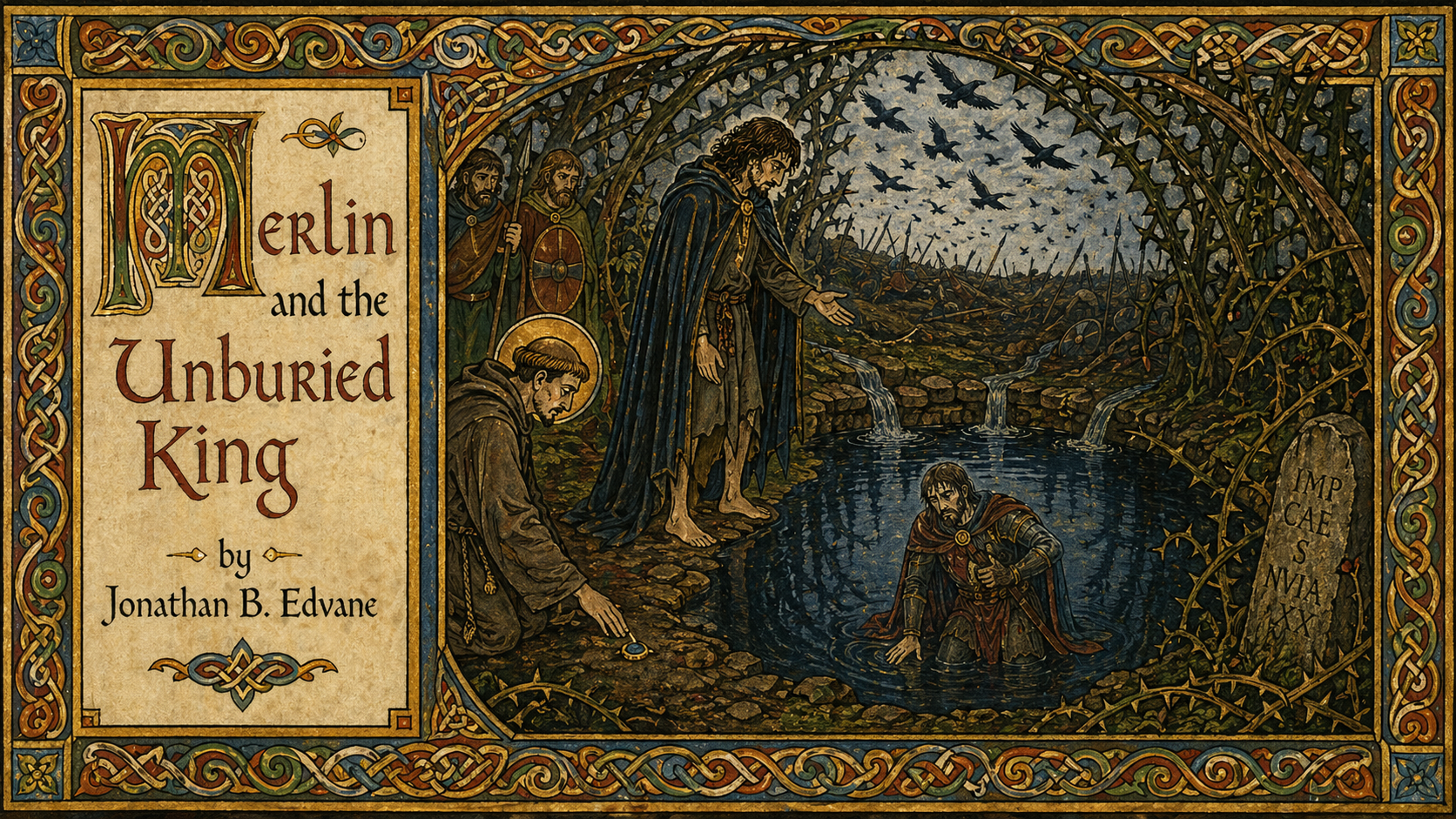
Three days after the battle at Arfderydd, the field had not learned silence.
The rain had passed in the night, but it had left itself everywhere. It lay in shield hollows and hoof prints, in the split mouths of dead men, in the dragged furrows where bodies had been pulled aside and abandoned when the work grew too heavy. Spears leaned at broken angles in the mud, the earth itself seeming to raise a last defence and failing. Helmets showed like dull stones among the trampled grass, and raven’s cries now sounded around the ruin as they prepared to feast.
Brother Robert stood at the edge of it and surveyed the carnage. He had been sent from the little house of Saint Kentigern with two men who still had swords and therefore still had duties. Their names were Mael and Ceredig. Mael was broad, older, and carried his grief quietly, folded away until it was needed. Ceredig was younger, red-eyed from drink, and had the look of a man who had survived by accident yet resented the accusation.
They had come looking for the king’s bard.
Merlin had vanished before the last shields broke. Some said he had been killed and covered in the press of bodies. Some said he had gone mad when Gwenddolau fell. Others said he had walked away from the field while men still cried for water, and that the crows had made a path for him.
Robert did not like that version. He liked least of all the way men lowered their voices when they spoke it.
King Gwenddolau lay under a cloak near the centre of the field, guarded by two exhausted boys with spears. He had not yet been carried to consecrated ground. No one could agree where he should go. His kin wanted him taken north. The priests wanted him washed and buried before rot made a mockery of rank. His remaining captains argued over honour, distance, weather, horses, and omens. While they argued, the king lay with rainwater darkening the cloak over his face.
“He should have sung him down,” Ceredig said.
Robert looked at him.
“Merlin,” said Ceredig. “That was his office. A king dies, and the bard fixes him in the world. Gives him order. Sends him where songs go.”
“Songs do not send souls,” Robert said.
“No,” Ceredig said. “Priests do that, I suppose. When kings die tidily.”
They crossed the field carefully. Robert saw a hand still gripping the turf, the knuckles packed with mud. He saw a man on his back with both eyes open and a beetle walking across one of them. He saw, near a broken standard, three ravens picking around a corpse but not touching it. They seemed to be waiting for permission.
Mael noticed them too. “That one was close to the king,” he said.
“How do you know?”
“No bird eats before it’s better.”
Robert almost rebuked him for superstition, but the words would not come. The field was full of appetite, yet here and there the dead lay untouched, waiting.
At the far edge, where the slope dipped towards a line of ash and thorn, they found the first signs of Merlin. A strip of dark cloth had caught on a bramble, torn from a cloak of better weave than any common soldier wore. Beside it, half pressed into the mud, lay a lyre-string knotted twice around a twig.
Ceredig crossed himself clumsily. “He went in there.”
Mael stared at the trees. “Or something took him.”
Robert bent to touch the lyre-string. It was wet, but when he lifted it, it hummed once between his fingers. No wind moved, and no bird cried. From somewhere among the trees came the dissonant sound of a cracked bell. One note only. Robert turned back towards the field. The monastery lay miles away. Its bell was small and bright, not this deep iron groan.
“You heard it?” Robert asked. Neither man answered.
Beyond them, the ravens rose from the battlefield all at once, circled once above the covered king, and settled again. The field had not learned silence. It was listening.
◆
Brother Robert did not ask again whether the others had heard the bell. Some questions become worse when answered, and worse still when they are not. He let the lyre-string fall back against the twig, then wiped his fingers on the side of his habit.
The trees before them stood close and wet, ash and thorn and rowan grown in a tangle along the lower ground. The grass at its edge was flattened in places by passing men, or deer, or something dragged. Mael crouched over the marks, touched two fingers to a print, and looked towards the shadow beneath the branches.
“Barefoot,” he said.
Ceredig frowned. “No man walks barefoot after battle.”
“Madmen do,” said Mael.
Brother Robert thought of Merlin as he had once seen him in Gwenddolau’s hall, seated near the king’s right hand, his dark hair bound back, his fingers resting on the lyre across his knee. He had not looked like a madman then. He had looked like a man who reflected upon words before he released them. When the warriors laughed too loudly, Merlin did not laugh with them. When the king praised victory before it had been won, Merlin had lowered his eyes.
Now his footprints entered the wood without shoes, without companions, and without return.
They passed under the first branches. The smell changed at once. The battlefield stench fell behind them, and in its place came damp leaves and fungus. Their feet sank softly. Twigs bent under their boots without snapping. Even Ceredig’s mail seemed quieter there. Robert sought comfort in naming what he saw. Ash. Thorn. Rowan. Hazel. Blackbird. Bramble. The mind, trained properly, could hold fear at bay by giving the world its proper order.
Ceredig heard his name. It came from somewhere to their left, spoken with the worn voice of an old woman. He stopped so suddenly that Mael nearly struck him.
“What?” Mael demanded.
Ceredig stared between the trees. “My mother.”
“Your mother is dead,” said Mael.
“Aye,” Ceredig answered. “That was her voice.”
A crow flapped down onto a fallen branch and watched them with one bright black eye. It opened its beak and gave an ordinary cry. Ceredig pushed forward before anyone could speak pity over him.
They found the horse a little deeper in. It stood upright between two ash trees, dead for at least a day. Its eyes were dull, its lips drawn back from yellow teeth, and black blood had dried along one flank. But it had not fallen. Branches had passed through its torn harness, or grown through it, or tightened around it in the hours since death. One green shoot emerged from the leather below the saddle and had already opened two pale leaves.
Mael crossed himself with more care than Ceredig had managed. Brother Robert stepped closer, though everything in him advised against it. The horse’s hooves barely touched the ground. Roots had risen around them like fingers.
“This is no devil’s work,” he said, though he did not know why he said it.
Mael looked at him. “Then whose?”
Robert had no answer. He thought again of the field behind them, of the ravens standing round the uneaten dead, of the king beneath his cloak, waiting for priest and kin and bard to agree what a dead man was allowed to be. Then, from far away, the bell sounded once more. This time it was followed by another note, lower than the first, and the wood seemed to receive it through every leaf.
Ceredig whispered, “Merlin.”
No voice answered. Yet somewhere ahead, beyond the dead horse and the listening trees, water began to run where there had been no stream before.
◆
The running water drew them deeper. It did not keep to one place. It slipped ahead, then seemed to run beside them, then bubbled under the roots at their feet, though the ground was only leaf-mould and black earth. Brother Robert tried to follow it by sense and failed. The wood was not obeying the ordinary habits of sound.
They found Merlin where the trees opened around a narrow stream. He sat on a stone with his bare feet in the water, his ruined cloak hanging from one shoulder, bloodstained and dark with rain and mud. Leaves clung to him, and a thorn had scored one cheek from temple to jaw. He looked thinner than Robert remembered, somehow altered.
He was speaking to the stream.
“Three at the cart-rut. Two brothers by the alder. One boy beneath the red shield, calling for a dog that would not come. I remember. I remember. Do you?”
The water moved over his ankles, but it gave no answer.
Ceredig said his name and Merlin looked up. His eyes were not wild in the common manner of madness. They were too exact for that.
“Not yet,” he said.
Ceredig gave a brittle laugh. “He is mad.”
Merlin turned his eyes toward him. “Your mother called you little wren because you sang at the wash-stone. She died with wool in her hands.”
Ceredig’s face emptied. Mael’s fingers gripped his sword, but Brother Robert moved closer before fear could sharpen itself.
“You were the king’s bard,” Robert said. “You are wanted among the living.”
“The living are always wanting what belongs elsewhere.”
“Gwenddolau lies unburied.”
“No,” Merlin said. “His body lies unburied. That is a smaller matter.”
Robert felt anger rising. “His soul must be commended to God.”
“It may be. But the land has not received him.”
Mael spat into the leaves. “The land can wait.”
The stream stopped. It did not slow or shallow. It simply held itself still around Merlin’s ankles, every ripple fixed as glass. Mael also saw it and found no answer. Merlin touched the surface with two fingers, and the water resumed its course.
“A king has many names,” he said. “The one cried over the cradle. The one entered by priest and witness. The one shouted before battle so frightened men may borrow courage from it. The one polished by flatterers until a hall mistakes it for truth. And the last one.”
“The name given at death?” Robert asked.
“The name death finds already there.”
The words settled badly among them.
Merlin looked beyond the trees, towards the field they could no longer see. “Gwenddolau died without that name spoken. So he lies in men’s mouths, not in the earth. His captains quarrel. His kin delay. His priest measures him by rite and cloth. His bard fled. Between all that, the dead man waits.”
“You fled,” Mael said.
“Yes.”
The plainness of it was worse than the denial. Robert searched Merlin’s face for the man he remembered from Gwenddolau’s hall, seated near the high place with his lyre. Some part of that man remained, but the court had gone out of him. Rank, duty, praise and all the bright garments of service had been torn away. What sat beside the stream was not less than Merlin, but less sheltered.
“You must come back,” Robert said.
“Back is a place men invent because forward frightens them.”
Mael moved, meaning to take him. He had made only one step when Merlin looked at his left hand.
“Return the prince’s ring first.”
Mael stopped as if struck.
Merlin’s voice did not change. “Gold. Blue stone. Cut from the dead hand because the finger had swollen. You told yourself the dead have no use for it.”
Ceredig stared at Mael. Brother Robert said nothing, but he knew that lie and truth could not stand equally in this place. For a moment Mael resisted them all. Priest, soldier, bard, stream, tree. Then his fist opened slowly. The ring lay in his palm, bright and wet.
Merlin looked at the wood around them. “The dead have use for everything,” he said, “until they are finished being dead.”
◆
Mael did not return the ring at once. Shame held him as tightly as greed had done. Brother Robert took it from him gently. He expected Mael to resist, but the man’s strength had gone elsewhere. The soldier looked suddenly older, his broad face slack with the knowledge that whatever had seen him steal had not been human.
“We will take it back,” Robert said.
Merlin rose slowly from the stone. Water slid from his feet, but no mud clung to them when he stepped onto the bank. That troubled Robert more than the stopped stream had done. A small miracle, if miracle was the word, ought to have announced itself. This did not. The ground had simply chosen not to dirty him.
“Not back,” Merlin said. “Not yet.”
Ceredig made a wounded sound. “Then where?”
Merlin turned towards the deeper trees. “Where names go when men are done misusing them.”
No one liked that answer, but no better one was offered. Mael wiped his sword-hand against his tunic, though he had not drawn the blade. Ceredig walked too close to Robert, quietly hopeful that a monk’s habit could serve as armour against the unquiet dead. Robert held the ring inside his sleeve and felt its small, hard weight knock against his wrist with every step.
Merlin moved awkwardly at times, catching at branches, pausing to listen where no sound had been made, yet the wood opened for him. Bramble lifted from his path. Nettles bent aside. Once, when Mael forced his way through the same gap, thorns caught his sleeve and tore it to threads.
The water followed them. Sometimes it ran unseen beside the path. Sometimes it whispered beneath roots. Once it crossed before them in a silver thread no wider than a belt, and when Ceredig stepped over it, he gasped and clutched at Robert’s arm.
“What is it?”
Ceredig stared down. “Cold.”
Robert wanted to dismiss it as terror, but the soldier’s face had gone pale in a way no ordinary chill could explain. Merlin did not turn around.
“Water remembers all who enter it,” he said. “That is why men prefer blood. Blood forgets once it dries.”
Mael muttered a prayer, not well and not fully, but sincerely enough that Robert did not correct him. The road, if it could be called a road, narrowed until they had to walk in single file. The trees grew lower, older, and more bent. Here and there scraps of cloth hung from branches, so rotted that they might have been offerings or remnants of men who had passed too close.
They came at last to a place where three small streams met. The trees formed no perfect circle, yet the shape was unmistakable. Their branches curved inward, woven by years or intention into a low crown of spikes. At the centre lay a black pool, smooth despite the three streams feeding it. Beside the pool stood an old Roman milestone, half swallowed by roots, its carved letters worn into almost nothing.
Merlin stopped at the edge of the thorn-ring, and Brother Robert felt the ring in his sleeve grow cold.
“This is a heathen place,” Mael said.
Merlin looked at the pool. “It is older than heathen.”
Ceredig backed away. His heel struck one of the streams, and the water splashed higher than it should have done, darkening his leggings to the knee.
Mael seized Merlin by the shoulder. “Enough.”
The thorn nearest him bent down, slow as a waking finger, and rested against the back of Mael’s hand. It did not pierce him. It merely waited.
Merlin said, very calmly, “Do not bring your iron temper into this place.”
Mael let go.
Brother Robert stepped past him to the edge of the pool. The black surface held no reflection of trees or sky. He saw rain falling on a battlefield, shields breaking, men turning their faces from death and finding it anyway.
Then the water went smooth again.
Merlin knelt beside it. “Now,” he said, “we ask whether the king is ready to hear himself.”
◆
Brother Robert did not know what prayer belonged in such a place. The pool lay before him, black and still, while the three streams entered it without troubling its surface. The old milestone stood nearby with its dead letters turned to shadow. Above them, the woven branches let down a dim green light, and in that light Merlin looked neither like a bard nor a madman, but like a sage listening at a door no one else could see.
Robert knelt because he could think of nothing better to do. Mud soaked through the cloth at once. He pressed the prince’s ring into the earth beside him, blue stone upward, and made the sign of the cross over it.
“Lord, receive the soul of Gwenddolau, son of Ceidio,” he began, and his voice sounded quite small. “Forgive him his sins, known and unknown. Grant him mercy beyond the judgement of men, and rest beyond the quarrels of the living.”
Mael stood behind him with his head bowed. Ceredig had withdrawn to the edge of the clearing, arms wrapped about himself, watching the streams as though one of them might rise and take him by the throat.
Merlin did not kneel. He stood at the edge of the pool with his feet planted in the wet leaves, and when Robert’s prayer fell into silence, the bard began to speak. He spoke first in the old court manner, and the change in him was terrible. His back straightened. His voice deepened and took on the measured tone of hall and firelight. For a few breaths, the ruined man beside the pool vanished, and Robert heard the Merlin who had once controlled the stature of kings.
“Gwenddolau, son of Ceidio, lord of the northern host, keeper of high table and red shield, giver of gold, breaker of spears, hawk of the ridge, wolf at the ford…”
The thorn branches stirred, and the pool darkened further. Robert saw shapes pass beneath the surface. Shields, horses, rain, the white flash of a face lifted from the mud. The air filled with the sound of battle returning. Men shouted in triumph and terror. Iron struck wood. Someone screamed for water. Someone laughed because he was about to die and had forgotten how else to use his mouth.
Merlin’s voice held steady. “Lord of Arfderydd, beloved of his hearth, terror of his enemies, feast-giver, oath-keeper, bright-handed king…”
The pool shuddered, and Merlin stopped.
The battle-sound rushed on without him, louder now. The clearing filled with the stink of trampled grass and opened bowels. Robert saw Gwenddolau fall, not nobly, not as men would later want it sung, but heavily, one knee first, one hand clutching at nothing. His mouth was open. Rain ran down his face. He looked bewildered, offended by his death arriving that way, in that place.
“Finish it,” Mael said. “You were his bard.”
Merlin looked down into the pool. The old tone had gone from him. When he spoke again, it was with the plainness of the man beside the stream.
“I was. I carried his names,” Merlin said. “I burnished them. I set them in order and gave them back to men who had paid in blood to hear them. I made his raids into justice, his pride into courage, his hunger into right. I stood in his hall while boys too young for beards learned how sweet it was to be promised a beautiful death.”
Robert did not move. He felt the prayer still inside him, unfinished and useless.
“On the field,” Merlin said, “when the line broke, he called for me. Not for God. Not for his mother. Not for the captains. For me. For his bard. He wanted the last lie ready.”
“And you fled,” Mael said.
Merlin turned on him this time, and the thorns above them trembled. “Yes. I fled. Not from death. From the song.”
Ceredig made a low pleading noise. He had come nearer without meaning to, drawn by the horror of truth as men are drawn to the edge of a grave.
“I saw him,” Merlin said. “I saw the king without the names we had dressed him in. No hawk. No wolf. No bright shield. Only a man in the mud with blood in his teeth, afraid to leave the world. And all at once I knew what my craft had been. I had taken fear and given it armour. I had taken killing and taught it metre. I had made slaughter memorable enough that sons would ask to inherit it.”
The black pool showed the field again, but this time every man wore the same face. Mael groaned and turned away. Ceredig stumbled back, heel striking water, and the stream rose around his boot, though it was no deeper than a hand. He cried out and ran.
“Ceredig!” Robert shouted.
Mael cursed and went after him, plunging between the thorns and out beneath the trees. Their steps crashed away through brush and wet leaves. Then came a sound of running water, sudden and impossible, too broad for any stream they had crossed. Mael shouted once. Ceredig answered with a strangled cry. There was splashing, a desperate thrashing, then nothing but a continued rush of water where no river should have been.
Robert rose halfway, but Merlin shook his head. “Go and you will bring back only one more name.”
“You knew,” Robert said.
“I heard the water take his measure when first he crossed.”
“And you let him go?”
Merlin looked older then than any man Robert had known. “I am not yet what later men will accuse me of being.”
The pool grew still again. Robert looked into it and saw Gwenddolau on his knees in the mud, his mouth shaping the word he had wanted Merlin to hide beneath splendour. Not lord. Not hawk. Not wolf. Not king.
Brother Robert understood. “The last name is not a title.”
“No.”
“It is what he was.”
“It is what death found already there.”
Merlin closed his eyes. He seemed to be resisting every hall that had ever fed him, every patron who had praised him, every warrior who had believed in him. When he opened his eyes, they were fixed and empty.
“I could not sing it,” he said.
Robert placed his hand over the ring in the mud. “Then do not sing,” he said. “Speak.”
◆
The three streams fed the black pool silently. Somewhere beyond the trees, the impossible water that had taken Ceredig and Mael was gone, or had never been there in any way a man could prove. The wood had withdrawn into stillness. It waited.
Brother Robert kept his hand over the prince’s ring and felt the cold blue stone beneath his palm. He did not know whether he had given counsel or temptation. He only knew that the prayer alone had not been enough, and the old song had failed.
Merlin stood at the edge of the pool. His face was turned downward, and in the dark water, Robert saw the fallen king. Gwenddolau knelt in mud and rain, one hand pressed to the wound beneath his ribs, his mouth opening and closing on the name no court had ever allowed him.
Merlin breathed deeply. “Gwenddolau,” he said, and the pool deepened around the sound. “Son of Ceidio.” The thorn branches stirred. “Lord of men who followed him. Killer of men who feared him. Giver of gold that bought praise. Breaker of bread. Breaker of bodies. Beloved, hated, obeyed, and misremembered.”
The water trembled. “Gwenddolau the afraid.”
Nothing happened. Then everything did. The pool gave back the battle in a single silent image. The broken shields, the churned mud, the king’s eyes, the boys dying for songs not yet composed. It held the image briefly, then let it go. The blackness cleared. The three streams struck its surface, now making ordinary ripples.
Far off, from the field beyond the trees, came the beating of wings. Hundreds of birds rising together. The thrash of wings passed above the wood like a cloak torn apart by the sky. Robert looked up and saw the ravens crossing through the branches, black shapes against the dimming light, no longer gathered around the dead.
Merlin staggered, and Robert moved to help him, but the thorn nearest him lowered a branch between them. Not threateningly. Sadly, if wood could be sad.
“Come back,” Robert said.
Merlin looked at him then, and Robert saw that the man from the king’s hall had gone farther away than ever. His face was calmer, but not healed. Something had opened in him when he spoke the name.
“Back is for men with doors,” Merlin said.
“You are still a man.”
“For now.”
The answer chilled Robert, but he lifted the ring from the mud. The blue stone was dull now, only a stone again. When he looked back, Merlin had stepped beneath the thorn branches. He did not vanish in a blaze. He merely moved where the trees were thickest, and the wood failed to show him clearly. One moment, he was there, barefoot in the wet leaves. The next, he was no more certain than a dream remembered after waking.
Robert found the way out by following the smallest stream. It led him back to the battlefield, though he could not later say how. Men were already moving there with a new purpose. The boys who had guarded the king’s body stood aside as Robert approached. The cloak over Gwenddolau’s face had dried in places, though no sun had touched it.
The captains demanded to know where Merlin was. The dead king’s kin demanded the ring. Robert gave it to them and said only that the bard was lost.
“And the burial?” one priest asked.
Robert looked at the covered shape of the king.
“Plainly,” he said. “His name. His father’s name. No victory song.”
There was anger at that, and muttering, and the old hunger for embroidered honour. But no one contradicted him for long. The ravens had left the field. Even the captains knew enough to fear what that meant.
That winter, in the house of Saint Kentigern, the monastery bell cracked exactly as Merlin had foretold. Brother Robert heard the broken note roll over the frozen yard and into the trees beyond the wall.
He crossed himself. And said nothing.

I welcome polite comments. If you enjoyed this tale, you might also enjoy The Ghosts of Godstow Abbey
Leave a Reply