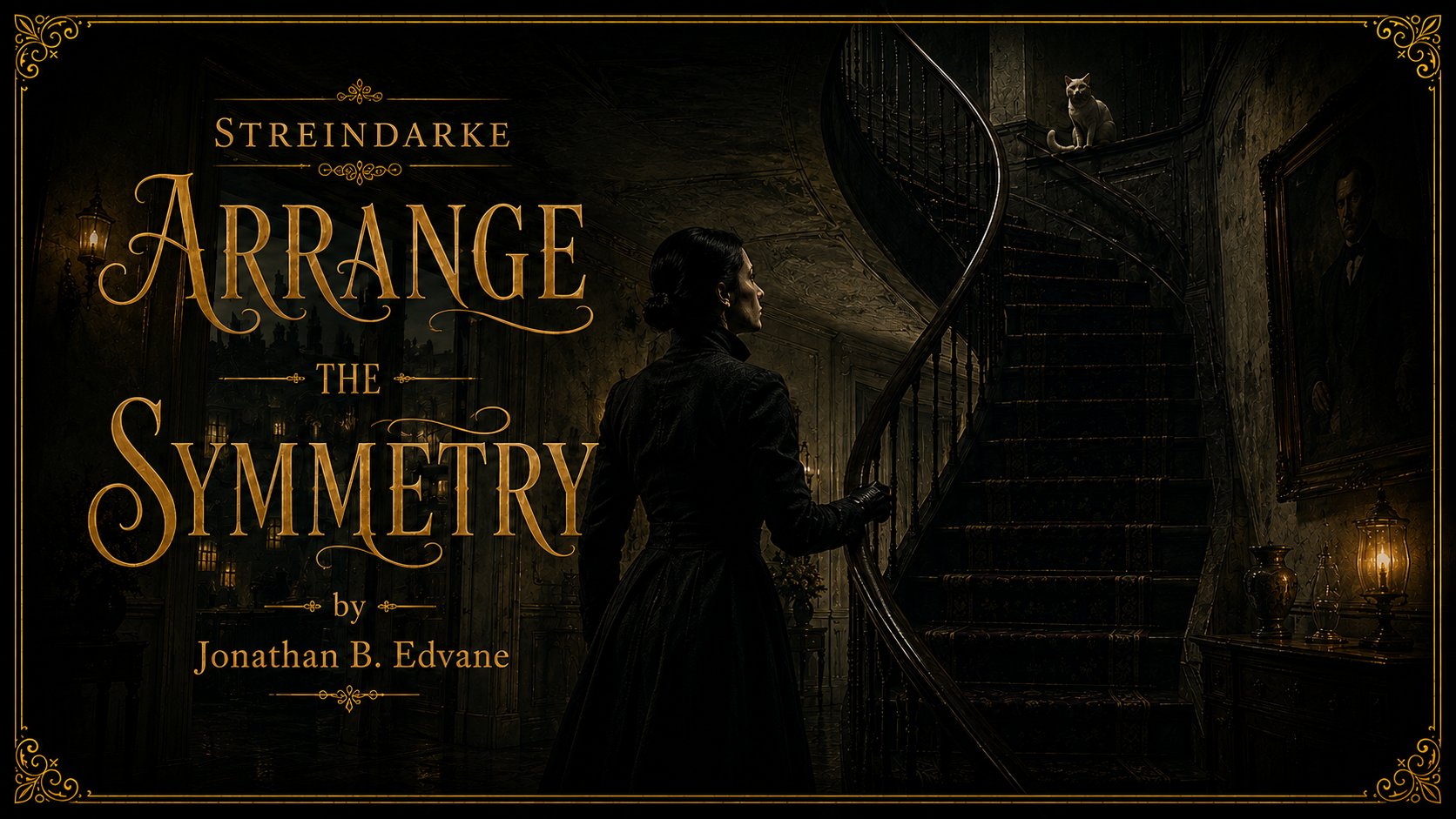
In Streindarke, unrest was not permitted the dignity of beginning.
It was detected first as imbalance, as tone, as a hesitation before applause, as a door closed too quickly in one of the upper courts. By the time poorer districts understood that something had happened, Civic Quiet had usually been and gone, leaving no statement behind, and only a slight improvement in the behaviour of those who had almost spoken.
Ballion had served there long enough to know the limits of such power. Her credentials opened doors, halted servants, silenced dinner tables, and turned important faces carefully blank when she entered a room unannounced. It allowed her to inspect private papers, question household staff, examine absences, and recommend correction. Recommend. That was the word that had followed her for years like a small, patient animal.
“You have influence enough,” Director Chemgoc had once told her, in the tone senior men used when denying a thing while pretending to grant it. “What you lack is improvement.”
He had meant the stallions. He had meant the stats. He had meant all those evenings by which Ballion made the hours obey her when office no longer would. They knew, of course. Streindarke always knew. It forgave nothing, but it often made use of what it refused to forgive.
So she remained where she was, neither rising nor falling, too useful to discard and too flawed to advance. She lived alone, ate precisely, slept poorly, and took such pleasures as could be found in the minor cruelties of arrival. A door opened before it was knocked upon. A nobleman’s hand trembled over a glass. A hostess laughed once too loudly, then understood who had entered.
That morning, Verenis came to her desk with a sealed slip held in both hands.
“Civic Quiet,” he said, because he had not yet learned how little titles comforted those who possessed them. “There is an absence in the Ben-Sashe residence.”
Ballion continued reading field reports. “Deaths are absences. Journeys are absences. Boredom produces absences in half the upper courts.”
“Lord Suze failed to attend the Meridian reception, then missed a private advisory hour at Court Three. His staff have not answered formal approach.”
Now she looked up.
Verenis was young enough to mistake her stillness for thought. “The concern is reputational,” he added. “Several names may be exposed if the matter is not kept narrow.”
Lord Suze Ben-Sashe. Beautiful, purchasable, dangerous. Men denied him in daylight and sent carriages after dark.
Ballion reached for her gloves. “Then we shall keep it narrow.”
Verenis opened his mouth, perhaps to ask whether assistance should be requested first, but thought better of it.
“Bring the carriage,” Ballion said. “And no written entry until I have seen the rooms.”
The Ben-Sashe residence stood in one of the quieter ascents above Court Three, where Streindarke’s wealth ceased to advertise itself and began instead to assume that others would notice. Its entrance held no pomposity. Dark stone, polished brass, a porter’s grille closed from within, and beside it the civic escalator rising behind glass with that moral silence ubiquitous to Streindarke.
Ballion stepped onto it without waiting for Verenis. The motion took her upward at the same pace it always had, smooth enough to flatter the body into believing it had chosen elevation for itself. She had ridden it before in a black evening coat, uncredentialed, with a private appointment folded inside her glove and no intention of asking questions. The memory moved beside her now, unwelcome and exact.
Verenis stood one step below, careful not to crowd her. “Shall I request structural attendance, Civic Quiet?”
“For an absence?”
“For the sealed entrance. For the lack of response.”
“For your nerves, perhaps.”
He lowered his eyes. “As you advise.”
“I do not advise yet,” Ballion said. “I observe.”
At the upper landing, the corridor waited in long, expensive quiet. No servant appeared. No neighbour’s door opened. Such buildings were designed to conceal disturbance, but this was more than discretion. This was the quiet of a room after the last breath had left it.
Ballion presented her credentials to the lock. The plate warmed, clicked, and withdrew any objection it may have been preparing.
“Remain here,” she told Verenis.
He glanced past her into the unlit hall. “Alone?”
“That is generally what remain means.”
“I meant, if assistance is required.”
“Then you may enjoy being necessary.”
She entered before he could answer. The apartment smelled faintly of extinguished perfume and old flowers. Some expensive residue of life halted without warning. The outer hall was unremarkable. A long runner lay straight along the floor. A mirror showed her standing where she ought to stand. Gloves rested on a little lacquered table. A silver tray held invitations, two unopened, one creased and refolded. Nothing had been overturned. Nothing declared itself.
That was the trouble.
Ballion moved through the receiving room with some irritation because she knew the arrangement too well. There was the low couch where Lord Suze had once watched her remove her gloves finger by finger, smiling at her. There was the cabinet where the decanter had stood. There, near the window, the chair he preferred when he wished to appear bored by desire.
A sound came from above her, and she stopped.
On the top of a tall bookcase, where no animal of ordinary laziness should have bothered to climb, Christine sat with her white paws tucked beneath her and her yellow eyes fixed downward.
“You,” she said.
The cat did not move. It had seen her before, not as Civic Quiet, or as an officer of restrained inquiry. It knew her as the woman leaving before dawn with her collar misfastened and her dignity arranged in haste. Ballion looked away first.
From the corridor, Verenis called, “Civic Quiet?”
“Wait.”
Her hand had already gone to the small tin inside her coat. She opened it, placed two stats beneath her tongue, and stood quite still until their dry, metallic calm began to spread through her. Then she closed the tin, replaced it carefully, and looked up again. Christine was gone.
The stats did not make Ballion calm so much as more able to imitate calm. They laid a clean surface over the disorder beneath it, and for several moments that was enough. She took out her notebook, merely as a gesture belonging to her office and somehow steadying her hand.
Lord Suze’s rooms yielded themselves one by one with the same careful absence. In the dining alcove, two glasses stood washed and inverted beside a bottle left uncorked but untouched. In the dressing room, coats hung according to shade, from pearl grey to funeral black, each more expensive than the salary of a junior clerk. A drawer stood half open. Inside lay folded silk, pearl studs, scent bottles and a packet of letters tied with green thread.
Ballion loosened the thread with the point of one fingernail. The letters did not need to name their authors. Certain men had habits even in concealment. One wrote on the thin blue paper issued only to advisory chambers. Another pressed too hard, as if command could be carried through ink. A third had sealed his note with blank wax, then ruined the precaution by using a phrase Ballion had heard him speak twice in council and once over wine.
She closed the packet.
“Fools,” she said, but softly, because she was not speaking only of them.
From the corridor came Verenis again. “Civic Quiet, shall I enter?”
“No.”
“There has been no response from the station clerk. I have requested assistance and received deferral.”
“Deferral is not refusal.”
“No, Civic Quiet.”
“It is merely refusal in its court dress.”
There was a pause long enough to be agreement.
Ballion moved on. In the bedchamber, the air changed. It was naturally more intimate, yet she felt that it now resented her official breath. The bed had been made. The black coverlet lay smooth, its corners exact. On the side table stood a lamp, a book opened face down, and a little porcelain dish in which Christine’s shed hairs clung to the glaze. Ballion looked at the floor, then at the chair near the screen, and memory arrived with an almost physical discourtesy.
Suze in black silk, loose at the throat, laughing without pleasure as Ballion stood too stiffly before him.
“You even undress like an inquiry,” he had said.
“You complain after taking my payment?”
“I observe. Just like you, Ballion.”
He had crossed the room, beautiful in that careless way which was never careless at all. Every movement adjusted to make the unrestrained want appear to be the other person’s weakness. Ballion remembered his hand at her collar, his mouth near her ear, the smell of smoke, powder and expensive soap. Christine had watched from the dressing table, indifferent and superior.
Later, while Ballion fastened herself again, Suze had sat wrapped in the same dark silk, one bare knee visible beneath it, and said, “We are not so different, you and I, Ballion.”
She had laughed, of course. Her cruelty was generally clever enough to pass for wit.
“You are purchased,” Ballion had replied.
“And you are authorised, Ballion. Arrange the symmetry and you will see it. Arrange it properly, and you will know.”
At the time, she had treated the remark as performance, some bitter display sold with the rest. Now it returned from the walls as though it had waited for her.
A scrape sounded behind the screen, and Ballion turned sharply. Christine stepped out from its shadow, tail high, and crossed the floor with delicate indifference. At the door, she looked back once, then slipped through, though Ballion would have sworn the door had been nearly closed.
“Christine,” Ballion said, and somewhat despised herself for using the name.
The cat did not stop, so she followed through the dressing room and into a narrow service passage she had never noticed on previous visits. At its end stood a plain white door with no handle plate, no number, or apparent domestic purpose. She pressed it and found it unlatched. Beyond lay a stair, carpeted, narrow and spiralling upward into the dark.
Ballion stood at the foot of the stair and listened. Nothing in the passage behind her moved. Nothing in the rooms she had crossed disturbed the expensive stillness of Lord Suze’s home. Yet from somewhere within the stair came a soft tread, muffled by carpet. One foot, then another. A pause. Then two more steps. It sounded like someone above her had heard her arrive and was deciding whether to continue.
“Verenis,” she called, not loudly.
The answer came from too far away. “Civic Quiet?”
“Send again. I require assistance.”
There was a pause in which Streindarke seemed to draw breath through all its hidden pipes and polished vents.
“The station clerk has deferred attendance,” Verenis said. “Structural authority requires senior confirmation. Medical will not attend without a declaration of injury. Shall I escalate?”
Ballion looked up into the stairwell. Its spiral narrowed as it rose, turning upon itself with a neatness that made the dark above it seem deliberate.
“Escalate quietly.”
“Yes, Civic Quiet.”
She waited another moment, hating him for being below, hating herself for wanting him nearer, then placed one hand on the rail and climbed. The carpet swallowed her steps. That was the first offence. In public buildings, sound belonged to order. Footsteps declared approach, rank, urgency, or permission. Here, her own ascent vanished beneath her.
Christine appeared three turns above her, seated on the inner edge of a landing no wider than a servant’s tray. Her tail flexed as she looked back down.
“You should not be there,” Ballion said.
The cat just blinked, and Ballion climbed toward her, but after seven steps, or perhaps nine, the landing was empty. Below now, a sound caught her attention. She looked down and saw Christine on the stair beneath her, looking up with the same mild contempt.
The stats had settled fully now. They steadied the edges of things but made the centre unreliable. The banister gleamed too cleanly. The walls were too close. When she touched the papered plaster, she felt the faint warmth of a room recently occupied.
She climbed again, and at the next turn, she found herself standing on another landing. Ballion stood there and breathed through her nose until the unpleasant taste beneath her tongue receded.
Then she noticed the mirror. It was the mirror from the entrance hall. Not similar. The same one. It showed her standing with one glove creased in her fist and her face arranged into official indifference. Behind her, in the glass, lay the long runner from the outer hall, straight along the floor, leading back to the door by which she had entered.
Ballion turned. She was standing in the hall.
No. That was the word, immediate and professional. No. She had climbed. The stair was behind her. The service passage was behind the stair. The hall lay below and elsewhere. Her mind produced the sequence with desperate urgency, each fact placed beside the next like evidence on a table.
The hall remained around her, and from above came the muffled footsteps again.
Ballion turned back and found the spiral stair where the mirror had been, rising from the wall, awaiting her return. The steps seemed to twist while she watched, altering their agreement with one another. The outer edge slipped downward. The inner rail leaned inward. The stair did not spin in any theatrical manner. It simply persuaded her that stillness had never been one of its obligations.
She gripped the rail harder and climbed.
Suze’s voice returned to her. “You are authorised,” he had said, smiling in his black silk. “I am purchased. There is less distance between those arrangements than you flatter yourself to require.”
“You mistake permission for understanding,” she had told him.
“No, Ballion. I mistake neither. That is why people pay me.”
The steps narrowed. Her shoulder brushed the wall. Somewhere below, Verenis called again, but the words arrived shredded by the turn of the stair.
“Civic Quiet? Assistance has been… delayed. Civic Quiet?”
Of course it had. Help in Streindarke was always available after the proper person had decided what form of suffering could safely be witnessed. Ballion almost laughed, but the sound failed before leaving her mouth.
She climbed past another landing, then another, though the house from outside had possessed no height sufficient to contain them. A faint scent of Suze’s rooms drifted down. Smoke, soap, silk warmed by skin. Christine waited above, a pale shape in the dark, then slipped through a door Ballion had not yet seen.
When Ballion reached it, she was sweating beneath her collar. The door was plain, white, and perfectly centred at the top of the spiral.
She ascended and opened the door.
The room beyond was small, square, and windowless. Its walls had been painted the same white as the door. One chair stood in the centre. One narrow table had been placed beside it. Above them, from a ceiling hook too clean to be old, Lord Suze Ben-Sashe hung in his black silk dressing gown, the garment closed enough for decency and loose enough to make secrecy useless.
For a moment, Ballion saw him as she had last seen him alive. Amused, fragrant, bare beneath the silk, watching her arrange herself into an official shape before leaving his bed.
Then death took back the room. “No,” she said, though there was no one living to correct.
On the table lay an envelope. Her name was written across it in Suze’s hand. Not her title, just Ballion. She opened it with fingers that did not feel properly attached to her body. Inside was a single line.
Arrange the Symmetry.
The words did not explain themselves, but the night did. Suze had made a room of it. The chair, the table, the silk, the body, the note, and, most importantly, the woman he had banked on being sent to find him. He had placed her where she belonged in the pattern and trusted her to misunderstand it until too late.
Behind her, something brushed the floor, and she turned. Christine was not at the door. The stair waited instead, descending in a spiral back toward Verenis and a normal routine.
She folded the note. “Verenis,” she called, and heard her own voice fall away.
No answer came.
Ballion stepped out and closed the door carefully behind her.
The report later recorded that Civic Quiet Ballion suffered a fatal misstep while conducting an upper-court welfare inquiry. No related civic irregularity was established. The Ben-Sashe matter was closed under senior review. Newly promoted Civic Quiet Verenis would dutifully ensure that its implications were contained, its record corrected, its symmetry restored.
This story was inspired by the song The Staircase (Mystery) by Siouxsie and the Banshees
I welcome polite comments. If you enjoyed this story, you might also enjoy this other Streindarke story: His Pretentious Love
Leave a Reply