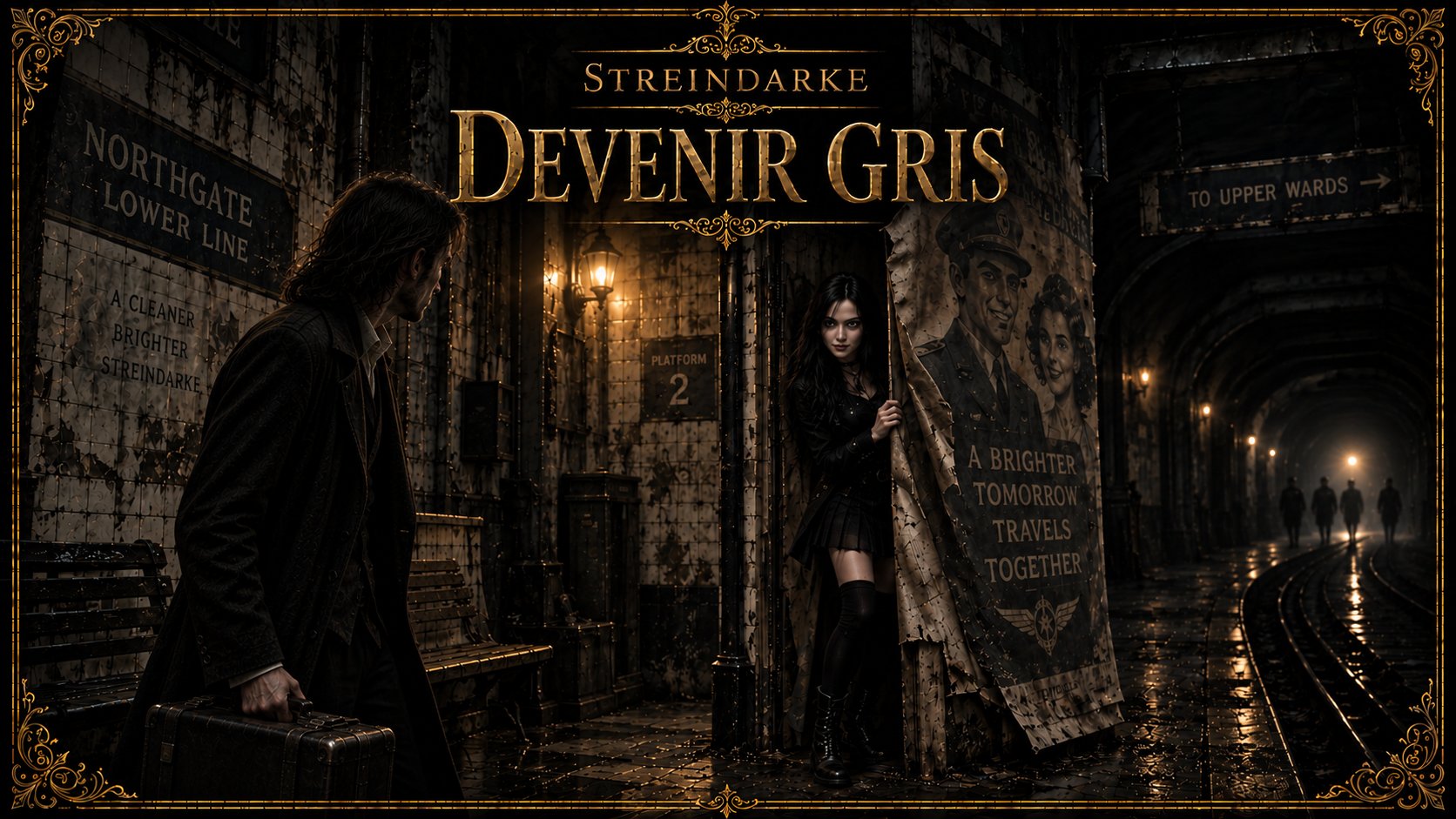
Rhett Bormis couldn’t imagine how long he had been walking when the city quieted behind him, and the streets began to give way to the old transit works. He had somehow avoided the larger avenues and used narrower roads where lamps were fewer, and the buildings seemed to draw closer together. Somewhere, Streindarke was already correcting the evening.
The case in his hand had grown heavier with every street. It contained objects reached for through instinct, rather than decision. A clean shirt. Two brushes. A small tin of pigment. Money enough for several days, if money would continue to matter. He had packed without thinking and left without knowing where he was going.
The abandoned platform lay below street level, reached by a stair whose tiled walls had lost their shine beneath years of grime and neglect. Rhett descended because it was there. At the bottom, a single lamp still burned beneath an old enamel sign bearing a district name the city no longer used. The rails beyond the platform were dull with rust. Grit had gathered along the wall where generations of shoes had once disturbed it. Water moved somewhere inside the masonry though he could not see it.
He set down the case. For the first time since leaving the mortuary, he stopped, and Charlotte came back to him immediately.
Not as she had looked beneath the lamp, though that came too. The evidence of pressure at her throat. The damaged wrist. The mouth he had refused to soften into peace. What returned first was Charlotte alive, standing beside the window in his rooms and telling him that he would one day disappear behind his own caution.
He had thought her unfair. He almost laughed remembering it, but the sound would not come.
He sat upon a wooden bench and looked towards the black mouth of the tunnel. Somewhere beyond the platform, from a place he could not identify, several notes of music repeated themselves faintly. They were thin with distance and distortion, part of some abandoned mechanism that had forgotten it was obsolete. Rhett recalled the viewing chamber and the moment the covering had been drawn back. He remembered the stillness that followed, the physician staring at him, the officials moving once they understood what he had done. Charlotte had been visible for perhaps a minute. Perhaps less.
Was that all he had managed for her? A minute of truth after years of cowardice? Those questions exhausted him more completely than the walking had done.
He knew they would come.
Streindarke did not forgive public embarrassment, especially when the embarrassment had a dead woman’s face. Somewhere his name would already be moving through offices faster than he ever could.
A light appeared at the far end of the tunnel, and Rhett watched it grow. For several seconds he remained seated. Then he thought of Charlotte once more and knew that if they took him now, the city would close the matter neatly around them both. He stood, lifted the case, and walked towards the dark. Rhett moved quickly at first, although he had no idea whether speed would help him. The old passage curved away from the platform and carried him through a succession of tiled corridors where the lighting had failed in uneven sections. His boots sounded too loudly against the floor. Twice he looked behind and saw nothing, yet the knowledge that someone had entered the abandoned line remained stronger than the sight of a pursuer.
At the next junction he chose a wider stair and almost reached it before a female voice said his name.
“Rhett Bormis.”
He stopped.
A girl stood partly concealed behind a large civic poster that had come loose from its mounting and bowed outward from the wall. The image on it showed a smiling couple beneath the slogan of some long-forgotten transport campaign. For a moment Rhett had the absurd impression that she had stepped directly out of the advertisement.
She was perhaps twenty, perhaps a little older, with black hair falling untidily about a pale face. Her clothes were dark and severe, and he didn’t recognise them as a Streindarke uniform. She eyed him suspiciously, showing neither alarm nor admiration.
“You need to come away from there,” she said.
Rhett stared at her. “How do you know my name?”
“Everyone knows your name now.”
That halted him more effectively than the sound of pursuit had. She stepped out fully from behind the poster and grabbed his arm before he could object. Behind it was a narrow maintenance opening that Rhett would never have noticed. He resisted for only a second.
“I saw you on the broadcast,” she said as she pulled him through. “They showed your face twice.”
“What did they say?”
“That you were required for questioning after a serious procedural disturbance.”
Rhett recognised the sterilisation of the language. Streindarke could make murder sound like untidiness and cowardice sound administrative. “And that made you decide to help me?”
“No. It made me decide they wanted you found before anyone could ask why you did it.”
The passage behind the poster was cramped and smelled dank and metallic. The mysterious young woman moved through it without hesitation. Rhett followed, carrying the case awkwardly at his side.
“My name is Dove,” she said after a while. “You can ask the rest later.”
Behind them, somewhere beyond the wall, a clanging noise travelled through the station, and Rhett glanced back.
Dove did not. “Stop doing that,” she said. “You are telling them exactly what you are.”
“And what am I?”
“Frightened.”
She looked at him for a second, and added that frightened men were easy to see. The faint music returned through the walls, several more notes distorted by the distance. Dove listened until they faded, then led him deeper into the dark. She took Rhett through the forgotten parts of the system. The passages narrowed, opened, narrowed again, sometimes ending at service doors that opened onto active corridors where the city still moved with its usual confidence. Each time, Dove stopped him before he crossed.
“You are still walking like yourself,” she said.
Rhett looked at her. “I have been myself for some time.”
“That will now be a problem.”
She led him into a shallow recess behind a bank of obsolete electrical cabinets and looked at him more seriously this time. His coat was still too well cut. His collar sat correctly. His hair, though disordered by haste, retained the habit of a man accustomed to mirrors and professional rooms. Dove reached towards his face with two fingers, then stopped.
“What?”
“You look exactly like the picture they showed.”
Rhett opened the case and set it on the floor between them. Dove watched as he took out the small tin of pigment and one of the brushes he had packed without understanding why. The sight of them almost embarrassed him. They belonged to another life, yet his hands knew what to do before his mind had finished deciding.
He used the dull reflection in a metal cabinet door. The first alteration was around the eyes, reducing the contrast there and dragging the attention away from their shape. A little shadow beneath one cheek changed the balance of his face. He flattened his hair differently, then rubbed grit between his fingers and worked it lightly along the collar and cuffs until the remaining neatness looked accidental.
Dove watched him work.
“You did that to the dead?”
“Yes. I made them resemble what their families preferred to see.”
“That sounds kind.”
“Only for the living.”
He adjusted the set of his mouth and let his shoulders fall slightly forward. That mattered more than the pigment. A man in fear held himself too carefully. A tired clerk, porter or maintenance worker carried his body as though nobody had been interested in it for years. When Rhett looked again at the metal reflection, he saw someone he might have passed in the street without remembering.
Dove smiled. “Better.”
They emerged into an active concourse two levels above the abandoned line. People moved around them carrying parcels, newspapers and covered baskets. A civic screen hung above the ticket barriers. Rhett’s own face appeared upon it almost at once.
Dove’s hand closed around his wrist. “Keep walking.”
The broadcast described him as required for immediate civic assistance following an irregularity in the mortuary quarter. The image was clear, composed and recognisable. Rhett passed beneath it, but nobody looked twice. Something changed at that moment. For years he had believed appearance served record, that the face merely submitted to whatever authority had already decided. But the opposite could also be true. The record could be made blind.
At the far side of the concourse, Dove released his wrist. “Now you understand.”
Rhett glanced back at the screen, then towards the service door ahead. “Yes,” he said. “I think I do.”
They left the concourse by a service stair and returned to the older levels beneath it, where the city had less reason to maintain appearances. Dove moved more cautiously now. She still knew the routes, but she had begun to pause before doors she had crossed without thought before. At the third junction she stopped altogether. A civic locking device had been fitted across the passage ahead. “That was not there yesterday,” she said.
Rhett looked at the fresh metal plate against the older door. “Then they know these routes.”
“They know some of them.”
Dove turned back without wasting time, but the change in her manner was obvious. Until then, she had treated the pursuit as something that could be outmanoeuvred by her local knowledge. Now Streindarke was beginning to alter the ground beneath them. They took another passage and climbed beneath a ventilation shaft where rain splashed against the grilles above. The sound followed them for several minutes, sometimes close, sometimes distant.
Dove waited until they reached a narrow landing before she spoke again. “You are not being searched for like a common criminal,” she said. “They are closing old access routes and waking stations nobody has used in years. What really happened in that mortuary?”
Rhett leaned against the wall. He had hoped to avoid this question, but Dove was looking at him and evidently trying to decide whether he had become too dangerous to continue helping. “There was a woman,” he said.
Dove waited.
“Charlotte. I knew her before. She and I were… They brought her to me with a cause of death that was not true.” He found himself seeing her again beneath the lamps. The damage at the throat. The bruising. The city’s diagnosis written beside her name. “They expected me to hide what had been done to her.”
“And you did not.”
“No.”
Dove thought for a moment. “So you made them show their lie, because you once cared for her.”
“I allowed the truth to remain visible.”
Dove looked away towards the passage ahead. “That is much worse.”
Rhett was about to ask for whom, when a tone sounded somewhere. Not the broken melody they had heard before, but a civic signal. Dove crossed quickly to an inspection grille and looked through.
“Come here.”
Beyond the grille, on an active service route below, two uniformed officers were speaking with a transit supervisor. One held a small illuminated slate. Rhett could not hear what was being said, but the supervisor pointed towards the older tunnels.
Dove stepped back. “They are ahead of us now.”
The distant music returned, faint and warped, several notes rising behind the civic signal before vanishing again. Dove chose another route, and Rhett followed. Above them, the rain kept lashing the city while, one by one, the forgotten passages were rediscovered. The passage Dove chose brought them down through a service stair that had partly collapsed at the lower turn, forcing them sideways through a maintenance door and into a chamber Rhett guessed had once housed signal equipment. The walls were lined with dead panels and lengths of cable thick with dust. Beyond them, another corridor ran towards the eastern side of the abandoned line.
Dove listened before opening the next door. “Too quiet,” she said.
Rhett had begun to notice that silence meant more to her than sound. He stood behind her while she eased the door inward and looked through the narrow opening. She closed it again at once. “They are there.”
Rhett felt the words settle rather than strike. “How many?”
“Enough.”
Behind them came another sound, faint at first, then clearer. Footsteps travelled through the passage they had just crossed. Not hurried. The authorities no longer needed haste. Dove looked towards the collapsed stair, then at the sealed maintenance door on the opposite wall. She tried the handle anyway, though Rhett could see from the plate that it had not moved in years.
For several seconds neither spoke.
The strange calm that had held him on the platform returned. He recognised it with disgust. He became aware of the old temptation to stop resisting and let events finish themselves. Streindarke had always made surrender easy by presenting it as the end of uncertainty.
Yet the feeling no longer fit him.
He thought of Charlotte in the viewing chamber, visible beneath the light for those few uncompromised moments, then contemplated the concourse and his own face passing unnoticed beneath its broadcast image. Somewhere between the two, something had changed. He had spent years wishing his life would become shorter simply because he had not known what else to do with it. Now, with the authorities approaching from both directions, he found that he wanted more of it.
Dove glanced at him. “If they separate us, say nothing about these tunnels.”
“They will know.”
“They know routes. They do not know people.”
Before Rhett could answer, a harsh signal sounded somewhere above them. The footsteps behind them stopped. A second alarm followed, then the deep mechanical vibration of something large moving through the old system. Dove’s head lifted. Somewhere beyond the wall, metal struck metal and a service bell began ringing in rapid succession. Voices called from the corridor ahead. The officers there answered, then withdrew with sudden purpose.
Dove was already moving.
“What happened?” asked Rhett.
“Someone opened a line that should be dead.”
She pulled the door wide and stepped into the corridor. Far off, an emergency lamp began flashing over a junction, and beyond it the search party disappeared toward the active tracks. Rhett followed, and when they reached the junction Dove allowed herself a smile. “That was not an accident.”
The corridor beyond the junction carried them towards a service platform that had not appeared on any public map for years. Its lamps were dark, but a narrow strip of light showed beneath a door at the far end. Dove crossed quickly and knocked twice, paused, then once more.
The door opened before Rhett had time to wonder who might be waiting behind it.
A tall man stood there. His face was calm, but not welcoming. Behind him, a woman in a dark blue coat looked past his shoulder and saw Dove first.
“You took your time,” she said.
Dove stepped inside. “I was delayed.”
The woman’s eyes moved to Rhett. “Clearly.”
They entered a cramped room furnished with little more than a table, two chairs and shelves holding maps, tins and folded clothing. The tall man closed the door behind them and listened for several seconds before sliding a bolt into place.
Dove introduced them. Lysand DaVivi and Canto Barbi. The names meant nothing to Rhett, but the manner in which Dove said them suggested that elsewhere in Streindarke they once had.
Lysand looked at her. “You were seen near the western passages.”
“I know.”
“We opened the old service line when the search turned east. Canto triggered the carriage movement.”
Canto gave a small shrug. “They still trust alarms more than people.”
Rhett sat because his legs had begun to object to the night. He set the case beside his chair and became aware of all three of them looking at him. Lysand asked Dove who he was.
She smiled at Rhett. “I thought you might already know.”
Rhett realised then that while Dove had recognised his face, but not his life, he now needed to explain why the city was acting with such force.
“My name is Rhett Bormis.”
Canto’s gasped slightly. “The mortuary man?” she said, and Rhett looked at her.
Lysand nodded in recognition. “We heard about the viewing.”
For a moment Rhett said nothing. He had spent the entire night believing the incident had already been sealed behind official language and correction. “What did you hear?”
“That the body did not match the record,” Canto said. “That you left the evidence visible.”
Rhett looked down at his hands. Charlotte had been seen. The knowledge entered him quietly, but it altered the room more completely than anything else that night. Streindarke had not managed to close over her entirely. Somewhere between the viewing chamber and the streets, the truth had escaped.
Lysand sat opposite him. “They will not stop looking.”
“I know.”
“Then Rhett Bormis cannot keep walking around Streindarke.”
Canto leaned against the table. “People disappear here every day. The city taught us how. We have learned to choose the direction.”
Dove watched Rhett carefully, then placed her hand on his. Looking at her, he sensed that the loss of his old life need not feel only like punishment. It could become material. He looked at the small case beside him and realised that whatever remained of Rhett Bormis would have to become useful.
Rhett placed his hand over Dove’s. “What now then?”
“You fade to grey.”
This Streindarke story was inspired by the song Fade To Grey by Visage
I welcome polite comments. If you enjoyed this tale, then you might also enjoy these other Streindarke Stories. His Pretentious Love, Under A Yellow Moon, Arrange The Symmetry, I Spill It All and To Shy From The Rain.
Leave a Reply