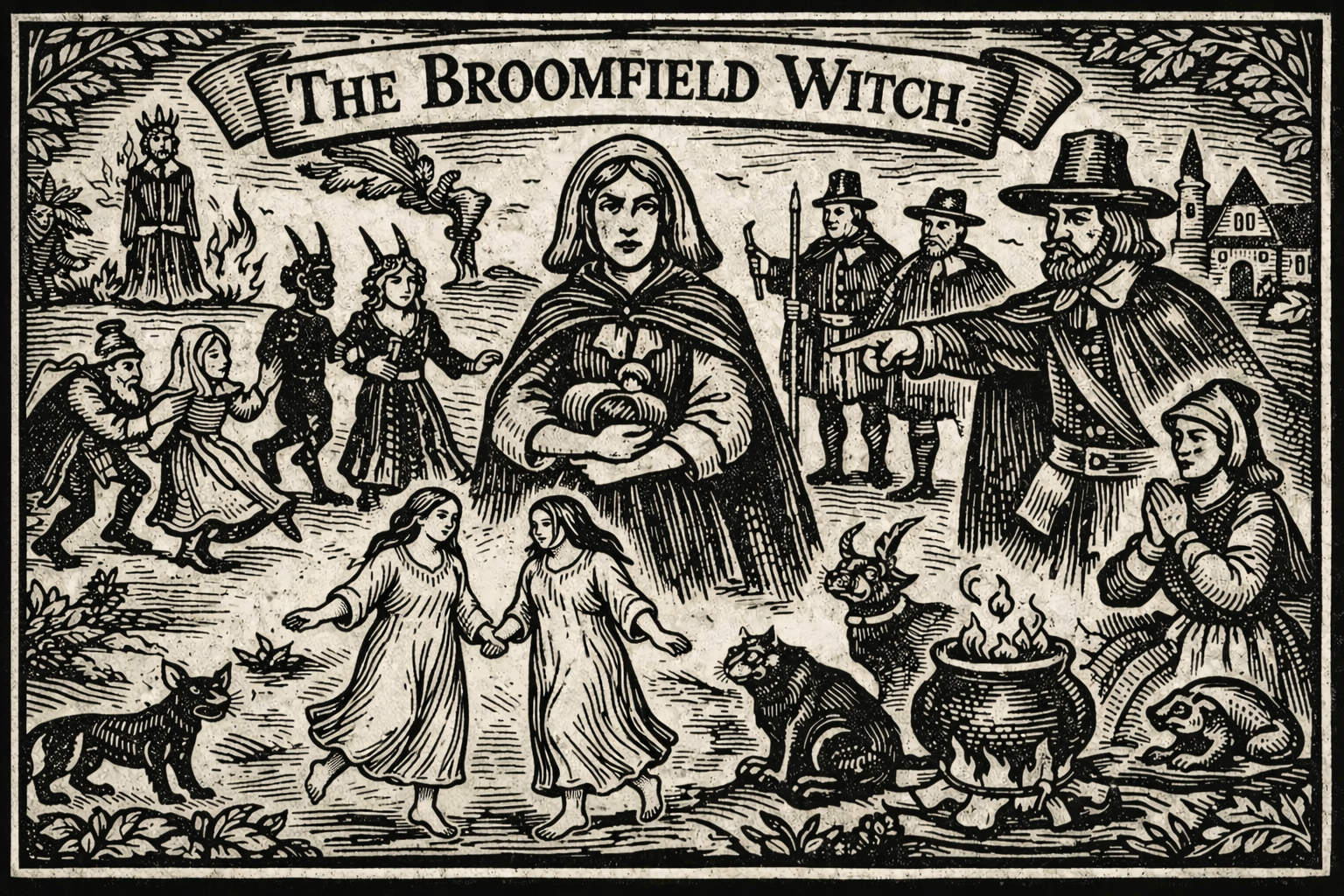
I am Jess Harwood of Broomfield, and when I came back to my mother’s house, I had been absent near seven years. In all that time, I had not once expected to cross her threshold again, except perhaps to see her laid out. I did not think to find the place standing open to me by law and blood after she had been burned, nor to come to it with the lane quiet behind me and no hand raised either to stop me or to welcome me in. Such mercies as the parish had ever shown her ended at the stake. What remained to her was left for me.
I had the key in my pocket, wrapped in a rag because I could not bear the feel of the bare iron against my hand all the way from Great Waltham. It had been handed to me by the constable, and he would not meet my eye when he did it. He said only that the dwelling and goods, such as they were, fell to me now, if I meant to claim them. I took the key and said nothing. There are times when silence serves better than spirit.
The house stood abandoned, with the ditch thickened by reeds and the patch of garden gone to stalk and rot. The roof had sagged more than I remembered. There was no charm hung over the door, no bunch of rowan, no rag, no skull, no village foolishness of that sort. My mother had no taste for show. If others made her into a tale for their comfort, that was their own work.
When I turned the key, the latch stuck. I had to set my shoulder to the plank and force it inward. I stood just within and waited for my eyes to settle. There was the hearth, black and low. There was the table, scrubbed once and then left to collect dust. There was the settle under the wall, the three-legged stool, the hanging line with two bunches of something brown and brittle still tied upon it. I had half thought that I should feel some violent impression upon entering, terror perhaps, or pity, or the old shrinking that used to seize me when I heard her tread after midnight. Instead, I felt only the flat weight of business.
A basin stood by the hearth with a skin of dried matter at the bottom. A strip of linen lay over the back of the settle, stiff where it had once been wet. Near the bed-place was a small earthen jar with its cork loose and a black rim around the lip. These were not relics laid out by grief. They were the remnants of interrupted use. It came to me at once, and against my will, that she had not left the house as a woman quits it for market or church. She had been taken out of it. Her hand had been stopped in the midst of labour. That thought did not soften me toward her. Not then. Yet I remember that I set the basin upright with more care than was needed.
I knew the room too well for comfort. There was the beam I had once struck my head on, running from her temper. There was the peg where her cloak had hung, winter and summer. There was the crack by the shutter through which the wind used to speak on hard nights. It is strange what returns first. Not love or sorrow, just the body’s memory of ducking, reaching, listening, and waiting to be called. I saw again the mother I had known before the change came over her. A woman quick in hand and step, stern at times, but not unkind without cause. Women came to her then as they came to many such women, for brewing herbs, for salves, for advice when children burned with fever, or men fouled their blood with bad drink and worse sense. Then later came the watching, the locking away of things, the sudden silences, the nights she would sit wakeful by a covered pan, somehow expecting speech from it. Then the sharpness. Then the rages. Then the day she told me I was to go to my aunt in Great Waltham and be thankful for it.
She had not wept when she sent me. I had done enough of that for both of us. She said the house was no place for me and that I had become more hindrance than help. She said I had my father’s softness and should make a poor end if I stayed where there was real work to be borne. I have remembered those words often, and never kindly. Standing there in the room after her burning, I remembered them again and thought that whatever else the parish had lied about, they had not lied in saying she had gone past mercy before the end.
I set down my bundle on the table, opened the shutter and caught movement by the hedge. Someone had waited to see whether I would truly enter. When I looked full that way, the figure retreated. That too was as it had always been. They would not cross the threshold by day, yet they would keep account of who did.
So I tied up my sleeves and began with the hearth, as any woman must begin where a house has stood neglected, though all the while I had the odd and growing sense that I had not come into an empty place at all. I had come into the pause left by something unfinished.
I had not been in the house a full day before the first knock came, though it was no true knocking. It was the doubtful touch of nails against wood, the caller wishing the door to answer of itself and save her the shame of being found there. By this time, I had cleared the hearth, drawn two pails, swept out the worst of the rush rot, and opened a chest in which I found linen, a winter kirtle gone shiny at the folds, three packets of dried leaves tied with thread, and my own old wooden comb with two teeth missing. I had eaten bread and onion standing up and was thinking whether the bed rope would bear my weight for one more night before it needed restringing when I heard the sound.
It was Mary Pepper at the door, though now a married woman and with the look of one already worn by that condition. Her face was thinner than I remembered, yet she had the same fair lashes and the same way of holding herself, ready to apologise for having a body at all. We had run the lanes together as girls before my mother’s name settled too heavily on me for such freedoms to continue. She had not written. I had not expected her to come. Yet there she stood with a child on her hip, her sister’s boy, and the little creature burned so hot at the face that even from the threshold I could see the flush standing hard upon his cheeks.
“I would not have troubled you,” she said, which was plainly not true, “only he has run with it since morning and cannot hold water.”
I looked past her. The lane was empty. She had come alone and secretly, which told me all I needed to know of Broomfield’s present courage. I let her in.
The boy’s eyes had the dim, inward look of fever. Mary kept speaking in little hurried pieces. Her sister had dosed him with broth and vinegar. The priest had said to keep him clean and pray over him. Henry’s wife had given a little powder that had done no good. Then she lowered her voice and said she remembered what my mother had once done for her brother in a sweating sickness, and before she had finished that sentence, she looked ashamed of it.
I told her to lay him on the settle. There are some things the hand remembers before the mind gives leave. I fetched water, found dried willow bark among the tied bundles, and from another packet leaves I knew by smell though I had not touched them in years. I did not think of my mother while I did it, though of course I was in her motions from the first. The jar I wanted was where my fingers reached for it. The spoon hung where I turned to find it. Mary watched me with that strained stillness the desperate have, half hopeful, half afraid that hope itself might damn them.
The brew was bitter. I cooled it and got some into the child, though much ran from the corner of his mouth. I sponged him down and made Mary hold him upright while I changed the cloth under him. It was no miracle, nor did I pretend one. I said only that if the fever eased and he passed the night, he might live. If not, there was little any soul in Broomfield could do. Mary nodded, but I saw in her face the old village habit of hearing from such women not the thing said, but the thing desired.
When she asked what she owed, I nearly laughed. Owed. As if she had come to market. I told her to bring clean eggs if the boy still breathed by morning. She said she would. Then she hesitated and looked past me into the room.
“You have left it much as it was,” she said.
“I have had one day.”
“No. I meant.” She stopped there and then asked whether I meant to stay.
It was a simple question, but it seemed to come from more than herself. I said the house was mine and the parish had left me little else worth claiming. At that, she gave a small, unhappy smile and shifted the child higher on her shoulder.
As I walked her to the door, she touched my arm very lightly, like the girl she had once been. “They say you have her look already,” she said. “Only not yet the rest.”
I do not know whether she meant to warn me or wound me. Perhaps she did not know herself. When she had gone, the room felt altered by use resumed. Someone had come in need. I had answered it. The old traffic had found the path again quicker than I would have believed.
That night, I began looking more carefully at what had seemed mere disorder. A strip of red wool had been tied inside the cupboard door where no eye would mark it unless searching. Three pewter spoons had been laid in a drawer bowl to handle, bowl to handle, as if according to some rule. In the chest beneath the bed-place, under folded linen and two winter shifts, I found a square of waxed cloth empty of whatever it had once wrapped. It was stained dark at the middle. I sat with it in my hand for some moments, thinking of her habits. My mother had not only hidden things. She had kept them according to order.
I folded the cloth again and put it back where I found it. Then I barred the door, though I could not have said against whom.
On the second day, two more came, and on the third, another. I could have told myself this was a chance, that illness runs where it will and a house long shunned may yet be remembered when pain grows sharp enough, but that would not have been honest even then. Need had reopened the path to my mother’s door, and once one woman had crossed it, the others found courage in secrecy. They came at the edge of dark, or under some poor excuse of passing, each with the same look about the eyes, fearful less of me than of being seen needing me.
I gave what I could from memory and from the stores I found. For a swelling in the jaw, I boiled comfrey and salt. For a cut gone yellow at the edges, I washed it clean and packed it with honey and bruised leaves. For a woman racked with her courses, I made up pennyroyal and willow and warned her to lie still. I took eggs, a heel of cheese, one little twist of bacon, and once a promise that was not worth the air used to utter it. Yet with every cupboard I opened, every jar I lifted to the light, every bundle of dried stalks I turned in my hand, I felt less that I was making my own order in the house than stepping back into one laid down for me years before.
The place had hidden strictness in it. What seemed at first mere thrift or meanness proved arrangement. Things most often used together had been separated, while worthless scraps were kept close and wrapped well. One shelf, warped by damp, held nothing but common stores. Another, higher and harder to reach, had small objects in cloth and ash. I found chalk marks on the inner side of the buttery door, rubbed almost out, then renewed and rubbed again. Beneath the settle cushion was a length of plaited cord with nine knots, blackened at one end. None of this was show. It had the look of rule. I began to see that what I had taken in my girlhood for a sour old woman’s suspicion of disturbance had been something colder and more exact. She had ordered the house around a centre I had not yet found.
It was Mary who brought the need that forced my hand beyond ordinary things. She came before dawn, white with haste, not even shawled properly against the chill. Her cousin Elias had been thrown from a cart in the night. The wheel had not gone over him, but the iron pin or the shaft had torn him in the thigh, and though they had bound it and pressed hard, the blood would not be done. The wife was fainting. The men were useless. Would I come?
I went because there are occasions on which refusal is only another shape of cowardice. He was laid on a board, grey already at the lips, his breeches cut away, the cloth beneath him soaked through. The wound was high and ugly. They had packed it with rag and wool and panic. When I pulled the mess away, the blood came fresh and eager, the body itself wishing to be rid of him.
I had seen such wounds before. Not often, but enough to know what common skill could and could not do. I called for vinegar, clean linen, and more light. I pressed. I packed. I bound. Still, it welled between my fingers in little hot surges. Mary stood behind me with a basin and made no sound at all. The wife prayed aloud in gasps. Speech was all she had left.
I said then what any honest woman might have said, that he was likely dying and they had best send for the priest. Yet even as I spoke it, I knew I was thinking of the square of waxed cloth under the linen chest, of the dark stain at its middle, of the strictness hidden through my mother’s house.
I left them with a compress and ran back through the lane with mud at my hem. The house felt smaller when I re-entered it, and more watchful, though I would not have used that word at the time. I went first to the chest, then to the cupboard, then to the hearth. None yielded it. At last, I stood quite still and looked where my mother would have wished to reach quickest, not safest. My eye went to the back of the chimney breast, to a brick darker than the rest from years of smoke. It gave under my nail. Behind it was a cavity no bigger than two joined fists, lined in soot and old wool. In it lay a bundle wrapped in waxed cloth and bound with thread gone hard as wire.
When I opened it, the thing within seemed for a moment not like a jewel at all, but some clot of thickened dark that had taken shape under pressure. Then the light found it. It was deep red, with a depth that drew me inward. No larger than a pigeon’s egg and heavier than it had any right to be. My hand wanted at once to close round it and to drop it.
I knew, though I could not have said how, that this was the centre of all her order.
There was no time for fear. I wrapped it in the cloth again and carried it back to the house under my apron. Elias had worsened in my absence. His breathing had gone shallow, and his skin waxed over. The wife had begun that low animal moan some women make when they have abandoned hope. I sent them all back from the table except Mary. She did not question me. God knows what she thought she saw in my face.
I unwrapped the stone and set it against the wound through the linen packing, not knowing whether I acted from memory buried too deep or from some instruction the mere holding of it had passed into my hand. It was cold, far colder than river water in winter. Immediately, the blood, which had been pushing warm and bright between my fingers, slowed. It did not stop as a tap is stopped. It faltered, shuddered, and withdrew. It felt like some thirst greater than its own had suddenly met it there.
Elias did not rise. No marvel followed, but he breathed easier and the grey at his mouth lessened. When I drew the cloth aside, the wound was not healed. It was checked, closed inward to a depth no binding ought to master.
I wrapped the stone again, my hands shaking so badly I near dropped it. No one in the room spoke. They all stared as country people stare at weather they cannot account for.
Only later, when I had put the gem back within my apron and was washing my hands in their basin, pink threads unwinding into the water, did I hear it. Not with the ear exactly, and yet as plainly as speech.
Keeper of the Eye of the Dracan. Pledge fealty to Runig of the Gled.
I turned so sharply that the basin rocked. Mary looked at me, but her face told me she had heard nothing.
Elias lived, and the manner of going to and from my house altered. Before, they had come under pressure of need with the look of those stooping to some shameful necessity. After, they came with that same fear, but sharpened now by expectation. It is one thing to ask a woman for herbs because her mother knew the old brews. It is another to come to a house where a man has bled like an opened cask and yet still lived to ask for bread. By the week’s end, there were faces at the door I had not seen since girlhood and names spoken in my hearing by persons who would once have crossed the road rather than greet me.
I did not set the Eye to every trouble brought me. I would have been a fool to do so, and I was not yet so far gone as to mistake power for licence. For common aches, boils, women’s pains, teething fevers, I gave what any sensible and instructed woman might give. I let the house do its old work where the old means would serve. Yet the Eye had altered more than Elias’s wound. It had altered the measure by which I looked at extremity. There was now, in every difficult case, a second reckoning beneath the first. Not only what might be done by broth, binding, cooling, resting, and time, but what might be checked, turned, or drawn away if I took out the red stone and laid it where flesh failed.
I found very quickly that my mother had lived by rules stricter than I had understood. In the recess behind the chimney brick, there had been more than the waxed cloth. Beneath it lay three narrow slips of paper folded and refolded until the edges had begun to go to fluff. Her hand was on them, though the letters were small and pressed hard enough to near cut through the surface. She had not written prayers. Nor were they charms, at least not as village folk use the word for muttered nonsense over butter churns or swollen ankles. They were cautions. Bare phrases. Never twice in one house if blood has been taken there. Never after midnight. Never for the child if the mother asks in hatred. Burn the cloth after flux of the bowels. Keep it from the mouth. Do not hold it to yourself longer than the count of twenty. There were other lines I did not at first understand, and one that had been scored over so many times with the pen that it could not be read at all.
Those papers unsettled me more than the whisper had done. The whisper might still, if I chose, be put down to strain. The papers could not. They proved discipline. They proved repeated use. They proved that my mother had not merely possessed the Eye, but had fought to govern the terms on which it entered the world. I read them half the night by the hearth and remembered, unwillingly and with growing force, the woman she had become in my last years with her. Not only harsh, not only secretive, but exact. Her anger had always come quickest when things were moved from where she kept them, when a cloth was used for the wrong purpose, when I touched what she had set apart. I had called that madness, and the meanness of a woman turned in upon herself. Now I saw the possibility that it had been management, or some remnant of it, under strain.
Mary began coming daily. At first, she had reasons. Elias’s wife wished to know how the wound should be washed. Her own sister had a child still loose in the bowels. There was talk of a swelling in Bess Noake’s throat. Then the reasons dried up, and yet she came. She would fetch water if my back was turned. She would bring eggs, oatcake, drippings, once a little wedge of good cheese wrapped in cloth, and would stand in the doorway with her hands folded in that quiet, waiting way of hers until I either gave her some task or told her to sit. She had become, without any spoken agreement, my witness and helper. If one came by dusk with a trouble to be seen in private, it was Mary who barred the door after them and Mary who rinsed the basin out once they had gone.
There was comfort in it, though I did not admit so much even to myself. A house kept by one pair of hands alone grows too full of its own silence. Mary filled that silence, and because she had known me before I was my mother’s daughter in any public sense, she gave me for a little while the dangerous impression that I might do this work and remain myself.
If there was fault in her, it was a hunger for nearness to me. She watched me more than was needed. Once I turned from the hearth and found her looking at the front of my kirtle where the Eye sat wrapped and hidden in the pocket sewn beneath. Another time I came back from the yard and saw that she had been at the table with the folded slips in her hand, though she put them down at once and coloured when I entered.
She was not made coarse or heedless by this hunger. That would have been easier to deal with. She grew instead more useful, more attentive, more ready to anticipate what I wanted. Eventually, she lay with me and then never left. It made her dangerous because it made her hard to rebuke.
The priest came on a wet afternoon. Mary was there and a woman had just gone from us with a packet for her husband’s cramps. He asked no leave but stepped straight into the room with rain on his shoulders and that pinched, careful look of a man who has spent too long trying to judge rightly and knows too well how often he has failed.
He was not old. I think now he cannot have been more than forty, though as a girl I had taken him for ancient because he belonged to the church and spoke differently to ordinary men. He shut the door and stood some moments looking round the room. Not rudely. Not like the constable would have looked. He looked with sadness and with recognition.
“So it begins again,” he said.
Mary rose, muttering that she should go, but he held up his hand. “Stay, if you please. There is no shame in concern.”
I said there was little concern in arriving unasked to a woman’s house and speaking in riddles. At that, he gave me a glance so weary that I was near ashamed of the sharpness in my tone.
“I was concerned for your mother once,” he said. “I am concerned for you now.”
He spoke then with more frankness than I had expected. He had watched the traffic to my door. He had heard of small recoveries where no skill should have sufficed. He knew what such need does in a parish. First, it excuses. Then it conceals. Then it kneels. He said my mother had not come all at once to the end she met. She had begun, as all such women do, by being useful beyond her proper place. Then she had grown possessive, suspicious, hardened. She had come to believe herself necessary where God alone is necessary. He did not say witch. The room held the word for him.
I asked whether he had come to save my soul or to inventory my mother’s sins in me before the neighbours were ready to speak them aloud. Then he said, very quietly, “I would save your life, if you will let me.”
Had he thundered, I might have laughed. Had he threatened, I might have turned him out. But that answer struck nearer home because I knew, even while I hated him for it, that he believed it. He was not hunting me. He was watching the shape of an old ruin gather itself round another woman and praying perhaps that he was mistaken.
When he had gone, Mary said he feared me.
“No,” I told her. “He fears what use may make of me.”
It was the truest thing I had yet said aloud in that house, and it left a coldness behind it. That night I took out the Eye and held it in the cloth longer than I should have done, counting under my breath as my mother had written, and when I reached twenty I did not put it down. There was no new whisper. None was needed. I had begun already to see the village more clearly than before. They had burned one woman for holding fast what they came by night to beg from her. They would do the same again if it suited them, and call it righteousness both times.
The thought did not horrify me as it ought to have done. It steadied me. That was the beginning of the greater change.
The end came two nights later, and if I set it down plainly, it is because plainness is all that remains to me now. Fine language does not alter blood, nor make justice of what was done by priest or parish or me.
Mary had detained me with her libidinous persuasion until late that evening, later than was needful. There had been no callers after dark, only rain at intervals and the dripping from the eaves. She sat near the hearth, mending a torn cuff for me with such neatness and care that one might have thought herself mistress there already. I remember looking at her bent head and wondering whether she knew how much of her soul had crossed my threshold before her body ever did. She had become easy in the house, easy with my silences, easy with my stores and cloths and hidden things. It was neither the cunning nor the desire in her that troubled me. It was appetite of another sort, the appetite to be admitted, to stand nearer the centre than others, to be the one who need not ask what lay in the wrapped bundle when I took it from its place.
When the knock came this time, it was no woman’s secret touch. It was the hard, flat blow of a man who means to enter and believes he has the right. Mary started and rose half out of her seat. I did not move at once, because I knew who it would be before the second blow fell.
The priest stood there with the constable and one other man from the parish, John Carter, a broad fellow who had never once met my eye in daylight since my return. The priest looked older than he had two days before. He had not come in anger. That was plain. He had come at the end of his patience and what he believed to be the end of mine.
“I asked leave before,” he said. “Tonight I do not ask it.”
The constable made to step past me, but I stood my ground long enough that he checked, if only from the old reluctance to touch anything in that house. The priest saw Mary over my shoulder, and his face altered. Not triumph. Sorrow. He understood too much and too late.
“You must come away from here,” he said to me. “And she with you. Whatever your mother kept, whatever she taught herself through necessity, it ends tonight.”
Mary had gone very pale. She looked at me and at last understood that usefulness and safety were not the same gift. I think she expected me to speak for her, to gather her in with myself against them. That was the last error she made.
The priest stepped inside, and because I did not yield room quickly enough, his sleeve brushed mine. It was a small thing. No more than cloth touching cloth in a narrow doorway. Yet in that instant, I felt what my mother had known before me. There comes a point at which pleading, concealment, measure, and rule are done. What remains is sentence.
I shut the door behind them.
What passed next would be called by others seizure, or apoplexy, God’s wrath, devil’s work, fright, bad blood, or hidden corruption. Let them have their words. I know only what I did. The Eye was in my hand before the constable had crossed the middle of the room. I had wrapped it in its cloth and kept it in my sleeve that evening without admitting to myself why. Perhaps I had known all day. Perhaps the house had known for me.
The priest saw the movement and came toward me, reaching to take my wrist. He still thought rescue possible. That is what undid him. I laid the Eye against the skin at the base of his throat where the pulse labours nearest the surface, and I thought, not in words exactly but with a force beyond speech, that he had looked long enough into other lives and would now look into his own blood.
He gave one short sound and staggered back. His hands went to his neck. No wound showed on him, yet his face darkened before my eyes, red flooding to purple, then draining to a grey I had seen only in the dying. He tried to speak and could not. The vessels in the whites of his eyes burst open as if painted there. He dropped first to one knee, then sideways against the settle, and the room filled with Mary’s screaming.
John Carter lunged for the door. He never reached it. The blood came from his nose in such force that it splashed the plank and his own hands together before he understood what was happening. Then from his mouth too, thick and sudden. He folded where he stood like a man struck in the belly with a mace. The constable lasted longest. He drew back from me with one hand raised. He called me by my mother’s name, not mine, and that in itself was judgement enough on the whole parish. When I touched the cloth to his hand, he cried out and clutched it to his chest. He went down gasping and beat the floor twice with his heel before he was still.
Through all of this, I was aware of Mary by the hearth, pressed against the wall, both hands to her mouth, her eyes fixed on me with the awful dawning knowledge that she had never been standing beside me at all. She had only been standing near.
The room settled. Rain ticked at the shutter. The priest made one final effort at breath and failed of it. I remember thinking then, with a calm that should have frightened me and did not, that my mother had borne the Eye all those years and still contrived to stop short of such uses until they burned her for her pains. I had not stopped. That was the true inheritance.
Mary said my name once. Very softly. It was not accusation. It was appeal.
I told her to fetch neighbours. She stared, not understanding. Then I said she had been with me every day, that others had seen it, that she had handled what was mine, barred the door for those who came, washed the basins after, and stood witness to more than was safe. I said it all without heat. There was no need of heat. By then, she knew. She began to shake her head before I had finished, but the movement was weak and useless.
“If you speak carefully,” I said, “they may think you misled. If you speak poorly, they will think you served me willingly. In either case, they will have someone to lay hold of, and I shall be gone before dawn.”
There are cruelties one commits in passion and others in cold blood. The second kind last longer in the world. She sank down by the hearth and made no further plea. Whether she hated me then, I cannot say. Perhaps hatred requires more strength than remained to her. Perhaps she was genuinely in love.
I left before first light with money, bread, my mother’s papers, and the Eye wrapped close against my body. No one hindered me. In Broomfield, there was too much death in one night for the parish to think first of the road north. By the time they did, they would have Mary, the house, the old stories, and enough terror to satisfy them.
So I went on. If this memorandum has any purpose, it is not repentance. I write only to set down that my mother was not mad in the simple manner they supposed, though madness came to her in the end. She kept in hand what they used and feared in equal measure. They burned her and returned to the same threshold when pain compelled them. They would have done the same by me. I judged them first.
Whether the Eye chose rightly in me, I do not know. I know only that when it first spoke, it spoke to one already marked, and that when I crossed the last boundary, there was no thunder, no darkness, no cry from Heaven. There was only the room, the blood, the silence after, and the road.
I welcome polite comments. If you enjoyed this tale, then you might also enjoy Gossia’s Garden
Leave a Reply