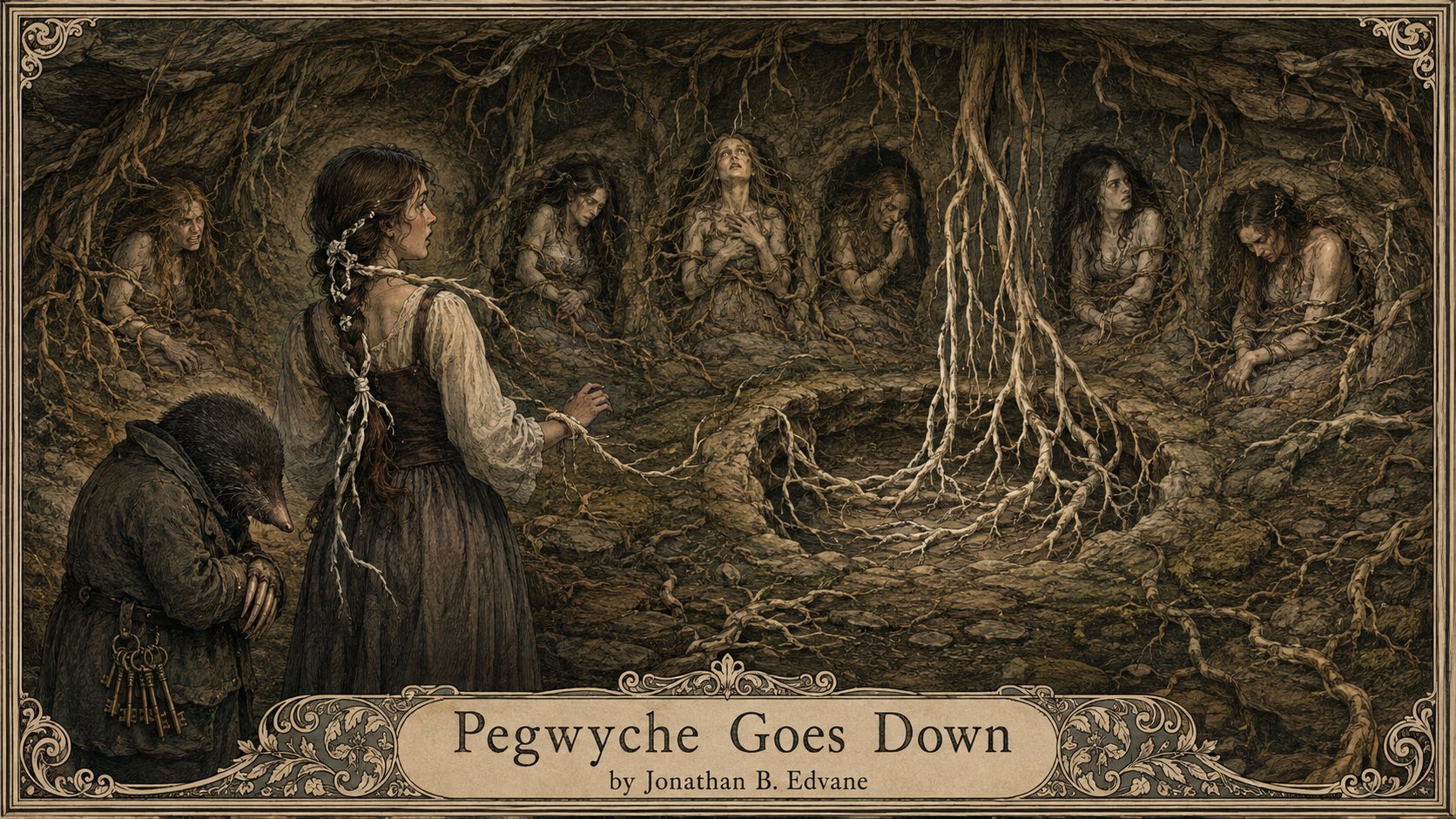
Pegwyche woke before the bell, though the bell was rung for her anyway.
Her mother had already lit the rushlight. It stood in its little dish beside the bed, bending in the draught. Pasha parted Pegwyche’s hair with a bone comb. Outside, doors opened, and feet passed over the packed earth. Children were hushed, then began again regardless.
“Hold still, my dove,” Pasha said.
“I am holding still.”
“You are shaking.”
“I am cold.”
“It is spring.”
Pasha threaded white through the first braid and drew it tight. The thread was kept wrapped in blue cloth in the elder chest and brought out only for the going-up. Pegwyche had seen it once before, seven springs ago, in Idna’s hair, small then on Samson’s shoulders, thinking Idna looked tall enough to step into the sky by herself.
Outside, garlands hung between the lintels. Pale willow, stitchwort, and the first ragged primroses. The tables from last night’s feast still stood in the green, crusts left for birds, cups overturned, benches crooked from dancing. The younger children had been taught the going-up song for weeks and now sang it in pieces, getting the order wrong, calling her blessed, calling her chosen, calling her sky-called Pegwyche until the name hardly sounded like hers.
Her father came in while Pasha was tying the second braid. Samson had washed and shaved, but there was a nick below his jaw where the razor had slipped. He looked at the rushlight, the blanket, and Pasha’s hands. Anything but his daughter.
“Well,” he said. “Our Peg. Look at you.”
Pasha’s fingers tightened by mistake.
“It hurts,” Pegwyche said.
“Sorry.” Her mother smoothed the braid at once. “Sorry, love.”
Dayra came with Fyn and Shingei, kissed Pegwyche’s brow, and said the village would remember this honour. Pegwyche smiled, and by the door, Samson turned away. She told herself she was not afraid. Brides were frightened too, everyone said so. That was all this was.

The cage waited at the upper meadow where the grass had been cut short for the day, a man at the lifting rope serious as a butcher pretending not to know the name of the lamb. The cage itself was prettier than Pegwyche remembered, with willow hoops, white cloth, little bells, and garlands twined through the bars until it looked like a basket for flowers.
“Step carefully, blessed girl,” Shingei said.
Pegwyche stepped in.
The first pull was not graceful, the cage jolting hard enough to knock her shoulder against the frame. On the second pull she rose smoothly. For a few moments she could still see the mud on Samson’s boots, and the red mark under Pasha’s nose where she had been rubbing it. Hands lifted after her, and the going-up song faded and broke apart as the cage climbed beyond the gathered throng.
Wind pressed cold fingers through the bars, and Pegwyche clutched the willow hoop and looked up. No towers. Only the underside, a vast mass of earth and stone, hung above her, broad as a hill torn from the world and left in the sky. Roots trailed from it, and water dripped from unseen channels, falling past her face as rain that had never known clouds.
Then the cage passed the lip of the suspended land, and the kingdom appeared.
The Rookery of Ninelast rose from its own floating earth, streets and towers set under the morning cloud, bells answering the bells on her cage. People waited at the receiving platform with soft faces and lowered eyes.
Steward Abel bowed as attendants made the cage fast. “Welcome, chosen Pegwyche. You honour us,” he said, and Pegwyche somehow understood, even then, that they were not smiling at her arrival. They were smiling at the delivery. Steward Abel gave her into the care of Mister Talp at the edge of a garden. “This is our groundskeeper,” he said. “Mister Talp.”
Mister Talp was a mole.
He was smaller than Pegwyche had expected, velvet-dark fur brushed flat for ceremony, a narrow snout tasting the air. His eyes were filmed and useless. His paws were clean, but the nails were made for earth, and at his waist hung a ring of little brass keys.
“This way, chosen,” he said.

He led her along a path between clipped hedges and wet stone basins, pausing sometimes without warning to turn his head, as if attending to some private trouble in the stone. They came to a low door set behind ivy. He unlocked it, then stopped with his paw still on the iron. “I have done this seven times now,” he said.
Pegwyche waited because he did not seem to be speaking to her in particular.
“Six times in silence,” he said. “Once before I was keeper, when I only watched and carried what I was told to carry. Then Melira. Lettie. Oslanche. Aviarel. Godlyn. Idna.” His mouth worked around the last name. “Idna sang until the roots entered her throat. Marvellous.”
Pegwyche felt the garden sway, though nothing moved. “What are you saying?”
“That going-up is not a marriage, Pegwyche.”
“I know that.”
“No,” Mister Talp said. “You know the village words. Chosen. Blessed. Called. You know the feast words.” His blind face lifted toward hers. “It is a planting.”
She laughed. “Then send me back.”
“I cannot.”
“Then take me to Steward Abel.”
“He knows.”
“To Dayra.”
“She knows enough.”
“To my father.”
Mister Talp’s paws closed and opened. “Your father knows how not to know.”
Those truths struck her all at once.
“The Rookery should fall,” he said. “A mass of earth cannot hang forever by old charms and prayers. It is held by a living lattice beneath us. Roots enter the chosen and keep them alive. Their fear feeds the binding. Their hearts teach the Rookery to remember itself. Six are below. Six heartbeats, all different, all mine to feel.”
Pegwyche could not feel her hands.
“I feel them through the soil,” he said. “Every year of them. Every change. Every mercy denied because terror holds better than peace.”
The garden, the towers, the bells, the soft reception, the white thread in her hair, all reordered themselves around one black centre. She had not been welcomed. She had been brought.
Pegwyche struck him.
The blow landed badly, catching Mister Talp across the side of his snout. He stumbled against the door. There was no anger in him when he lifted his face again, only the tired surprise of someone who had known pain was coming and had still failed to prepare for it.
“Open it,” she said, and when he answered that he could not, she told him she would find someone in this place with the power to undo what had been done. Mister Talp only bowed his head. “They know enough,” he said. “Enough to keep their voices calm.”
That was when she ran, back through the garden, past the wet basins and clipped hedges, past all the little beauties arranged around this horror. Somewhere a bell rang for breakfast, and the ordinariness of it made a red fury open in her. At the arch, two attendants waited with folded hands, their faces carrying the same reverence given to something both valuable and doomed.

“I am not yours,” Pegwyche cried. “I am not blessed, not chosen, not sky-called. I am going home.”
The ground moved under her, so slight she thought her own anger had made her unsteady. Then the basin water puckered in rings, dust slipped from the garden wall, and far beneath the paving the stone gave a long low groan, like a giant turning in a troubled sleep.
Mister Talp had followed. He stood among the white flowers, utterly still, his ears twitching toward a hurt no one else could hear. “Be still,” he said.
“I have done nothing.”
“You have. Refusal has its own consequence. Fear feeds the binding, but panic tears at it. The roots have reached for the seventh heart and found only revolt.”
A second tremor rattled a window above them and brought pale grit whispering from a cornice. Pegwyche wanted to say, “Let it fall.” The words were ready. They were almost joy.
Then Mister Talp said, “The Rookery will not fall into emptiness.”
She turned back to him. “It will fall on Simminy Stoop.”
The words stopped her more surely than hands. Mister Talp came no closer. If the court were quick enough, he said, they might cut the sheltering charms and let the kingdom drift from the village fields instead. Then the storms beyond the lowlands would return by winter. Roofs first. Crops after. Children after that. He did not say her mother’s name. He did not say Samson’s. He did not need to. They were already under every stone above her.
“Do not use them,” she said.
“I am not using them,” said Mister Talp. “They have been used already.”

Pegwyche pressed both hands to her mouth. The kingdom shuddered, and she felt the awful truth of the Rookery waiting for her body to understand what her mind had refused. Freedom had looked like a door. Now she saw where it opened. Downward, through the roofs of Simminy Stoop, through her mother’s hands and Samson’s bowed head and every child who had sung the lie.
When she lowered her hands, she did not sound brave. She sounded older. “Take me down,” she said, and Mister Talp nodded slowly, his grief touched for one shameful instant by relief.
He led her behind the ivy, down a servant’s stair cut into the inward flesh of the land, where the fine paving gave way to damp rocks, and the air lost its sweetness. Above, it had been towers, basins, bells, and white flowers, the careful evidence of a place that believed itself civilised. Below, it became roots and muddy water. The steps narrowed. Fibrous threads slipped through the cracks and withdrew when Pegwyche’s skirt brushed them.
She asked how far, and Mister Talp said, “Far enough that the court need not hear them.”
Pegwyche tried not to touch the walls. She failed. Everything touched everything here.
“Do you hear them?” Mister Talp asked.
“No.”
“You will.”

At the last turn, the passage widened into a cavern so low and broad it felt grown. Roots descended from the ceiling in cords thick as wrists and threads fine as hair, some sunk into the floor, some knotted into the walls, some gathered toward six hollows where the stone had opened around human forms.
Pegwyche stopped dead.
She had expected corpses, some mercy in her still hoping for death. These were not corpses. They were women, or what the years had left where women had been. Skin pale, hair threaded into the earth, arms bound in living fibre. Their faces were turned inward, each caught in the private room of her own endurance.
Mister Talp named them in sequence. “Melira. Lettie. Oslanche. Aviarel. Godlyn. Idna.”
Pegwyche could feel their pulses. Melira was a hard beating, furious still, hammering against the stone. Lettie was almost nothing, a thin delayed flutter Pegwyche had to wait for. Oslanche trembled in little broken runs, then steadied, then trembled again. Aviarel burned through the roots with a fierce heat of refusal, a temper kept alive past all usefulness. Godlyn counted, pulse after pulse, like beads under a thumb. Idna was nearest. Idna, whom Pegwyche remembered bright in white thread seven springs before. Her heartbeat rose and fell against the binding, rose and fell, rose and fell.
Pegwyche pressed one hand to her own chest. Mister Talp stood beside her with his blind face lowered. “This is what I have heard,” he said. “Every spring. Every storm. Every quiet day above when the gardens were watered, and the streets swept.”
She looked from one hollow to the next, and the cavern calmly made room for her. There was space beside Idna. A pale fall of roots hung there, loose and clean, waiting for hair, wrist, and throat. Her body had been expected long enough to leave an absence before it arrived. The horror was no longer only theirs. It had opened a place for her too.
The roots touched Pegwyche lightly at first. One pale thread lay across her wrist. Another found the loosened braid at her neck. She waited to hear her own scream, to strike Mister Talp again, to claw at stone until her nails tore. Then Idna’s heartbeat rose through the floor, still trying after seven years to find a way out.
“You are holding them,” she said, not knowing whether they heard her through word or root or pulse. “The roofs. The fields. The children who learned the song. My mother. Your mothers.”
Melira’s furious beat struck harder. Pegwyche felt it and did not flinch. Fury at least was still insisting the world owed it something. Godlyn’s counting meant something was being kept. Oslanche’s trembling, breaking and steadying, was not weakness but a decision not yet made. Lettie had not stopped. Aviarel was burning, which was a kind of holding too.
Last she spoke to Idna, who had been bright in white thread seven springs before and was still climbing with nowhere left to go.
“I know what you were climbing toward,” she said. “It was never out. It was this.”
“If it is only theft, they own even this. Even what we do now. I will not give them that as well.”
Godlyn changed first. The counted pulses lengthened. Oslanche’s trembling faltered, then came back steadier. Lettie’s thin delay filled by a small measure. Aviarel did not cool, but her heat ceased to thrash and began to press outward, fierce and deliberate. Melira raged longest, until her fury stopped striking out and began to hold.
Idna climbed once more. Then she rested.
Pegwyche wept because she believed herself. The lie had not become clean. Nothing stolen had been returned. Yet something passed from one heart to another that was almost unbearable because it was love.
“Then let it be ours,” Pegwyche whispered.
The roots took Pegwyche with the tenderness of hands that had already learned her. They drew her into the hollow beside Idna, wrist and ankle first, then hair, then throat. She cried out when they entered her, and the six held the cry between them, knowing exactly what had made it.
Her heart ran wild among them.
Mister Talp knelt with both paws on the cavern floor. Through the earth he felt all six of them bending their ruined strength around Pegwyche’s terror as she had asked them to, holding because the stone above must not fall, because the roofs below must not break, because Simminy Stoop lay small and sleeping under every choice they made.
Beat by beat, her fear learned their rhythm. Mister Talp bowed his blind head. Above them, the Rookery settled. Beneath it, the village was spared again.
Pegwyche had taught the horror to call itself love.

I welcome polite comments. If you enjoyed this tale, you might also enjoy Emmie and the Black Orchard
Leave a Reply