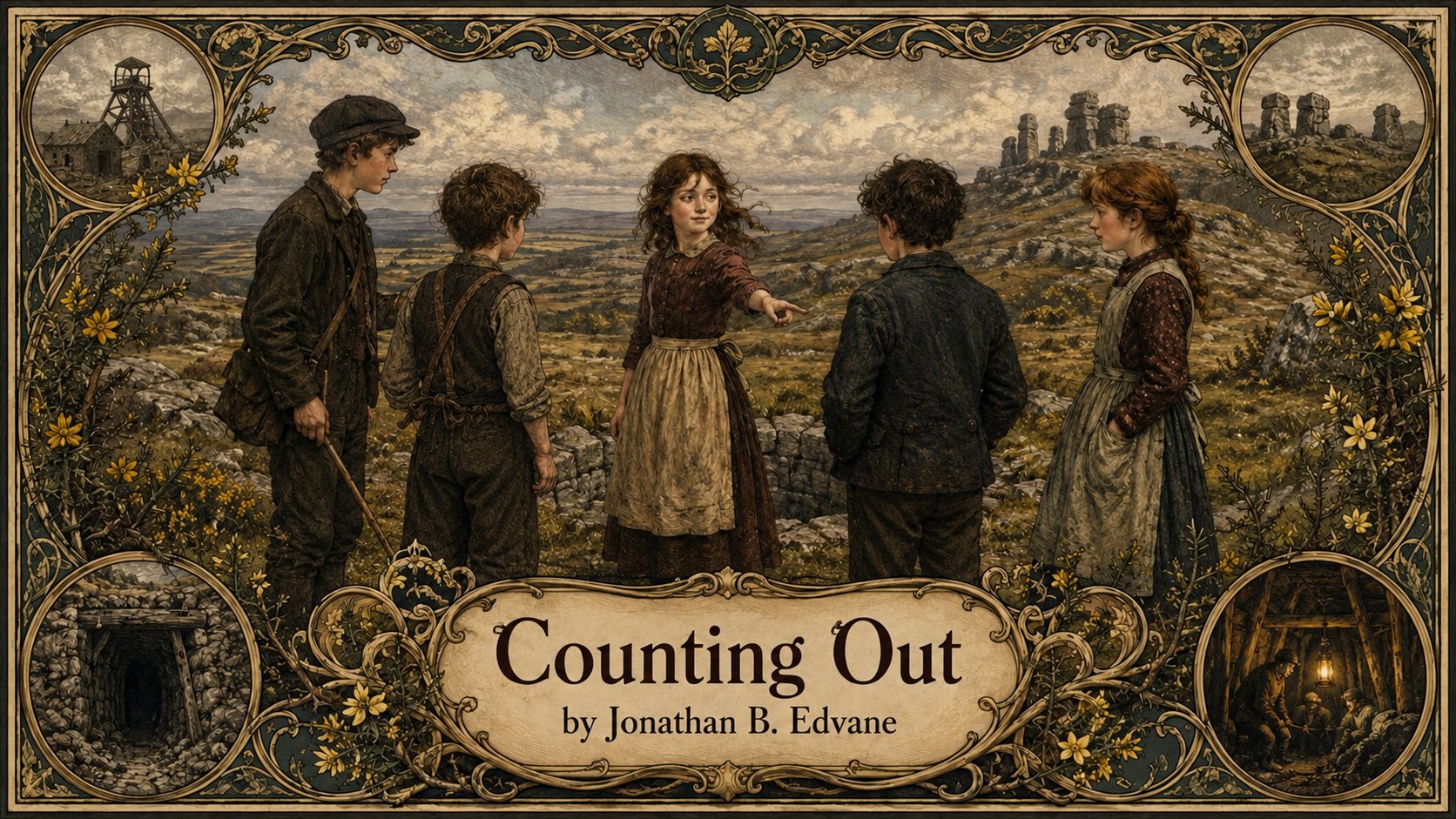
The moor above Minions was warm that afternoon, though the wind still moved over it with enough force to flatten the longer grass and set the gorse trembling. Beyond the village the ground rose in broken shelves of granite, scattered with the remains of tracks that had once carried men and ore between the mines. The Hurlers stood further off, grey against the summer light, while here and there the earth opened without warning into shafts whose stone mouths had been left uncovered when the old workings were abandoned.
Grace Pascoe knew nearly all of them.
She had spent enough of her twelve years wandering the moor to learn which hollows flooded in winter, where adders basked when the stones grew warm, and which shafts were shallow enough for a dropped pebble to strike bottom quickly. She knew the dangerous ones too, and took pride in having knowledge that the others could not quite share. It was one of the few things she possessed that they wanted from her. That was why she had brought them to Wheal Dozmary.
Denzil Rowse had stopped several yards short of the opening when Grace walked towards it, and although he tried to make his voice sound mocking, there was caution beneath it when he told her she would not dare look down. Grace turned at once. She had been laughing most of the afternoon, sometimes because something was funny, and sometimes because laughter was the easiest way to keep herself in the group. She told him she had looked down before.
Abel Oates, who was fourteen and therefore treated two years as though they constituted a lifetime, said that if she had done it before she could do it again.
So Grace did.
She approached the broken ring of stone and stood with the toes of her boots almost over the edge. The shaft appeared black even beneath the afternoon sun. Grass had grown between the stones and a few pale roots descended into the opening before losing themselves below. Grace bent forward until Tamsin Nancarrow called her name sharply from behind.
“You’ll fall, Grace Pascoe.”
Grace looked back with a smile. “I won’t.”
Simeon Teague had remained beside Tamsin, pretending that he had no interest in coming nearer. Grace picked up a loose piece of granite and held it between finger and thumb.
“Listen.” She dropped it.
They waited. Denzil was beginning to grin when something faint came from far below, no more than a click against the rock. Grace looked pleased with herself, and Simeon muttered that nothing would persuade him to stand where she had.
“You’re frightened,” Grace told him.
He denied it quickly enough to make the others laugh, then said that Grace would be frightened too if somebody gave her a shove. Abel made a show of stepping towards her, but Grace jumped away from the edge before he reached her and laughed with everyone else.
She did not notice that they were laughing longer than she was.
They wandered back towards the open ground. Abel had cut himself a hazel switch earlier and spent much of the day trimming away the bark with his knife. Denzil was preoccupied trying to sharpen a thin piece of slate he had found. Tamsin had gathered bright chips of quartz into the pocket of her apron, while Simeon complained endlessly about a button torn from his coat by the gorse. Grace moved among them happily, joining each conversation as it arose.
It was Denzil who suggested the counting out.
They had played the game many times before, and Grace came willingly when he called them into a circle on a patch of short grass between two granite outcrops. She squeezed herself between Tamsin and Simeon, smiling as their shoulders touched. This moment was always her favourite. Before the first word was spoken they were all equal, five children enclosed within the same ring, and nobody had yet been chosen to stand outside it.
Denzil lifted his hand and began.
“Ena, mena, bora mi, kisca, lara, mora di.”
His finger moved from one face to another with every word. None of them knew what the sounds meant. Their mothers had used them, and older children before them, and perhaps their mothers too. The rhyme belonged to the village. Nobody remembered learning it.
“Eggs, butter, cheese, bread.”
His finger came to rest on Grace. She laughed when he told her she was out, then immediately asked him to begin again. Abel said she must enjoy losing because she did it so often, and Grace protested, still smiling, that she did not lose any more than the others.
Denzil began again.
But something had altered, though Grace did not yet feel it. Perhaps none of them did. There had been no discussion, no whispering apart, no plan made before they formed the circle. It was only that Denzil spoke the words more loudly the second time and Abel began tapping his switch against his boot in time with them.
“Ena, mena, bora mi.”
The finger travelled.
“Kisca, lara, mora di.”
Grace watched it come nearer.
“Eggs, butter, cheese, bread.”
Denzil touched her chest with one finger and said, “Stick.”
Abel’s hazel switch struck her lightly across the shoulder. Grace stared at him, then laughed.
Denzil said, “Stock.”
Simeon pushed her. It was not hard enough to hurt. She stumbled against Tamsin and recovered herself while the others laughed, and because they laughed Grace laughed too.
“Stone.”
One of the pieces of quartz struck her shin. This time the pain was sharp enough to stop the laughter in her throat. She looked at Tamsin. Tamsin still had her hand raised.
“Dead,” Denzil said.
Abel hit Grace again. The switch came across her forearm with a crack, and Grace cried out. She looked from Abel to Denzil expecting one of them to explain what was happening, but Denzil was already chanting again, and Simeon joined him before the first line was finished. Grace tried to step out of the circle, but they closed around her.
There was still something of play in it for the first few seconds, something that allowed each child to believe the others would stop before anything serious happened. Abel struck with the switch. Denzil slapped at her with the flat side of the slate. Simeon shoved her whenever she tried to move away. Tamsin threw another stone and missed.
Grace shouted at them to stop, but the rhyme continued.
By the time she fell, whatever boundary had existed between game and cruelty had disappeared. The words drove them on, giving shape to what otherwise might have broken apart beneath its own ugliness. Grace covered her head. Abel kicked at her legs. Simeon struck her across the back with both hands. Denzil brought the slate down again and again while Tamsin stood close enough to see Grace’s face.
Grace reached for her. For any kindness.
Later, across all the years that followed, Tamsin would remember that hand and tell herself she had tried to take it. She would remember pulling at Denzil, screaming for him to stop, being pushed aside when she attempted to protect the girl on the ground. None of that happened.
Grace caught hold of her sleeve, but Tamsin tore herself free and struck Grace’s hand with a stone. The chanting faltered only when Denzil shouted the final word.
“Dead.”
The others shouted it with him. Then no one spoke.
Without the rhyme there was nothing to hold them together. Four children stood breathing hard on the moor while Grace lay curled in the grass between them. Abel’s switch had broken. Denzil still held the slate. Blood had run across his fingers without his noticing it. Tamsin stared down at the stone in her own hand and let it fall.
It was Simeon who said Grace’s name. She did not answer. Denzil nudged her foot and told her to get up. When she remained still, he said it again, more angrily this time, as though stubbornness rather than death kept her on the ground.
Tamsin began to cry. “We’ve killed her.”
Abel rounded on her immediately and told her to be quiet, but she repeated it through her tears until he seized her shoulders. Denzil was looking towards Minions. Nothing moved on the track. Nobody was coming across the moor.
“It was an accident,” he said.
Abel looked at Grace, then towards the dark opening they had visited earlier. “No,” he said. “She fell.”
For a moment none of them understood him. Then they did.
They carried Grace to Wheal Dozmary between them. She seemed heavier now than she had ever seemed alive, and her boots dragged over the grass where Simeon lost his grip on one leg. Tamsin cried soundlessly while Denzil kept looking behind them. Abel said nothing at all.
At the shaft they hesitated. Grace had stood there less than an hour before, laughing because the others had been afraid to look down. Abel took her beneath the arms, and Denzil held her legs. Simeon helped because Abel ordered him to. Together they lifted her over the stones. For an instant Grace hung above the opening. Then they let her go.
All four listened. No sound came back.
That evening they agreed that Grace had wandered away while they were playing. By nightfall, men were crossing the moor with lanterns, calling her name among the workings and lowering ropes into shafts. The four children joined the search when they were told to. They searched the gorse. They searched beside the tracks. They stood near men who spoke gravely about how quickly a child could lose her footing around the mines. Nobody searched Wheal Dozmary.
The Pascoes remained in Minions for almost a year after Grace disappeared. Then the family left. Only old Joe Pascoe stayed. People had called him Ornery Joe for so long that some had forgotten whether ornery described his disposition or had somehow become his name. He lived alone, walked the moor at strange hours and asked no questions of the four children who had last seen his great-niece alive, although sometimes they found him watching them.
◆ ◆ ◆
Twenty years was long enough for Denzil Rowse to become respectable. By the autumn of 1874 he was Deputy Mayor of the parish, broad through the middle, careful with his beard and particular about the shine on his boots. He sat on committees, spoke at dinners, settled small disputes before they became bigger ones and had recently become betrothed to Charlotte Radleigh, the daughter of a prosperous family whose approval pleased him more than she did. People listened when he spoke now, and when strangers asked after him they were told that Denzil Rowse was solid, dependable and likely to rise further.
He had spent twenty years building that man over the boy who had stood on Bodmin Moor with blood on his fingers. The work had been so gradual that he scarcely noticed it happening. Grace Pascoe had become a sadness from his childhood, then a misfortune, then an accident. Children played rough. Children frightened one another. There had been no intention in it. Nobody had meant for her to die. If the thought came to him in the night, and it did so more often than he admitted to, that he, Denzil, had been the one chanting while the others struck her, he answered it with the version he had polished smooth over two decades. It was a game. It went wrong. Nothing more.
The first time the rhyme returned to him, he was walking home from a parish meeting shortly after dusk. A fine rain had begun, and the stones of the lane shone beneath the lamps. Somewhere behind a row of cottages a child was chanting in a high, careless voice, “Ena, mena, bora mi, kisca, lara, mora di,” and Denzil stopped so suddenly that Mr Penrose, walking a few paces behind, nearly collided with him.
“Something the matter, Rowse?”
Denzil looked towards the cottages, but there was nobody there. “No. Thought I heard someone singing.”
Penrose listened for a moment, registered nothing and wished him good night. Denzil continued alone.
Near the square he saw Ornery Joe sitting on the wall opposite the inn. Joe was old now. The years had withered and bent him, but there was nothing weak in the way he watched Denzil approach. Denzil would normally have passed without speaking. That evening he stopped.
“You’ll catch your death sitting out in this.”
Joe looked at the rain and then back at him. “Not mine I’m waiting for.”
Denzil felt a pinch. “What is that supposed to mean?”
Joe only gave a small shrug and turned his gaze towards the road.
The following morning, Denzil found words scratched into the wood beside his office door.
Eggs, butter, cheese, bread.
His clerk saw him staring and asked whether some child had been playing there. Denzil said, “Looks like it,” and made himself laugh. He took out his pocket knife and scraped the marks away until the grain was rough beneath his thumb.
After that the disturbances remained small enough to be explained. A child ran past his window humming the old rhyme, and when Denzil looked out there was nobody in the lane. Three pebbles struck the glass of his bedroom one night, though no evidence of anyone having stood beneath it could be found. Once, while signing a parish document, he discovered that he had written ena, mena in the margin and tore the page out before anyone saw.
He told himself that memory was a treacherous thing. He had heard the rhyme because children still used it. He had noticed Joe because Grace had been on his mind. None of this meant anything.
On the night he died, Denzil returned home shortly before ten. His housekeeper had left a lamp burning in the hall and called from the kitchen that she would see him in the morning. Denzil answered, “Yes, yes. Go on home,” with more irritation than he intended, and once the front door closed he stood listening to the silence.
He poured brandy and carried it into the study. His chain of office lay in its case beside a stack of papers for the following morning. He had worn it earlier that day at a civic luncheon, enjoying the weight of it against his waistcoat and the looks it drew from men who had once known him as a boy.
He had been reading for perhaps ten minutes when he heard the first line.
“Ena, mena, bora mi.”
The voice was soft and close.
“Kisca, lara, mora di.”
He stood so quickly that the chair scraped the floor and fell backwards with a thud. “Who’s there?”
No answer came.
The door was locked, and the windows were fastened. He crossed to the hearth, then turned at a clinking sound behind him. The chain of office had slipped from its case. Denzil stared at it on the carpet.
“Stop this.” His own voice sounded foolish in the room.
The third line came from somewhere near the wall.
“Eggs, butter, cheese, bread.”
Denzil backed away, and the chain jolted, then moved.
Later nobody could agree what had happened. The room was still locked when his servant raised the alarm the following morning. There was no broken window, no forced door and no sign that anyone had entered. They found Denzil on the floor beside his desk with the chain of office twisted twice around his throat. His face was purple, his lips blue and his fingertips had been torn where he had clawed at the metal links. One chair was overturned, and his brandy glass lay shattered near the hearth.
On the plaster beside him, cut deeply enough to expose the stone beneath, were the four lines of the old rhyme. The final word had been gouged deeper than all the rest.
DEAD.
Soon half the parish had heard. By evening people were whispering that no man could strangle himself like that.
Ornery Joe sat on the wall opposite Denzil’s house while neighbours gathered in the road. Someone asked whether he had heard the news. Joe just smiled and nodded.
◆ ◆ ◆
Simeon Teague had not seen Minions for nearly seventeen years when the letter arrived telling him that Denzil Rowse was dead.
It was delivered to his chambers in Exeter on a wet November morning and lay unopened beside a pile of conveyancing papers while he finished dictating a letter to his clerk. Simeon had built a comfortable life there, far enough from Bodmin Moor that the landscape of his childhood no longer belonged to his daily world. He had a wife, two children, a respectable practice, and rooms above Eland’s on the High Street, where clients came to him with disputes over property, inheritance, and debt. He had spent so many years dealing in evidence, testimony and the careful apportioning of blame that he had almost convinced himself his own past could be treated in the same fashion.
When he finally opened the letter, he read Denzil’s name twice before moving on. The account was confused. Denzil had been found dead in a locked room, strangled with his chain of office, and the old counting rhyme cut into the wall beside him. Simeon sat very still after reading that part, then folded the letter and placed it beneath the papers on his desk.
His clerk, who had been waiting for the next instruction, asked whether there was bad news.
“An old acquaintance has died,” Simeon said. “Nothing that concerns us here.”
He resumed work and managed almost an hour before noticing that he had written ena, mena in the margin of a draft petition. Simeon tore the sheet across and dropped it into the fire.
For two days he persuaded himself that Denzil’s death had disturbed a memory and nothing more. The rhyme had remained somewhere in his mind for twenty years, buried with everything else from that afternoon, and naturally the letter had brought it back. He had been thirteen then. Abel was older. Abel had led them. Denzil had driven the game onwards. Tamsin had been wild with excitement. Simeon himself had barely taken part.
This version had served him for years because it contained enough truth to survive examination. Abel had been older. Denzil had led the chant. Tamsin had struck Grace. Simeon simply left out the moments when his own hands had joined theirs.
The rhyme began following him through Exeter before the week was out. He heard a group of children using it somewhere near the market, although when he turned he could not see them among the carts and umbrellas. Later he found the first line written in pencil on the blotting paper in his chambers. He called his clerk in and demanded to know who had done it.
The young man looked genuinely bewildered. “Done what, sir?”
“This.”
Simeon pointed at the words.
His clerk leaned closer. “That is your handwriting surely, sir.”
Simeon dismissed him and closed the door so sharply that it rattled in its frame.
The news from Cornwall had already reached his wife through another acquaintance, and that evening she asked whether he intended to attend Denzil’s funeral. Simeon replied that he did not. When she reminded him that Denzil had been one of his childhood companions, he said, “Precisely. Childhood is finished. I see no virtue in travelling halfway across the county merely to prove that I remember it.” She looked at him for a moment, surprised by the bitterness in his voice, but did not press him further.
Three nights later Simeon remained late at his chambers to prepare papers for a hearing. Rain lashed the windows, and the street below had gradually emptied until the usual sounds of wheels and voices became occasional interruptions in the quiet. He was reading a witness statement when he became aware of a voice chanting outside.
“Ena, mena, bora mi.”
Simeon went to the window and looked down. Nobody stood beneath it. The voice continued while he remained there, quiet enough that it might have come from the far end of the street.
“Kisca, lara, mora di.”
He stepped away from the glass and told himself aloud, “There is nobody there.”
The room had grown cold. His candle guttered despite the windows being shut, and somewhere beyond the door came the soft scrape of a shoe upon the stair. Simeon called out that the office was closed. Nothing answered him except the next line.
“Eggs, butter, cheese, bread.”
He backed towards the window without realising he was doing so. For the first time in twenty years he remembered Grace properly, as a girl reaching towards them while they struck her. He remembered her calling his name. He remembered kicking her when she tried to rise.
“Abel made us,” he whispered.
The room gave him no absolution.
The final line came in Grace’s voice. “Stick, stock, stone, dead.”
The window burst outward. Across the street, Simeon’s wife heard the glass break and reached the front window in time to see her husband’s body strike the cobbles below.
By the following evening the news had travelled back to Minions. Tamsin Nancarrow heard it from a neighbour and closed her cottage door without a word. Abel Oates heard it at the mine and stood for a long time with his lamp in his hand.
Ornery Joe heard it outside the inn. He listened to the man telling the story, looked towards the moor, and smiled again.
◆ ◆ ◆
Tamsin Nancarrow had known for years that something would come for her. The waiting had become a part of her life. By the time news of Simeon Teague reached Minions, she was living alone in a cottage beyond the village, on the edge of the moor. People went to her for poultices, tinctures and help with sick animals, though many of the same people crossed themselves after leaving. Tamsin knew what they called her when they thought she could not hear. She did not much care.
The cottage was crowded with living things. Two dogs slept beside the hearth. Three cats came and went through a gap beside the door. There were cages for injured birds, boxes lined with rags for creatures too weak to be released and shelves full of drying herbs. Tamsin had spent twenty years keeping things alive with a devotion that had hardened into habit. She would sit through the night with a ewe that could not lamb, feed a fledgling from a spoon or walk miles in winter to tend a neighbour’s dog. People said she had a gift for it.
Tamsin knew it was not a gift. It was a penance. She had imagined, when she was younger, that enough small mercies might eventually outweigh one great cruelty. They never did.
After Denzil died she began sleeping badly. After Simeon died she stopped pretending that sleep mattered. On the third evening she lit every candle in the cottage and sat beside the hearth while rain pattered the roof. One of the dogs rested its head on her knee, and she stroked the coarse fur between its ears.
“You needn’t be afraid,” she murmured. The dog looked up at her, and Tamsin almost laughed. “That makes one of us.”
For years she had told herself that she had tried to save Grace. The lie had changed as she grew older. At first she remembered herself shouting. Later she remembered pulling at Denzil’s arm. Eventually, she had added the moment when someone struck her aside and prevented her from reaching the poor girl.
None of it had happened.
The memory had become harder to maintain since Denzil’s death. Now, sitting in the candlelight with the dogs breathing at her feet, Tamsin remembered Grace clutching her sleeve and begging her to stop them. She remembered looking directly into Grace’s face. She remembered striking her hand with a stone.
“I know,” Tamsin said quietly. One of the cats lifted its head from the rug. “I know what I did.”
The first line of the rhyme came from somewhere outside the cottage.
“Ena, mena, bora mi.”
The dogs rose, but Tamsin closed her eyes. She had been expecting fear, perhaps panic, perhaps the sudden childish urge to run for the village and throw herself at somebody’s door. Instead there was only a terrible relief.
“Kisca, lara, mora di.”
Tamsin stood and went to the door. When she opened it, there was nobody on the path. Rain had soaked the earth, and the moor beyond was lost in mist. For a moment she saw only the reflection of candlelight in the wet stones.
Then she saw Grace.
Or believed she did. A girl stood beyond the gate, pale beneath the rain, her dress clinging to her body. Her hair lay across her face. Tamsin saw the pink of blood being washed to the ground. She was twelve years old.
Tamsin gripped the doorframe. “Grace.” The girl did not answer, so she stepped outside. “I was sorry.” The words sounded small after twenty years. “I’ve been sorry every day.”
Grace raised her face.
For one moment Tamsin saw the child she remembered. Not the body on the grass and not the corpse dropped into Wheal Dozmary. Just Grace laughing too loudly because she wanted so badly to be one of them. There was something almost gentle in her expression now.
Tamsin began to cry. “I should have taken your hand.”
Grace seemed to hesitate. Behind Tamsin, one of the dogs whined. Then the rhyme continued.
“Eggs, butter, cheese, bread.”
The softness left Grace’s face, but Tamsin did not run. She went back inside and closed the door. The animals were standing now. Every one of them was watching her. The old terrier she had raised from a half-dead pup bared its teeth.
Tamsin stared at him. “No.”
A cat hissed from the table. Another moved across the floor. “Don’t.”
The dogs began to growl.
Tamsin backed towards the hearth, shaking her head as though refusal might undo what she already understood. These were the creatures she had fed, healed and kept warm. She knew every scar and habit among them. She had foolishly believed that kindness accumulated somewhere.
The final line began.
“Stick, stock, stone.”
The first dog sprang. Tamsin screamed and fell against the table. The others came after it. By the time the word dead sounded through the cottage, the animals were already upon her.
They found what remained of Tamsin the following morning. The dogs were crouched beneath the table with blood on their muzzles. One cat sat calmly on the windowsill. Another licked its paws beside the hearth.
Scratched into the stone above the fire were the four lines of the rhyme. Very soon, the village began remembering Grace Pascoe. By evening, people were saying her name aloud. Ornery Joe heard them. He said nothing.
◆ ◆ ◆
Abel Oates knew before anyone came to tell him that Tamsin was dead. He had been below ground when the thought entered his mind, deep enough that the daylight had ceased to exist as anything more than a memory above his head, and he spent the rest of the shift working in silence. By the time he climbed out of the cage at dusk, there were already men waiting near the yard, and one of them said Tamsin Nancarrow had been found in her cottage. Abel listened to the details, then washed the dust from his hands and went home.
His wife asked what was wrong with him while she was laying supper on the table. Abel told her only that someone from the village had died. She knew better than to press him when his face had closed in that way, but later, when their son had gone to bed, and the house was quiet, she found him sitting beside the cold hearth with his boots still on. She touched his shoulder and asked whether he meant to come upstairs. Abel looked at her for a long moment before saying, “Not yet.” He wanted to tell her more. For twenty years he had occasionally imagined telling someone everything, but the confession always stopped at Grace’s name.
Unlike the others, Abel had never managed to alter the memory enough to live comfortably beside it. Denzil could call it an accident, and Simeon could give Abel the largest share of the blame. Tamsin had invented a version of herself who had tried to intervene. Abel had no such refuge. He remembered the excitement in his own body when the game changed. He remembered striking Grace after she had fallen and shouting the rhyme with the others. Most of all he remembered taking her beneath the arms at Wheal Dozmary and lifting her while Denzil held her feet.
Years later, when Abel’s first child died before reaching five, he had believed for a time that the debt had been collected. He despised himself for thinking it, because the child had done nothing to earn a place in an account opened on Bodmin Moor, yet some secret part of him had accepted the loss as punishment. He had buried his son, returned to the mine and told himself that whatever waited for him after death could not demand much more.
Now Denzil, Simeon and Tamsin were gone, and Abel understood that the account had never been settled.
He went to work the following morning because there was nowhere else he could think to go. The mine had always suited him. Other men complained of the confinement, the damp and the weight of the earth overhead, but Abel had spent most of his adult life finding comfort in the depth and the isolation. Underground there were rules a man could trust. Timber held or failed. Rocks shifted under pressure. Water found the lowest place. Nothing pretended to be anything other than what it was.
That afternoon he was sent with two others into an older section of the workings. Near the end of the shift, one man went back for tools while the other was called towards a problem with a pump, leaving Abel alone beside a passage that had been closed years earlier after a collapse. He was trimming his lamp when he heard a girl chanting somewhere beyond the barrier.
“Ena, mena, bora mi, kisca, lara, mora di.”
Abel did not start or call out. He only closed his eyes.
The voice ceased.
For several seconds the mine was silent except for water dripping somewhere in the dark. Abel opened his eyes and saw that the timbers across the abandoned passage no longer sat as he remembered them. A gap had appeared wide enough for a man to pass through. He knew what to do. He lifted his lamp and entered.
The passage beyond was older than the workings he knew and sloped steadily down. It was dank, and the air smelled stale. The rhyme began again ahead of him, quiet now, and Abel followed because the voice remained between him and the way out no matter how often the tunnel turned.
“Eggs, butter, cheese, bread.”
His lamp flickered, and Abel stopped.
“I remember it,” he said. His voice travelled a short distance and died against the rock. “All of it.”
Something moved beyond the reach of the light. He saw Grace, or thought he did. She stood further along the passage in the dress she had worn that afternoon, one hand hanging at her side while the other was raised towards him.
Abel lowered his head. “It was me.” The old workings groaned around him. “I started it.”
Grace said nothing.
Abel looked up again and found that the passage ended behind him at the lip of a shaft. The final words came softly.
“Stick, stock, stone.”
Abel felt the emptiness at his heels. For one moment he saw Grace as she had been before any of them struck her. Then the word came.
“Dead.”
Abel went backward into the dark. His body was found the following day at the bottom of a worked-out shaft in a section of the mine that had been sealed for years. No one could explain how he had reached it.
Ornery Joe stood outside his cottage looking towards the moor for a long time. Then he went inside and closed the door.
◆ ◆ ◆
By spring, the village had begun speaking of the four deaths as though they belonged to a story rather than to people anyone had known. Denzil Rowse, Simeon Teague, Tamsin Nancarrow and Abel Oates had become names joined by whispers, and with them came another name that had not been spoken so often in years.
Grace Pascoe.
On a clear morning the moor lay open beneath a pale sky. The Hurlers stood where they had always stood, indifferent to generations, while the Cheesewring balanced against the horizon and the old shafts waited among the grass. Nothing in the landscape suggested that it remembered anything at all.
Near Minions, several women sat together while their children played. One little girl complained that the others were cheating, and her mother laughed and told them to start properly. “Make a circle then. I’ll show you the way we used to do it.”
The children crowded together, knocking shoulders and arguing over who should begin. At last the woman raised one finger and touched them in turn as she recited the old words.
“Ena, mena, bora mi, kisca, lara, mora di.”
The children stumbled after her, laughing at the strange sounds.
Grace stood a little distance away. Nobody saw her. She watched the finger travel from child to child and remembered. For twenty years the rhyme had lived in darkness with her, though it had never belonged to Grace and did not belong to her now.
“Eggs, butter, cheese, bread,” the mother continued, smiling as the children shouted the words back. “Stick, stock, stone, dead.”
The chosen child shrieked with delight and ran. The others scattered after him before reforming the circle and demanding another turn.
Grace watched for a while. Folk would give the rhyme meaning again. Perhaps not these children and perhaps not their children, but someday another circle would close around someone too eager to belong.
The moor would still be there.
Grace turned away and walked towards Wheal Dozmary. At the shaft she did not hesitate. The dark opened beneath her like home, and she went down.
Behind her, the children began the rhyme again.

I welcome polite comments. If you enjoyed this story, you may also enjoy Shall I Come Away?
Leave a Reply